Every packet of flour, liter of petrol, and gold ornament sold in India depends on one quiet promise: the measurement is accurate. That promise is protected by the Legal Metrology Act, 2009, and kept alive by professionals who rarely get the spotlight. Among them, Calibration Labs under Legal Metrology and independent verifiers carry the heaviest technical responsibility. At Legal Metrology, we help manufacturers, packers, importers, and service providers understand how this ecosystem works so they can stay compliant and protect their business.
This guide explains who these players are, what they do, how they differ, and how Calibration Labs under Legal Metrology and verifiers can strengthen your Legal Metrology Compliance program.
What Is Legal Metrology, and Why Does It Matter?
Legal metrology is the branch of measurement science that deals with units, standards, and instruments used in trade and consumer protection. In India, the Legal Metrology Act, 2009, along with the General Rules and the Packaged Commodities Rules, governs weights, measures, prepackaged goods, and the instruments used to weigh or measure them.
The purpose is simple: a buyer should receive exactly what they pay for, and a seller should be able to prove what they delivered. Weighbridges, retail scales, fuel dispensers, taxi meters, and flow meters all fall within this framework. If any instrument drifts out of tolerance, the result is unfair trade, consumer loss, and legal exposure.
Compliance is not a one-time event. Instruments must be verified, stamped, and periodically re-verified. That is where technical competence becomes essential, and where calibration labs under legal metrology enter the picture.
Is Your Business Legal Metrology Compliant?
Get a free compliance check from our experts.
Understanding the Role of Calibration Laboratories
The role of calibration laboratories is to connect everyday instruments to national and international measurement standards. A laboratory compares a device under test with a reference standard of higher accuracy, records the deviation, and issues a certificate stating the measurement uncertainty.
In India, Calibration Labs under Legal Metrology support the system in several important ways:
Maintaining traceable reference standards. Test weights, volume measures, and master meters used by verification officers and manufacturers must themselves be calibrated so that every stamped instrument traces back to national standards.
Supporting manufacturers and repairers. Licensed manufacturers, dealers, and repairers need calibrated standards to adjust and test instruments before submitting them for verification.
Providing independent evidence. A certificate from an accredited laboratory is objective proof that an instrument performed within permitted limits on a specific date.
Reducing disputes. When a customer or inspector questions a measurement, a valid certificate from one of the trusted calibration labs under legal metrology can settle the matter quickly.
Accreditation matters enormously. Laboratories accredited by NABL under ISO/IEC 17025 demonstrate technical competence, validated methods, and documented traceability. The scope of accreditation should match the exact instrument type and range you need calibrated.
Why Calibration Labs under Legal Metrology Matter for Your Business
Many owners see calibration as a cost center. In reality, Calibration Labs under Legal Metrology protect your margins. A scale that reads half a percent high on every packet quietly costs you money, while one that reads low invites penalties. Calibration Labs under Legal Metrology catch these drifts early, document them, and give you the evidence needed to correct them. For food processing, pharmaceuticals, fuel retail, and logistics, Calibration Labs under Legal Metrology are not optional extras; they are a core part of the quality system.
Is Your Business Legal Metrology Compliant?
Get a free compliance check from our experts.
Legal Metrology Calibration: What the Process Looks Like
Legal metrology calibration is more structured than a casual accuracy check. A typical cycle includes:
- Identification and condition check: The laboratory records make, model, capacity, least count, and visible condition.
- Environmental stabilization: Temperature, humidity, and vibration are controlled or recorded.
- Comparison against reference standards: The instrument is tested across its range, including repeatability, eccentricity, and linearity checks.
- Uncertainty evaluation: Errors are compared with permissible limits.
- Certification: A certificate is issued with results and traceability statements.
For businesses, the certificate tells you whether an instrument needs adjustment, repair, or replacement before an inspector arrives. This is why forward-looking companies treat legal metrology calibration as preventive maintenance rather than an annual burden.
Who Are Third-Party Verifiers?
Verification is the statutory act of confirming that an instrument conforms to the Act and Rules, followed by stamping. Traditionally, government officers carried out most of this work. As the number of instruments multiplied, the system recognized the need for more capacity.
Third-party verifiers under legal metrology are independent, authorized agencies that assist in verification and stamping, subject to conditions laid down by the competent authority. They must meet eligibility criteria, use calibrated reference standards, follow prescribed procedures, and maintain auditable records.
Third-party verification in legal metrology offers practical advantages:
- Faster turnaround for users who would otherwise wait for scheduled official visits.
- Wider geographic reach, including industrial clusters and remote locations.
- Consistent technical quality, because verifiers must demonstrate competence.
State rules and notifications determine who may act as a verifier, what fees apply, and which instruments are covered, so always confirm the current position with your state department.
Calibration vs. Verification: Clearing the Confusion
Many businesses use these words interchangeably. Under legal metrology, they are related but distinct.
Calibration determines the relationship between an instrument’s reading and the true value from a reference standard and reports error and uncertainty. It is a measurement activity.
Verification is a statutory conformity check. The instrument is tested against legal tolerances, and if it passes, it is stamped for use in trade.
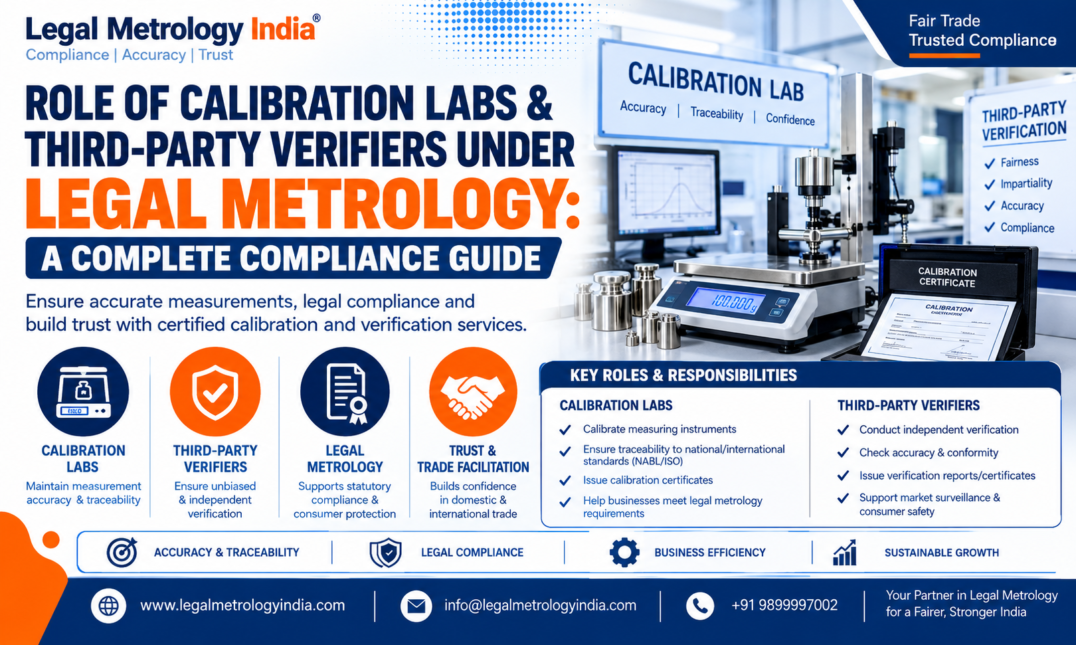
Calibration tells you how good the instrument is; verification tells you whether it is legally fit for trade. Strong systems combine both. Calibration Labs under Legal Metrology supply traceable standards and technical data, while Third-Party Verifiers under Legal Metrology apply those standards during statutory verification.
How the Chain of Trust Works
- National standards sit at the top, maintained by premier measurement institutions.
- Accredited calibration labs under legal metrology calibrate working standards against them.
- Verifiers and officers use those standards to test field instruments.
- Businesses use verified instruments in daily trade and keep records to prove compliance.
If one link breaks, the chain weakens. A verifier using an uncalibrated test weight cannot give reliable results, and a laboratory without accreditation cannot offer defensible traceability. This is why Calibration Labs under Legal Metrology and verifiers must be understood together.
Legal Metrology Compliance: What Businesses Must Do
Strong legal metrology compliance rests on a few disciplined habits:
Maintain an instrument register. List every instrument, its location, capacity, last calibration date, last verification date, and next due date.
Use only verified and stamped instruments. Using an unverified device in trade is an offense that can attract penalties, seizure, and prosecution.
Calibrate reference standards on schedule. If your factory uses test weights or master meters, send them regularly to Calibration Labs under Legal Metrology for traceable calibration.
Keep certificates organized. Store calibration and verification certificates where they can be produced quickly during inspection.
Follow packaged commodity rules. Declarations on pre-packed goods, including net quantity, MRP, and manufacturer details, must meet the rules. Accurate filling depends on accurate machines.
Train your team. Operators should know how to spot faults, protect seals, and report abnormalities.
Risks of Ignoring Calibration and Verification
The cost of non-compliance goes beyond a fine:
- Penalties and prosecution for using unverified instruments.
- Product seizure or stop-sale orders for incorrect declarations or short quantities.
- Revenue leakage, because overfilling gives away product while underfilling creates liability.
- Reputation damage, since one viral complaint can reach thousands of customers.
- Export and tender rejections, because buyers demand documented traceability.
An annual investment in calibration and verification is almost always smaller than a single enforcement action, which is why smart businesses budget for Calibration Labs under Legal Metrology every year.
Benefits of Working with Accredited Partners
- Audit readiness. Traceable records make inspections routine.
- Lower wastage. Accurate dosing and weighing reduce giveaway.
- Customer trust. Fair measurement builds loyalty.
- Better planning. Scheduled calibration reveals drift early.
- Faster approvals. Reliable documentation speeds licensing and vendor qualification.
Working with calibration labs under legal metrology and approved verifiers gives leadership confidence that compliance rests on evidence, not assumptions.
How to Choose Calibration Labs under Legal Metrology and Verifiers
- Accreditation scope: Confirm the NABL scope covers your instrument type, capacity, and accuracy class.
- Authorisation status: Confirm the verifier holds valid authorisation from the competent authority.
- Traceability: Ask which reference standards are used and when they were last calibrated.
- Turnaround time: Check whether on-site service is available for weighbridges and tanks.
- Report quality: Certificates should clearly state results, uncertainty and identification details.
Not Sure Which Lab or Verifier to Choose?
We’ll connect you with the right accredited partner.
Common Mistakes to Avoid
- Assuming a calibration certificate replaces statutory verification.
- Calibrating an instrument but failing to adjust it when errors exceed tolerance.
- Ignoring seals and stamps after repairs, which may require re-verification.
- Relying on one of the Calibration Labs under Legal Metrology whose accreditation does not cover the range you need.
- Tracking due dates from memory instead of a central register.
- Waiting for an inspector’s notice before acting.
Quick Compliance Checklist
Before your next inspection, confirm that every instrument is listed in your register, every certificate is current, every seal is intact, and every reference standard has a valid calibration date. Review this list quarterly, and assign one accountable person. Small habits prevent big penalties.
How Legal Metrology Helps You Stay Compliant
At Legal Metrology, our mission is to make legal metrology compliance simple, affordable, and stress-free. Whether you are a first-time packer or a large enterprise with hundreds of instruments, Legal Metrology connects you with qualified experts and gives you a clear action plan.
Here is what legal metrology can do for you:
- Review your instruments and identify what needs calibration and verification.
- Connect you with trusted calibration labs under legal metrology and approved verifiers in your region.
- Prepare documentation, registers, and renewal timelines.
- Guide you on packaged commodity declarations and licensing.
- Support you during inspections and help you respond to notices.
Need Help With Legal Metrology Compliance?
Share your requirement and get the right next steps.
Conclusion
Fair measurement is the foundation of trust between buyers and sellers. Calibration Labs under Legal Metrology provide traceable accuracy, Third-Party Verifiers under Legal Metrology bring speed and capacity to statutory verification, and businesses complete the chain with disciplined records and timely renewals. Together, they make Legal Metrology Compliance achievable for every manufacturer, packer, importer and retailer.
Do not wait for an inspector’s notice to find out where you stand. Audit your instruments, check your certificates and act early.
Ready to get started? Contact Legal Metrology by ELT Corporate today for a free compliance consultation. Our team at ELT Corporate will review your instruments, connect you with trusted calibration labs and approved verifiers, and support you at every step.
Frequently Asked Questions
Q1. What do calibration labs under legal metrology actually do?
Calibration Labs under Legal Metrology calibrate reference standards and instruments against traceable national standards and issue certificates that support verification and audits.
Q2. Is calibration mandatory under legal metrology?
Verification and stamping are mandatory for notified instruments used in trade. Calibration of reference standards supports that process and is strongly recommended.
Q3. Can any calibration lab issue certificates for legal metrology purposes?
For credible traceability, choose a laboratory accredited under ISO/IEC 17025 with a scope matching your instrument.
Q4. Who can act as a verifier?
Eligibility depends on the rules of the competent authority in your state. Confirm before engaging a provider.
Q5. What happens if I use an unverified instrument?
You may face penalties, seizure of instruments, and legal action under the Act.
Ready to Stay Penalty-Free? Let’s Talk Today
Free consultation. Quick response.