Like all other businesses, food companies in India function under a well-laid framework of rules and regulations to safeguard consumer interests and ensure the safety, quality, and authenticity of food products. It does not matter whether the company processes packaged snacks, imports drinks, sells spices in online stores, owns a restaurant, or distributes food supplements; it has to follow the rules laid out by food regulators before offering its products to customers.
The importance of compliance in the food industry is not merely about securing an FSSAI license. This includes formulation, approval of ingredients, hygienic production practices, packaging materials, correct information on food labels, declaration of quantity, advertising claims, and laboratory tests, as well as storage and transportation of products and monitoring of food products after their release into the market. This means that even though a product may be harmless for the consumer, it may still not comply with legislation, for instance, if it has wrong labelling, unapproved claims, or inaccurate declarations of quantity.
🍽️ Need Help with Food Product Compliance?
Our experts assist with Food Product Compliance, Legal Metrology Compliance, LMPC Certificate, Product Label Review, Import Compliance, and other regulatory requirements across India.
📞 Get Free Consultation 💬 WhatsApp NowWhat Is Food Product Compliance?
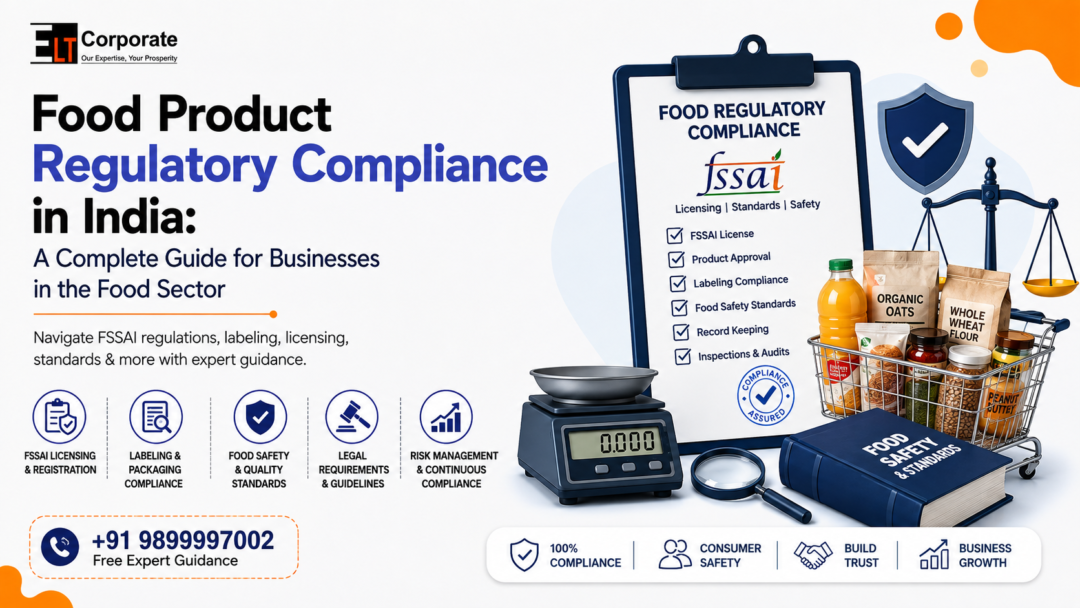
Food product compliance means that the product and business involved are following the relevant applicable laws, safety regulations, and rules. The situation with food compliance in India is governed by the Food Safety and Standards Act of 2006 to a great extent, regulations controlling the activity of the FSSAI, and the Legal Metrology Act of 2009, as well as the Legal Metrology (Packaged Commodities) Rules of 2011. FSSAI primarily deals with food safety, components, additives, food contamination, sanitation, packaging, marking, and claims, while legal metrology is concerned with statements related to quantity, price, and name of pre-packaged goods.
FSSAI regulations encompass food safety standards, ingredients, additives, contaminants, hygiene, packaging, label identification, and claims. Legal metrology compliance requirements are then applied to information related to the quantity, price, and identifier of pre-packaged products. Thus, the companies that package, produce, or import packaged food should comply with both regulations. The fact that the company has obtained the necessary FSSAI approval does not mean that it has automatically complied with legal metrology compliance requirements and vice versa.
Why should food products comply with food safety standards?
Food compliance ensures safety and protection for consumers from dirtiness, as well as dishonest, misleading info or inaccurate quantities of products. Besides, compliance proves the ethical behavior of businesses. If the business fails to comply with the regulations, it might lead to regulatory notices, detentions of products, seizures, suspensions, fines, recalls, and restrictions imposed on sales. Online marketplaces might reject the products in case the labels or licenses are incomplete. Compliant products enjoy many commercial benefits, such as the ease of being sold in online marketplaces, collaboration with distributors, and more appreciation from consumers. Moreover, compliance with requirements will help to avoid spending money on changes related to packaging that should be completed.
Checking Ingredient and Product Composition
The use of ingredients is regulated under food regulations for a particular type of food product.
Companies should check the following:
- Main ingredients and their specifications
- Food additives, colors, and preservatives
- Flavors and flavoring substances
- Vitamins, minerals, and plant extracts
- Processing substances and carriers
- Sweeteners and emulsifiers
- Maximum allowed percentage in final food
- Limitations related to specific consumer groups
The excessive use of a lawful ingredient can result in a product becoming non-compliant. And while an ingredient may be permitted within a given category, it does not necessarily follow that it is allowed in others as well.
Advertising, Food, and Health Claims
Advertising for food products needs to be accurate, straightforward, and capable of supporting relevant claims. Terms like “high in protein,” “low in fat,” and “natural” should not be used unless the product meets the criteria and the firm has relevant data and proof for each claim. It is crucial to ensure that the advertisement, website, product listing, or social media post is consistent with the label. If the message is misleading, disclaimers will not be able to help. In addition, comparisons must be truthful and proven and not mislead consumers into fearing for their health or overusing a product.
Health and disease treatment claims are especially dangerous. These statements should be cleared with regulatory authorities. The regulations governing the use of health and nutrition claims in the advertising of food products are the Food Safety and Standards (Advertising and Claims) Regulations, 2018.
Food Packaging Requirements: Safe and Legal
Food packaging must provide protection against food contamination, leakage, spoilage, and undesired interaction with the packaging itself.
The chosen packaging should be appropriate for the type of food, its shelf life, storage, and intended use by the product. It is essential for the firms to evaluate whether the type of packaging works properly for the product type, e.g., oily, acidic, frozen, hot-filled, moisture-sensitive, or light-sensitive.
Food packaging compliance requires a separate assessment from the label compliance. It does not matter if the label is informative and clear about food content—the packaging can still be non-compliant with the food contact regulations.
Understanding FSSAI Food Labels
The product label is one of the most crucial components of food product compliance.
Depending on the type of food product, the label may include:
- Name of the food
- Ingredients list
- Nutritional information
- Declaration of allergens
- Vegetarian and non-vegetarian symbol
- FSSAI logo and license number
- Batch, lot, or code number
- Date of manufacturing or packing
- Usage-by date, expiry date, or best-before date
- Storage instructions
- Instruction to use
- Name and address of the responsible organization
- Country of origin of the product, if imported
Simple Guide to Food Advertising Rules
Food businesses often resort to using the following phrases:
- High protein
- Low fat
- Sugar-free
- Natural
- Immunity booster
- Rich in fiber
- Heart-friendly
- No preservatives
- Clinically tested
It is important to remember that it is not enough to just use such phrases from the marketability point of view. The product must comply with
The following table shows the main points.
| Compliance Area | Applicable/Authority Law | Business Action Required |
| Product Classification | FSSAI Regulations | Classify the product before finalizing its formulation and label. |
| Ingredient Classification | FSSAI Product Standards and Food Additive Regulations | Review the complete formulation and ingredient specifications. |
| Packaging Material | FSSAI Packaging Regulations | Obtain packaging specifications and food-contact compliance documents. |
| Food Labeling | FSSAI Labelling and Display Regulations, 2020 | Conduct a complete label and artwork compliance review. |
Steps to Apply for FSSAI Registration or License
- Check Eligibility: Determine whether your food business requires Basic Registration, a State License, or a Central License based on its business type, scale, capacity, and location.
- Visit the FoSCoS Portal: Open the official FoSCoS portal and select “Apply for New License/Registration.”
- Select Business Details: Choose the state, type of food business, premises, products, and applicable eligibility category.
- Complete the Application: Fill in the business, proprietor, premises, food product, and contact details.
- Upload Documents and Pay Fees: Upload the required documents and pay the applicable government fee through the official FoSCoS portal.
- Submit and Track: Submit the application and use the reference number to track its status. After document review and inspection, where applicable, the authority issues the FSSAI Registration Certificate or License.
Distinctions Between Both Regulations
The focus of the FSSAI label check is on:
- Food compositions
- Nutritional information
- Allergies
- Food classification
- Food enhancements and preservatives
- Vegetarian and non-vegetarian rules
- Food assertions
- Food safety guidelines
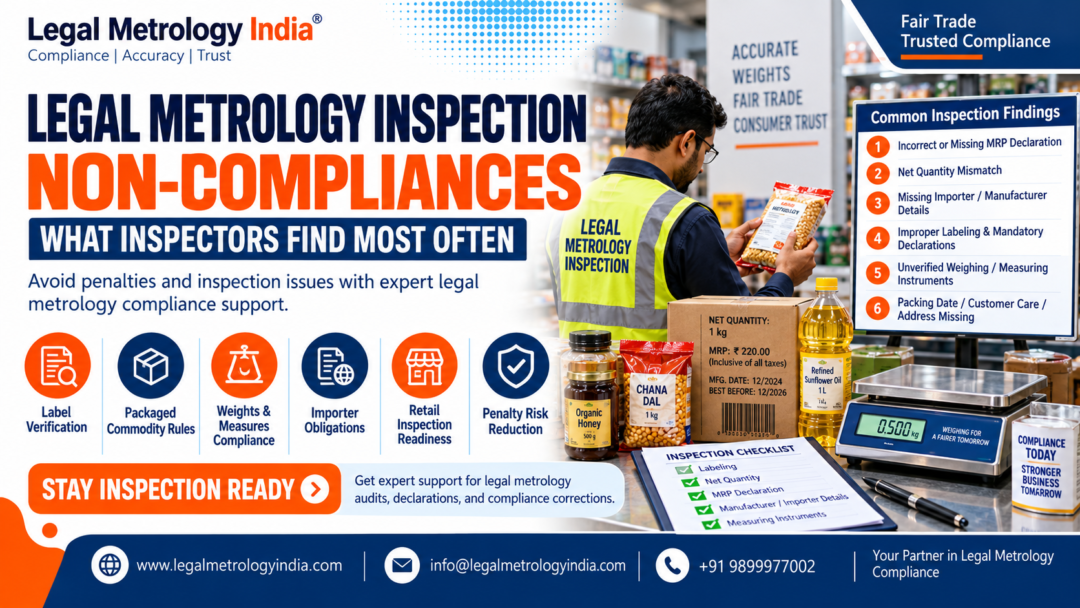
The objects of legal metrology are
- Name of the manufacturer
- General name of the product
- Total amount
- Maximum retail price of the product
- Dates of declarations
- Customer care information
Maintaining Safety and Hygiene in Food Operations
A manufacturing process that is compliant in terms of the formulation can prove to be a source of unsafety of the product when there are no adequate hygiene requirements and proper process controls in place. Several sanitation aspects, such as location, equipment utilized, water quality, and pest control method adopted, must be taken into account while dealing with food products.
The documented procedures should include a good manufacturing process and good hygienic utilization. The processes of receiving materials, the production process, the quality check system, and protocols for cleaning and maintenance, as well as deviation handling, must be assigned to employees and organized in a systematic way. Specific training for different groups of staff is also important.
Checking Food Quality and Shelf Life
Food testing confirms that a product is safe and of high quality. The extent of food testing should depend on the product itself, its ingredients, the process, the shelf life of the product, and the associated risks. Testing can include microbiological, contaminant, toxin, residue, heavy metal, and additive, as well as nutritional composition parameters and parameters specific simply to the category.
Specifications regarding the finished product should also show acceptable conditions, and reports prepared by qualified specialists should be reviewed before making a batch available for sale. If testing is performed externally, then an appropriate lab should be employed for performing the required testing. Supplier certifications can assist in quality control but should never replace testing based on risk assessment. All proofs of shelf life are to be scientifically justified. What is claimed to be “best before” or “use by” dates should be proved by stability studies conducted in appropriate storage conditions.
Important Changes in Food Safety Rules
Food regulations continue to change through amendments, directions, notifications, and enforcement decisions. What is compliant at the time of launch may not be afterwards. Companies need to have a compliance update mechanism in place and ensure products, supplier information, permits, statements, etc. are periodically checked.
Internal audits help identify potential inconsistencies and avoid compliance issues. Changes in ingredients, supplier and manufacturer locations, packaging, and product design must be effectively managed by keeping track of changes. Companies must store records systematically and be able to demonstrate compliance with them whenever required by authorities. Regulatory monitoring is key, especially since the local food safety authorities continue to make changes in the area of licensing, labeling, packaging, contaminants, and other standards. Before making changes to a product or a package, companies must check the latest requirements.
Documents for Imported Food
- License and Business Documents
- Valid FSSAI registration/license
- Company PAN
- GST registration
- Certificate of partnership deed or incorporation
- Proof of address of manufacturing unit
- Details of owner, manufacturer, packer, and marketer
- Name of the brand owner if different from the manufacturer
- Legal metrology registration if applicable
Conclusion
Compliance with food products is integral to a responsible and steadily growing food business. It includes aspects like product development, licensing, formulation, hygiene and manufacturing, tests, packaging, and labelling, as well as the declaration according to legal metrology, advertising, and tracking after the product is out on the market. Companies that use ongoing compliance as a management tool are prepared to launch their products safely, in compliance with legal metrology laws, and gain customers’ trust.
A compliance review performed by an expert enables the company to discover the right category of the product, licensing needs, limitations regarding production, packaging, and the legal metrology requirements to fulfill. All these steps will help avoid delays, fines, and recalls.
🍽️ Need Help with Food Product Compliance?
Our experts assist with Food Product Compliance, Legal Metrology Compliance, LMPC Certificate, Product Label Review, Import Compliance, and other regulatory requirements across India.
📞 Get Free Consultation 💬 WhatsApp NowFrequently Based Question
Q1. What is food product compliance?
It signifies that food products are compliant with the regulations regarding their safety, packaging, and labelling, as well as selling.
Q2. Is an FSSAI license mandatory?
Definitely, every food business needs to get the necessary FSSAI registration or license.
Q3. Is legal metrology compliance needed?
Of course, packaged food products must comply with the legal metrology regulations regarding their labeling.
Q4. What should a food label contain?
It should contain ingredients, net weight, price, dates, details of FSSAI, and details about the producer.
Q5. What happens in a case of non-compliance?
Non-compliance can lead to fines, withdrawal of the product, confiscation, or cancellation of the license. and losses with packaging in the process of entering the market.