
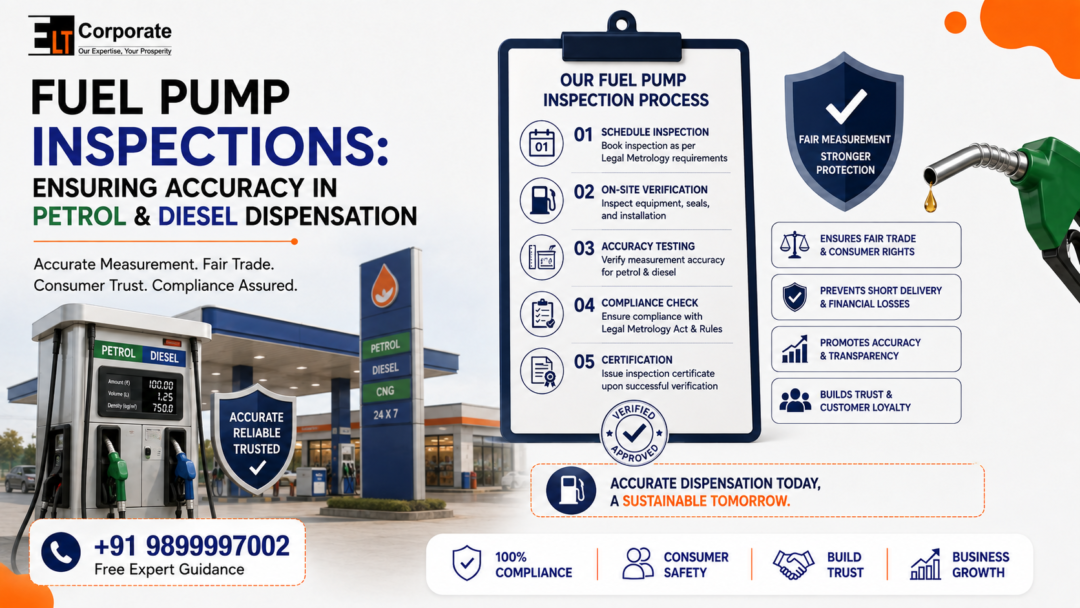
When consumers buy a litre of either petrol or diesel, they have the right to confirm that this matches what is recorded on the fuel pump. Any discrepancies, even small amounts, add up to a large loss of revenue for consumers. This is why fuel pump inspections are crucial for protecting the public and enforcing legal regulations in this area.
Fuel pump inspections help ensure that petrol and diesel pumps are calibrated properly. Under the Legal Metrology Act of India, all equipment used to assist in commercial transactions must be verified and stamped. According to this Act, under Section 24, we must verify all the tools used for measurement.
Regular fuel pump inspections therefore protect consumers while also helping petrol pump operators maintain regulatory compliance and confidence in their dispensing systems.
What Are Fuel Pump Inspections?
Fuel pump inspections are checks done to make sure that machines that dispense gasoline and diesel are correctly showing and giving the amount of fuel to people who buy it.
A fuel dispenser is basically a tool used to measure fuel during a sale. Because of this, being accurate is not a technical thing—it is something required by law and something that protects customers.
During fuel dispenser inspections, officials can look at the machine, the part that measures fuel, the seals, the amount shown on the screen, whether it has been checked, and how much fuel actually comes out of the machine.
The goal is simple:
The quantity displayed on the dispenser should correspond to the quantity actually delivered.
The Legal Metrology Act says that tools used to measure things are considered “weights or measures” when it comes to checking and controlling them.
Why Are Fuel Pump Inspections Important?
Fuel pump inspections are important because people buy petrol and diesel based on how much they measure.
Consumers cannot see if they got 5 litres or 10 litres of fuel. They have to trust the machine that dispenses the fuel.
If the machine is not working correctly or someone has tampered with it, people may pay for more fuel than they actually got.
Fuel pump inspections help people in several ways. Here are some of the things they do:
- Protect people from getting fuel that they paid for
- Make sure the fuel dispensing units are working correctly
- Find out if the dispensing equipment is broken
- Check if someone has tampered with the machine
- Ensure that the fuel pump is following the legal metrology rules
- Help people trust the petrol pumps
- Encourage dealers to be fair
- Reduce arguments between consumers and dealers
The Government of Haryana says that people should check that the dispenser is set to zero before they get their fuel. They also say that people can use a 5-litre measure to check if they got the amount of petrol or diesel. Fuel pump inspections are necessary to ensure that they are done correctly.
The Government of Haryana’s rules are in place to help people, and Fuel dispenser inspections are a part of this.
Fuel pump inspections help to make sure that people get the amount of fuel and that dealers are fair.
Legal Framework for Fuel Pump Inspections in India
Fuel pump inspections in India happen under the rules of the Legal Metrology Act, 2009. This Act is supported by legal metrology rules made by the Central Government. It also includes the Legal Metrology Enforcement Rules of each state and union territory.
Section 24 of the Legal Metrology Act says that any weight or measure used in a transaction must be checked before it is used. The Act also talks about rules for items that are not standard, not checked, changed, or used in the wrong way.
The Department of Consumer Affairs says that the Legal Metrology (General) Rules, 2011 are the rules that set the standards for types of weighing and measuring tools.
Each state’s legal metrology enforcement rules add to this system. These rules set out the steps for checking, marking, paying fees, inspecting, and enforcing the rules. Because of this, the exact steps needed can be different in each state or union territory.
What Happens During Fuel Pump Inspections?
When the people from Legal Metrology come to do fuel pump inspections, they look at things to see if the pump is working correctly and doing what it is supposed to do. They check important things, such as
Fuel pump inspections to see if the right amount of fuel is delivered
The main reason for doing fuel dispenser inspections is to make sure the pump is giving the right amount of fuel. They want to know if the amount of fuel the pump says it is giving you is actually the amount you get.
To do this, they pour fuel into a container that they know is accurate. Then they compare the amount of fuel in the container to the amount the pump said it was giving.
The people in charge in Delhi say that pumps should be tested when they are being used normally and with the kind of fuel they are supposed to be giving.
Fuel Pump Inspections for Verification and Stamping
Fuel pump inspections may also check whether the dispensing equipment has been duly verified and bears the appropriate legal metrology verification or sealing arrangements.
Section 24 of the Legal Metrology Act creates the statutory requirement for verification of weights and measures used or intended to be used in transactions.
Verification is important because calibration may change over time due to mechanical wear, servicing, replacement of components, or other technical factors.
Fuel Pump Inspections for Seals and Tampering
Sealing plays an important role in protecting the metrological components of a fuel dispenser from unauthorised adjustment.
The Gujarat Legal Metrology Department explains that the internal metering unit and totalizer unit of a petrol pump are connected through sealing arrangements bearing the inspector’s impression.
During Fuel dispenser inspections, damaged, missing, or suspicious seals can therefore require closer examination.
Fuel Pump Inspections and the 5-Litre Test Measure
One of the most familiar consumer checks associated with fuel pump inspections is the 5-litre test measure.
Government Legal Metrology guidance in Haryana states that a 5-litre conical measure is kept at petrol pumps so consumers can check the quantity of petrol or diesel. Gujarat’s Legal Metrology FAQ similarly states that petrol pumps should maintain a certified measure and refers to the five-litre measure used for checking delivery.
Fuel Pump Inspections and Short Delivery
When you buy petrol or diesel, you should get the amount. Sometimes Fuel dispenser testing find that you get less than what the machine says. This is called delivery.
For example, the machine says you got 5 litres of fuel. Actually, you got less. This is not right. The people in charge need to fix this problem. They might need to check the machine or take some action.
The main purpose of fuel pump inspections is to find out if Fuel dispenser testing machines are giving the correct amount of fuel.
They also have to tell the legal metrology officer so they can fix the machine. The officer will then make sure the machine is working correctly. This way, fuel pump inspections help make sure that you get the amount of Fuel when you buy it. Fuel pump inspections are important for this reason.
Fuel Pump Inspections After Repair or Adjustment
Fuel pump inspections are really important when a machine that dispenses fuel has been fixed or when some parts that affect how much fuel is measured have been changed. You cannot just assume that a machine that has been fixed will still give the correct amount of fuel.
Fuel pump inspections are necessary to make sure everything is working correctly. So petrol pump operators need to make sure they are working with:
- Authorized repair personnel
- Oil marketing company representatives
- Legal metrology authorities
- Retail outlet management
This way, fuel pump inspections can help prevent problems with a dispenser that has not been properly fixed and checked. Fuel pump inspections are crucial to ensure that the machine is working correctly and dispensing the correct amount of fuel.
Fuel Pump Inspections and Consumer Rights
Consumers also have a role in making sure fuel pump inspections work properly. When buying fuel, consumers should:
- Make sure the machine starts at zero
- Watch the amount and cost that is shown
- Ask for a bill or receipt when it is needed
- Ask for a test if they think they got less fuel than they paid for
- Check if the test tool looks properly checked
Tell someone if they think the machine is being changed in a bad fuel pump inspection way or if they keep getting less fuel. Do not just trust what the car’s fuel meter says. Government advice says that consumers can use the official tool that is at gas stations.
Fuel Pump Inspections and Responsibilities of Petrol Pump Dealers
For dealers, fuel pump inspections should not be viewed only as government enforcement activity. Internal monitoring is equally important. A petrol pump operator should ensure that:
- Dispensing units remain properly verified.
- Verification validity is monitored.
- Seals remain intact.
- Test measures remain duly verified.
- Dispensers are checked for correct delivery.
- Defective units are immediately identified.
- Unauthorized adjustments are prevented.
- Repair and maintenance records are maintained.
- Staff understand basic legal metrology requirements.
- Consumer complaints are promptly investigated.
Strong internal controls and fuel pump inspections reduce regulatory risk and help prevent consumer disputes.
Common Problems Found During Fuel Pump Inspections
When people do fuel pump inspections, they often find some problems. These problems can be different each time they do an inspection.
Some common things that are wrong can include:
- Delivery of petrol or diesel
- Expired verification
- Use of a dispensing unit
- Damaged verification seals
- Somebody adjusted the measuring mechanisms
- Defective displays
- There is leakage that is affecting delivery
- Verified test measures
- The people in charge failed to stop using a dispenser
- Somebody interfered with components of the fuel pump inspections
Just because fuel pump inspections have a technical problem, it does not mean that someone is trying to cheat. Sometimes a machine can become inaccurate because it is old or because it was fixed incorrectly. The machine might also have calibration problems. It might just be broken.
This is why people need to do fuel pump inspections and take good care of the fuel pump. Regular fuel pump inspections can help find problems before they become issues.
Fuel Pump Inspections and Penalties for Non-Compliance
Non-compliance found during fuel pump inspections can result in action taken by the authorities under the legal metrology rules.
The Legal Metrology Act has sections that deal with incorrect measurements, changing or messing with measuring devices, using unapproved measuring tools, delivering products with incorrect measurements, and obstructing Legal Metrology officers, among other problems.
For example, Section 33 talks about using scales or measuring tools, and other parts talk about changing measurements, using fuel pump inspections and incorrect measurements. The exact punishment depends on what kind of mistake was made, the laws that’re in place if the same mistake happened before, and the rules from the local government.
Best Practices for Fuel Pump Inspections and Compliance
Fuel pump owners can get ready for fuel pump inspections by using a compliance system. A useful checklist includes:
- Keep a list of all dispensing units.
- Note the dates for verification and re-verification.
- Have verification certificates on hand.
- Make sure test measures are correctly checked.
A preventive system makes fuel pump inspections simpler. Lowers the chance of breaking the rules.
Documentation Required for Fuel Pump Inspections
- Legal metrology verification or stamping certificate for every fuel dispensing unit
- Verification and re-verification records
- Valid certificate for 5-litre or 10-litre test measure
- Details about the make, model, and serial number of the fuel dispenser
- Records of calibration and accuracy tests
- Daily or periodic quantity-check records
- Records of repair and maintenance for dispensing units
- Re-verification records after repair or adjustment
- Details about the legal metrology seal or stamp
- Records of replacement of parts that affect measurement
- Previous legal metrology inspection reports
- Notices or compliance directions given by authorities
- Records of actions for short delivery
- Consumer complaint and resolution records
- Details of the authorised repairer or service agency
Best Practices for Fuel Pump Inspections and Compliance
If you own a petrol pump, you can get ready for fuel pump inspections by having a system in place to make sure you are following the rules. A simple list to follow includes:
- Keep a list of all the machines that dispense fuel.
- Write down when each machine was checked and when it needs to be checked
- Make sure you have the papers that prove the machines were checked correctly.
- Always make sure the machines are working right.
- Check the fuel when it is delivered to make sure it is okay.
- Write down what you find when you test the machines.
- If a machine is not working right, do not use it until it is fixed.
Having a system in place to make sure you are following the rules makes fuel pump inspections a lot easier. Fuel pump inspections will be a breeze if you follow these steps and remember that fuel pump inspections are for a petrol pump.
Conclusion:
Fuel pump inspections are essential for making sure that customers get the amount of petrol and diesel they pay for.
India’s legal metrology system says that the tools used to measure products in business deals must be checked. State officials do the checking, put a stamp on it, inspect, and make sure rules are followed.
Good fuel pump inspections look at how accurate the measurements are, whether the verification is done, the condition of the seals the test measures, the state of the equipment, and if there is any missing fuel.
For customers, knowing about zero reading and having a checked test measure gives protection. For the people who run petrol pumps, doing checks on their own, getting verified on time, taking care of the equipment, and fixing problems quickly are important things to do.
In the end, fuel pump inspections are not about following the rules—they help make sure that every litre of petrol or diesel sold is fair, clear, and trusted by the customers.
Frequently Asked Questions
Q1. What are fuel pump inspections?
Fuel Pump Inspections are checks that are done according to rules and technical standards to make sure that the amount of petrol or diesel that comes out of the pump matches what the customer sees on the display.
Q2. Why are fuel pump inspections necessary?
Fuel Pump Inspections are important to stop customers from getting less fuel than they pay for, to find broken or improperly checked pumps, to spot any cheating and to protect the rights of people who buy fuel.
Q3. Can a consumer check fuel quantity during fuel pump inspections or normal purchase?
Yes. Official rules from Legal Metrology say that special measuring tools are kept at fuel stations so customers can check the amount of fuel they get.
Q4. What happens if fuel pump inspections detect delivery?
If the inspection finds that the pump is giving less fuel than it should, the pump might need to be stopped, fixed, checked again, or action could be taken depending on the laws in the state.
Q5. Which law regulates fuel pump inspections in India?
Fuel Pump Inspections are controlled by the Legal Metrology Act, 2009, the Central Legal Metrology Rules, and the Legal Metrology Enforcement Rules of each state or union territory.
Q6. What should consumers check before petrol or diesel is dispensed?
Consumers should check that the pump starts at zero and watch the amount and price shown during the fueling process.