If your company manufactures packaging, imports, or manufactures products that are packaged for sale in India, then you’re probably acquainted with the Legal Metrology Packers and Manufacturers Certificate (LMPC)—the license that legally allows you to list net quantity MRP, net quantity, and other essential information on your packaged products. The thing is that a lot of firms, however, find the easiest way to do this is to let this permit slip away in the background even as the day-to-day operations continue to operate until an inspection, customs inquiry, or a market compliance audit exposes the expiry.
A lapsed LMPC license won’t stop you from your obligations as a result of the Legal Metrology Act, 2009. This simply means that every unit you sell and pack in the period of lapse is non-compliant and can lead to fines and other enforcement action regardless of how exact your labeling and net amount declarations actually are. It’s not a formality; it’s the sole certificate that keeps your entire operation of packaging legally and valid. This guide will explain the exact procedure for LMPC renewal works, the documents you’ll require, how much it will cost, and the places companies are most likely to be delayed.
Is Your LMPC License About to Expire?
Don’t let a lapsed certificate put your entire packaging operation at risk. Get your LMPC renewal filed and tracked by our compliance experts.
500+ businesses helped | PAN India service | Response within 2 hours
What Is an LMPC License, and Why Does It Need Renewal?
LMPC licenses are provided to all organizations involved in the manufacture, packing, or import of packaged commodities that are meant to be sold commercially as per the Legal Metrology (Packaged Commodities) Rules, 2011. This license allows the licensee to put the mandatory statements on the packages of each commodity. These include net quantity, MRP, and other details of the manufacturer/packer/importer.
Like most regulatory licenses in India, the LMPC certificate isn’t issued permanently. It’s granted for a fixed validity period, and once that period ends, the license holder must apply for renewal before continuing to legally pack or import commodities under that registration. Operating with an expired license is treated the same as operating without a license at all.
When Should You Start the Renewal Process?
However, the number one error that companies commit regarding this issue is waiting for the license to be expired or even just a few days away from being expired before initiating the application process for renewal. This is because it takes state legal metrology departments a period of weeks before they can process renewal applications, depending on how well documented they are.
Starting early gives you a buffer to correct any documentation gaps, respond to department queries, and avoid an operational gap where your license status is unclear during an inspection.
Documents Required for LMPC License Renewal
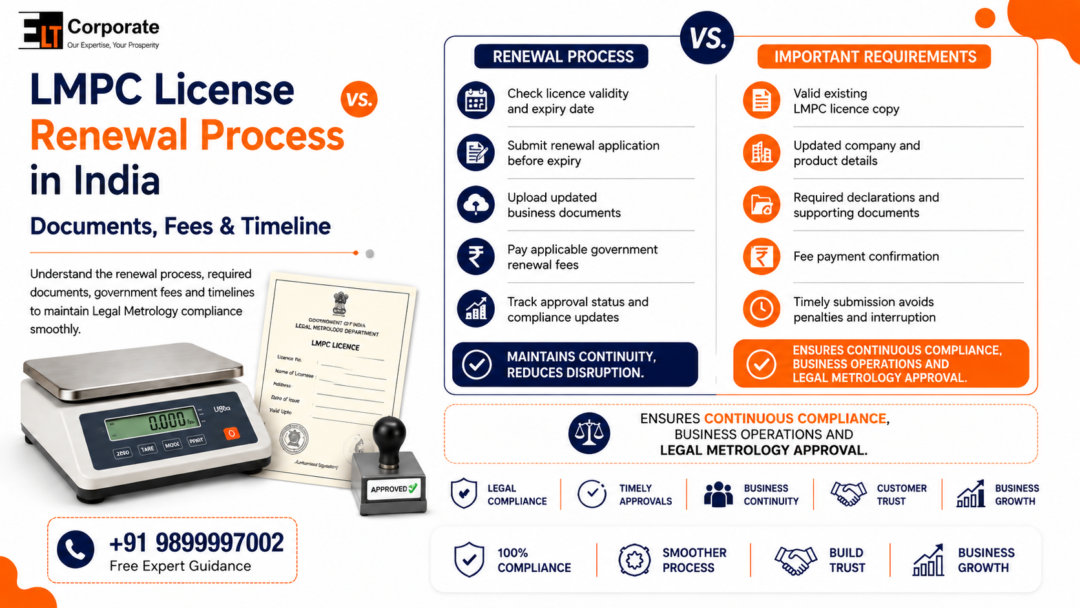
While exact document checklists can vary slightly by state legal metrology department, renewal applications typically require:
- Original LMPC certificate (the one being renewed)
- Proof of business constitution—partnership deed, certificate of incorporation, or proprietorship proof, depending on entity type
- PAN card of the business entity
- GST registration certificate
- Factory or premises proof—rent agreement, ownership documents, or utility bills for the manufacturing or packing address on record
- List of commodities currently being packed/manufactured under the license, updated to reflect any changes since the original registration
- Photographs of the manufacturing or packing unit, in some states
- Details of any changes to business address, ownership, or product categories since the last certificate was issued
- Renewal application form, as prescribed by the respective state Legal Metrology Department
Any change in business details since your original registration—a new address, an additional product line, a change in authorized signatory—typically needs to be reflected and supported with documentation at the time of renewal, not left for a future update.
The LMPC Renewal Process, Step by Step
- Compile and review documentation—cross-check your existing certificate details against your current business operations to identify any changes that need to be reported.
- Submit the renewal application to the relevant state Legal Metrology Department online through the state’s designated portal (where available) or offline through the local Legal Metrology office, depending on the state’s current process.
- Pay the prescribed renewal fee—fees vary by state and are often structured by business category (manufacturer, packer, or importer) and scale of operation.
- Department review and site verification—in many states, a legal metrology inspector may visit the manufacturing or packing premises to verify that operations match what’s declared in the renewal application, particularly if there have been changes since the original license.
- Query resolution—if the department flags missing documents or discrepancies, these need to be resolved promptly to avoid the application stalling past your current license’s expiry date.
- Issuance of the renewed certificate—once approved, the renewed LMPC certificate is issued with a fresh validity period, and this should be filed alongside your other compliance records.
Common Reasons Renewal Applications Get Delayed
- Mismatched business details—addresses, product categories, or ownership structures that have changed but weren’t formally updated before the renewal filing.
- Incomplete or outdated supporting documents—GST certificates, premises proof, or constitution documents that don’t match current records.
- Applying too close to the expiry date—and leaving no time to address problems raised by the department.
- Companies that have added new commodity types or SKUs since the license was first issued but have not formally amended their registration in order to add these types of products.
- State-specific procedural distinctions—since the lawful metrology enforcement process is conducted on a state level, the procedures for renewal, web portals, and document requirements may differ between states that can cause confusion for businesses that operate across several states.
What Happens If You Operate With an Expired LMPC License?
Continuing to manufacture, pack, or import commodities under an expired LMPC license carries the same enforcement risk as operating without a license at all:
- Monetary penalties under the Legal Metrology Act for operating without a valid license.
- Stoppage of packing operations if flagged during an inspection, disrupting production and dispatch schedules.
- Marketplace and retailer compliance holds—many large retailers and e-commerce platforms now request current LMPC certificates as part of their vendor onboarding and periodic compliance checks, and an expired certificate can trigger delisting or payment holds.
- Complications during customs clearance for businesses that also import packaged goods, since customs and legal metrology compliance checks increasingly cross-reference licensing status.
- Cumulative liability—every unit packed and sold during the lapse period is technically non-compliant, which can complicate matters further if a labeling or quantity issue is separately identified during that window.
Check your LMPC renewal status before it’s too late →
How to Avoid Renewal Gaps Going Forward
The companies that will not suffer from an LMPC compliance gap are those who have incorporated renewal into their regulatory cycle instead of considering it a one-time thing to do. Here is what needs to be done practically:
- Keep track of your LMPC renewal deadline along with other regulatory deadlines such as GST, factory licenses, and product registrations.
- Put renewal alarms 90 days in advance, giving yourself adequate time for all necessary documentation and site verifications.
- Ensure supporting documents are always up to date, and update them as changes occur. Instead of collecting them when there is a need for LMPC renewal, keep updating them.
- Keep a compliance file where you keep your current LMPC certificate, acknowledgment of your applications, and letters exchanged with the Legal Metrology Department.
- Work with a compliance partner for multi-state operations, since managing renewal timelines and procedural differences across several states Legal metrology departments in-house are where most delays and errors creep in.
Conclusion
The LMPC license is easy to treat as a “set it and forget it” formality, but it’s one of the few certificates that touches every single unit your business packs, manufactures, or imports. A lapsed renewal doesn’t just risk a fine—it puts your entire packaging operation on non-compliant footing until it’s resolved, with knock-on effects for retail and marketplace relationships, customs clearance, and enforcement exposure. Building renewal into your regulatory calendar, starting the process early, and keeping your documentation current is the difference between a routine renewal and a scramble under deadline pressure.
Frequently Asked Questions
Q1. How many years is the LMPC license valid until it is due for renewal?
Validity dates are determined by each state’s Legal Metrology Department and can be different; therefore, it’s essential to verify the validity of your certificate rather than taking an identical duration for every state.
Q2. Can I continue to sell and pack products even though the LMPC renewal is in the midst of processing?
It is based on the specific rules of the state and also if the renewal application was submitted before the certificate was issued in the first place. Making sure you file your tax return well before the expiration date is the best method to avoid confusion about your operating status throughout your review time.
Q3. How do I proceed if the firm has moved its manufacturing location since the first LMPC license was granted?
A change in address must be reported in writing and accompanied by current premises documents at the renewal time (or earlier, based on the rules of your state), as this license remains tied to a particular location in the record.
Q4. Do I require a new LMPC license when I begin manufacturing a brand new product category?
In most cases, the addition of an additional commodity category will require that the license be modified or modified to reflect the new coverage, rather than simply considering that your current LMPC automatically covers each new line of products.
Q5. Is this LMPC renewal process similar across all states in India?
No. Legal metrology enforcement is conducted in the states. As such, renewal portals, the requirements for documentation, and processing timeframes may vary from state to state and are a frequent cause of confusion for companies operating in multiple states.
Q6. What do I do if my LMPC license has expired?
Request renewal right away and be ready to be ready for an inquiry or site inspection following the expiry date. Continuing to package or sell products during this time frame is a risk to compliance; therefore, getting the renewal resolved as soon as you can is the top priority.
Talk to our Legal Metrology compliance team today to check your LMPC license status, get your renewal application filed well ahead of expiry, and keep your packaging operations fully compliant.
Is Your LMPC License About to Expire?
Don’t let a lapsed certificate put your entire packaging operation at risk. Get your LMPC renewal filed and tracked by our compliance experts.
500+ businesses helped | PAN India service | Response within 2 hours