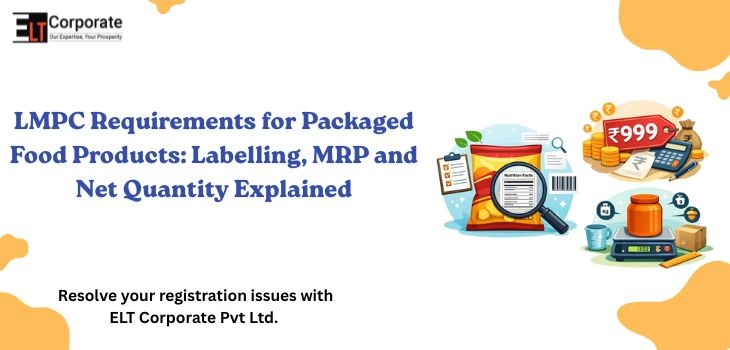
Navigating the world of packaged food products in India requires understanding several regulations. Among the most crucial is the Legal Metrology (Packaged Commodities) Rules, 2011, often called LMPC. These rules ensure fair trade practices and protect consumers by mandating clear and accurate information on product labels.
For anyone involved in manufacturing, importing, or packing food products, LMPC compliance is non-negotiable. It’s not just about avoiding penalties; it’s about building trust with your customers and ensuring your business operates smoothly within the law. This guide will simplify the LMPC requirements, focusing on essential aspects like labeling, Maximum Retail Price (MRP), and net quantity declarations.
Understanding LMPC for Packaged Food Products
What exactly is LMPC, and why is it so important for the food industry? The Legal Metrology Act, 2009, and its accompanying Packaged Commodities Rules, 2011, govern all pre-
packaged commodities sold in India. This framework ensures that consumers receive accurate information about the quantity and price of products they buy. For food items, this means every packet, bottle, or container must display specific details precisely. This includes anything from a bag of chips to a carton of juice or a jar of spices. Adhering to these rules helps prevent unfair trade practices and gives consumers confidence in their purchases.
Key Elements of LMPC Compliance for Food Labeling
The LMPC rules mandate several declarations on every pre-packaged food item. Getting these right is vital for compliance.
1. Net Quantity Declaration: This is perhaps the most fundamental requirement. You must declare the exact quantity of the product inside the package, whether by weight, volume, or number. For solids, use weight (grams, kilograms); for liquids, use volume (milliliters, liters). Semi-solids might use either, depending on their nature. It’s crucial to account for permissible errors and tolerances, which vary by product type, ensuring your declared quantity is within acceptable limits. Always use the standard International System of Units (SI Units).
2. Maximum Retail Price (MRP): Every packaged food item must clearly state its MRP, inclusive of all taxes. This declaration ensures price uniformity across retailers and prevents overcharging. If you sell combo packs, the MRP for the entire combo must be declared, not just individual items. Any re-packaging or re-labeling also requires careful recalculation and re-declaration of MRP.
3. Name & Address of Manufacturer/Packer/Importer: Transparency is key. For domestically produced goods, the name and complete address of the manufacturer or packer are mandatory. For imported food products, the importer’s name and address, along along with the country of origin, must be clearly displayed. This helps trace the product back to its source.
4. Date of Manufacture/Packing/Import: This date is crucial for consumers to assess product freshness and for regulatory bodies to monitor shelf life. It provides a timestamp for when the product was packaged or entered the Indian market.
5. Common or Generic Name of the Commodity: The label must include the common name of the food item inside. This ensures consumers clearly understand what they are purchasing. For example, “Potato Chips” or “Orange Juice.”
6. Consumer Care Details: Providing a way for consumers to reach out is a mandatory requirement. This includes the name, address, phone number, and email of the person who can address consumer queries or complaints.
7. Readability: The declarations must be printed in a clear, legible font size and style. The text should be easily readable against the background, ensuring all consumers can access the information without difficulty.
Read More: Food Labeling Regulations in India
Documents Required for LMPC Registration
To ensure your food business is legally compliant, several documents are typically required for LMPC registration. These help verify your business legitimacy and operational details.
- Proof of Business Registration (e.g., Company Incorporation Certificate, Partnership Deed)
- Proof of Identity and Address of Partners/Directors/Proprietor
- FSSAI License/Registration Certificate (mandatory for food businesses) Factory/Shop/Godown Address Proof (e.g., rent agreement, ownership documents) List of Packaged Commodities and their details
- Specimen of product labels
- PAN Card of the Company/Individual
- GST Registration Certificate
- NOC from Pollution Control Board (if applicable)
- Importer-Exporter Code (IEC) (for importers)
The LMPC Registration Process: A Step-by-Step Guide
Getting your LMPC registration for packaged food products involves a structured process. This ensures all legal requirements are met.
1. Application Submission: Prepare and submit the application form (Form A for manufacturers/packers, Form B for importers) to the respective Legal Metrology Department. This can be at the State or Central level, depending on your business’s scope.
2. Document Attachment: Attach all the required documents as listed above. Ensure all copies are self-attested or notarized as needed.
3. Fee Payment: Pay the prescribed application and registration fees. These fees vary based on the type of registration and the state.
4. Verification and Inspection: The Legal Metrology Department will review your application and documents. They may conduct an inspection of your premises to verify details and check compliance with packaging and labeling standards.
5. Grant of Certificate: Once satisfied, the department will issue the LMPC registration certificate. This certificate signifies your compliance with the necessary legal metrology standards.
Common LMPC Mistakes to Avoid
Even with the best intentions, businesses can sometimes overlook critical details. Avoiding these common mistakes can save you from potential penalties.
- Incorrect Net Quantity Declaration: Declaring a quantity that doesn’t match the actual content or using non-SI units.
- Ambiguous MRP: Failing to state “Inclusive of all taxes” or not clearly displaying the MRP.
- Missing Importer Details: For imported products, omitting the importer’s name, address, or country of origin.
- Illegible Labels: Using small fonts or low-contrast colors that make the mandatory declarations difficult to read.
- Outdated Information: Not updating labels when product formulations, net quantities, or addresses change.
- Ignoring Permissible Errors: Exceeding the allowed variations in net quantity for specific commodities.
- Incomplete Consumer Care Information: Providing only a partial contact detail, making it hard for consumers to reach out.
The Cost of LMPC Compliance (Rough Range)
Understanding the financial aspect of LMPC compliance helps in budgeting. Costs generally include government fees and potential professional assistance.
| Expense Type | Rough Cost Range (INR) |
| Official Government Fees (Registration) | ₹500 – ₹5,000 (Varies by state/type) |
| Professional Consultancy Fees | ₹10,000 – ₹50,000 (Depends on complexity & services) |
| Label Design & Printing Costs | Variable (Depends on volume & design) |
What Happens If You Ignore LMPC Rules?
Non-compliance with LMPC rules can lead to severe consequences for your food business. These penalties are designed to deter violations and ensure consumer protection. Authorities can impose hefty fines for incorrect declarations, often ranging from several thousand to lakhs of rupees, depending on the nature and repetition of the offense. In serious cases, products can be seized, and stop-sale orders might be issued, leading to significant financial losses and operational disruptions. Repeated offenses can even result in imprisonment for responsible personnel. Beyond legal troubles, non-compliance severely damages your brand’s reputation and consumer trust, which is often harder to recover from than financial penalties.
How ELT Corporate Pvt. Ltd. Can Help You?
Navigating the complexities of LMPC for packaged food products can be challenging. This is where expert guidance becomes invaluable. ELT Corporate Pvt. Ltd. specializes in Legal Metrology compliance, offering comprehensive solutions tailored for the food industry. We assist manufacturers, packers, and importers with every step of the LMPC registration and compliance process.
From preparing documentation and submitting applications to ensuring your labels meet all mandatory requirements, we provide end-to-end support. Our team ensures that your packaged food products adhere to all regulations, helping you avoid common mistakes and operate with confidence. Partner with ELT Corporate Pvt. Ltd. to streamline your compliance journey.
Conclusion
LMPC compliance for packaged food products is more than just a legal obligation; it’s a foundation for consumer trust and business integrity. Accurate labeling, correct MRP, and precise net quantity declarations are vital for operating successfully in the Indian market.
By understanding and adhering to these rules, you protect your business from penalties and enhance your brand’s credibility. Don’t leave compliance to chance; ensure your food products meet all LMPC requirements today.
FAQs
What are the absolute minimum declarations for food packaging?
You must declare net quantity, MRP (inclusive of all taxes), name and address of the manufacturer/packer/importer, date of manufacture/packing, common name of the commodity, and consumer care details. These are essential for legal compliance.
How can I accurately declare net quantity for varied food products?
Declare by weight for solids, volume for liquids, and number for items like eggs. Always use SI units (grams, milliliters). Account for permissible errors, ensuring your declared quantity is within the legal tolerance range for your product type.
What are the LMPC rules for imported packaged food?
Imported food products require the name and address of the importer in India, along with the country of origin. All other standard LMPC declarations for net quantity, MRP, and consumer care must also be present on the label.
What are the penalties for LMPC non-compliance?
Penalties include fines, product seizures, and stop-sale orders. Repeated offenses can lead to higher fines or even imprisonment. Non-compliance also damages your brand’s reputation and consumer trust significantly.
Are free samples of food products subject to LMPC rules?
Generally, all pre-packaged commodities, including free samples or promotional packs, must comply with LMPC labeling rules, particularly for net quantity and essential declarations. There are very limited exemptions based on package size.