
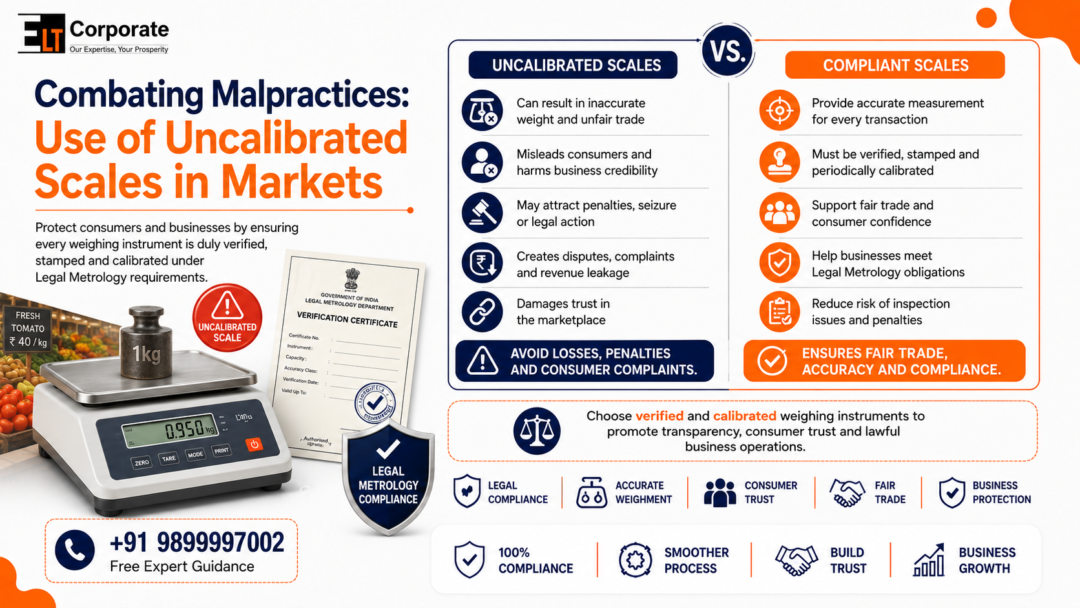
Walk into any local market, vegetable stall, or even a mid-sized retail store, and you’ll see the same weighing scale used dozens of times an hour, day after day, month after month. What most customers never think to ask is, when was that scale last verified for accuracy? For a shockingly large number of vendors, the honest answer is “never”—and that single gap is one of the most common and most under-reported forms of consumer fraud in India today.
Uncalibrated and uncertified weighing scales won’t simply shortchange consumers by just a few milligrams here and there. Over the course of millions of daily transactions of wholesale mandis and retail counters, petrol pumps, and delivery to cylinders, even an error in measurement can turn into massive losses for the consumer and unfair competitive advantages for sellers who do not comply. This is precisely the type of violation that the Legal Metrology Act, 2009, was created to eradicate—and is still one of the most vigorously applied areas of the law.
Is Your Weighing Scale Legally Verified?
Don’t wait for an inspector to find out. Get your instruments checked, verified, and stamped by our Legal Metrology compliance experts.
500+ businesses helped | PAN India service | Response within 2 hours
Why Uncalibrated Scales Are a Legal Metrology Violation, Not Just an Ethical Lapse
Under the Legal Metrology Act, 2009, and the Legal Metrology (General) Rules, 2011, every weight and measuring instrument used for trade, commerce, or protecting public interest—including weighing scales, weighbridges, fuel dispensing units, and taximeters—must be:
- Manufactured and stamped by a licensed manufacturer or repairer approved by the Legal Metrology Department.
- Verified and stamped by a government legal metrology officer at the time of first use.
- Re-verified periodically, typically on an annual basis, with the verification certificate and stamp renewed each cycle.
- Sealed in a manner that prevents tampering with the internal calibration mechanism between verification cycles.
Using a scale that has never been verified, or one whose verification has lapsed, is not a minor technical oversight—it is a direct violation of Sections 25 and 33 of the Legal Metrology Act, and it exposes the business owner to fines and, in cases of deliberate tampering, imprisonment.
How Uncalibrated Scales Are Used to Cheat Consumers
Not every uncalibrated scale is being used maliciously—some vendors simply neglect renewal out of ignorance or cost avoidance. But a significant share of cases involve intentional manipulation, and enforcement officers routinely encounter the same patterns:
- Mechanically tampered scales—internal springs or counterweights adjusted so the scale reads higher than the actual weight of goods placed on it.
- Digital scales with altered firmware or “zero-point” manipulation—electronic scales pre-set to add a small percentage to every reading, difficult for a customer to detect without a reference weight.
- Worn or damaged scales never recalibrated—genuine mechanical drift over time that the vendor never corrects because there’s no verification stamp forcing a check.
- Non-standard or unstamped weights used alongside a compliant scale, defeating the purpose of an otherwise accurate instrument.
- Fuel dispensing units and gas cylinders shortchanging volume or weight, which affects a far larger transaction value per instance than retail scales.
In wholesale markets and mandis, where transaction volumes are enormous, even a 2–3% measurement error can translate into significant, systemic losses for farmers and buyers on one side of the trade and equally significant illegitimate gains on the other.
The Real Cost to Consumers and Honest Businesses
The damage from uncalibrated scales isn’t limited to the individual customer who gets shortchanged at checkout. It ripples outward in ways that are easy to overlook:
- Cumulative consumer loss at scale—a shortfall of even 20–30 grams per kilogram, repeated across thousands of daily transactions in a single market, adds up to enormous aggregate losses across a city or region over a year.
- Unfair competition—compliant businesses that maintain properly verified scales operate at a cost and margin disadvantage compared to non-compliant competitors quietly shaving weight off every sale.
- Erosion of trust in local retail—once consumers suspect systemic shortchanging in a market, it damages the reputation of every vendor there, including the honest majority.
- Downstream effects in agriculture and wholesale trade—farmers selling produce by weight at mandis are especially vulnerable, since underweighing at the point of first sale affects their income directly and is difficult to challenge without independent verification tools on-site.
Enforcement: What Legal Metrology Departments Actually Do
Legal metrology enforcement in India operates at the state level, with each state’s Controller of Legal Metrology and a network of Inspectors and Assistant Controllers responsible for market surveillance. Standard enforcement activity includes:
- Routine and surprise inspections of retail shops, wholesale markets, mandis, petrol pumps, and delivery services to check verification stamps and test scale accuracy against certified reference weights.
- Consumer complaint-driven investigations, where a shopper’s report of suspected short-weighing triggers a targeted inspection.
- Seizure of non-compliant instruments—scales without valid verification stamps or found to be deliberately tampered with—can be seized on the spot.
- Penalty proceedings—under the Act, using an unverified or non-standard weight or measure can attract fines that scale up with repeat offenses, and deliberate fraud can lead to imprisonment in addition to monetary penalties.
- License cancellation for repeat or serious violations, particularly for repairers and manufacturers found stamping instruments improperly.
What Businesses Need to Do to Stay Compliant
For manufacturers, retailers, wholesalers, and anyone using a weighing or measuring instrument for trade, staying on the right side of the Legal Metrology Act comes down to a few consistent practices:
- Purchase only from licensed manufacturers or dealers whose instruments carry the required approval marks.
- Get every new instrument verified and stamped by the local Legal Metrology Officer before it’s put into commercial use.
- Track re-verification deadlines proactively—most states require annual re-verification, and letting a stamp lapse, even unintentionally, is treated as a violation during inspection.
- Never break or tamper with a verification seal, even for routine servicing—repairs must be carried out by a licensed repairer who reseals and re-verifies the instrument afterward.
- Maintain verification certificates and records on-site, since inspectors can and do ask to see proof of the most recent verification during a visit.
- Train staff on proper usage, since incorrect placement or handling of goods on a scale can create measurement discrepancies even when the instrument itself is fully compliant.
Why This Matters Beyond Compliance
For most businesses, the instinct is to treat scale verification as one more bureaucratic box to tick. But in a market environment where consumer awareness is rising and enforcement is intensifying—particularly around mandis, fuel retail, and e-commerce-linked delivery weighing—verified, tamper-proof measurement isn’t just a legal requirement. It’s a competitive differentiator. Businesses that can demonstrate consistent, verifiable compliance build the kind of trust that keeps customers coming back, while those caught using uncalibrated instruments face fines, seizures, and reputational damage that’s far more expensive than the cost of annual verification ever was.
Conclusion
Uncalibrated scales are one of the oldest forms of market malpractice, and they persist today for the simple reason that they’re easy to overlook until an inspection or a complaint brings them to light. The Legal Metrology Act, 2009, gives regulators clear authority to verify, seize, and penalize non-compliant instruments—but the responsibility to stay compliant sits squarely with every business that puts a scale, weighbridge, or dispensing unit into commercial use. Getting verification right isn’t just about avoiding penalties; it’s about protecting the basic trust that every transaction in a market depends on.
If your business uses weighing or measuring instruments for trade and you’re not fully certain your verification records, stamps, and renewal timelines are in order, now is the time to check—before an inspector does it for you.
Is Your Weighing Scale Legally Verified?
Don’t wait for an inspector to find out. Get your instruments checked, verified, and stamped by our Legal Metrology compliance experts.
500+ businesses helped | PAN India service | Response within 2 hours
Frequently Asked Questions
Q1. How often does a weighing device require re-verification in accordance with the legal requirements for metrology?
The majority of states require annual verification of instruments for weighing and measuring that are used in trade; however, the exact process may differ depending on the instrument type and the state that issued the notification. The verification stamp has the date, and companies are accountable for renewing it prior to when it expires.
Q2. What’s the distinction between “calibration” and “verification” of the scale?
The term “calibration” generally refers to the method of evaluating and adjusting the accuracy of an instrument against a standard reference. While verification is the formal procedure performed by a federal official in metrology who checks the instrument and then applies an official stamp to confirm that the instrument meets the prescribed accuracy standards for use in trade.
Q3. Can a shopkeeper repair or adjust a scale themselves without losing its verification status?
No. Any repair or internal adjustment must be carried out by a Legal Metrology Department-licensed repairer, who reseals the instrument and arranges re-verification afterward. Breaking a verification seal without going through a licensed repairer is itself treated as a violation.
Q4. What should a consumer do if they suspect a shop is using a tampered or unverified scale?
Consumers can report the shop to the local Legal Metrology Department or Weights and Measures office, either in person or through the state’s consumer helpline or online grievance portal. A complaint can trigger a surprise inspection, and legal metrology officers are also authorized to act on suspicion during routine market checks.
Q5. What penalties can a business face for using an uncalibrated or unverified scale?
Penalties range from monetary fines for using an unverified instrument to significantly higher fines and possible imprisonment for using a tampered instrument intended to defraud customers. Repeat offenses typically attract escalating penalties, and non-compliant instruments can be seized on the spot.
Q6. Does this requirement apply only to weighing scales or to other measuring instruments as well?
The verification requirement under the Legal Metrology Act extends to any instrument used for trade or to protect public interest—this includes weighbridges, fuel dispensing units, taximeters, and volumetric measures, in addition to weighing scales of every size and type.