The medical device industry in India is among the fastest-growing and most tightly controlled sectors in the nation. No matter if you make your own products or import them to distribute, all medical devices that are sold in India must meet stringent regulatory, labeling, and quality requirements prior to being delivered to an institution, hospital, or pharmacy, or a consumer. Failure to comply with the requirements doesn’t only mean penalties. It could result in shipments being held at customs, the removal of products off the shelves, and even a business being barred from the supply chain for healthcare in India.
In ELT Corporate, we help manufacturers as well as importers and distributors to navigate the ever-changing compliance landscape, from CDSCO labels and registration requirements to legal metrology points that are still applicable to packaging for medical devices and trade.
Understanding the Regulatory Framework
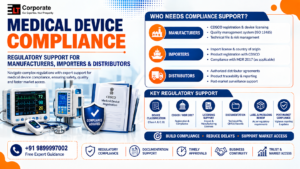
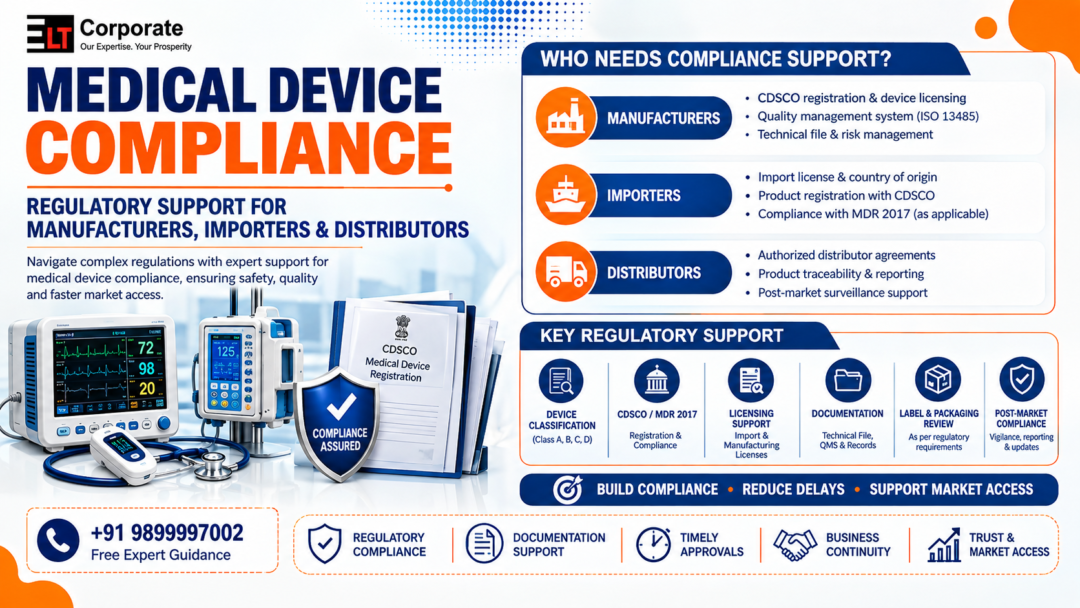
Compliance with medical devices in India is governed through the Medical Devices Rules, 2017, which are notified in the Drugs and Cosmetics Act, 1940, and supervised through the Central Drugs Standard Control Organisation (CDSCO). The rules categorize devices according to risk (Class A, B, C, D, and A) and require registration as well as licensing, quality control, and labeling requirements.
It’s crucial to take note of a major shift in recent times in the Legal Metrology (Packaged Commodities) Amendment Rules, 2025; medical device packaging was removed from all the rules of the Legal Metrology (Packaged Commodities) Rules in 2011. This means that declarations like MRP net quantity and details about the manufacturing process on labels for medical devices are now exclusively governed under rules of the Medical Devices Rules, 2017, and CDSCO’s labelling framework, not the millimetre-precision formatting guidelines that are in place for normal consumer packaged goods.
However, this does not eliminate regulatory complexity; it just shifts it. Companies must now ensure that their labeling is in line with CDSCO’s changing requirements and still manage larger legal metrology obligations that apply to their business operations in general, including import documents and NOCs for clearance through customs and all non-device-related packaged goods that are sold in conjunction with their medical product portfolio.
⚠️ Is Your Medical Device Labelling CDSCO-Compliant?
Avoid shipment holds, market withdrawal & penalties — talk to our regulatory experts today.
💬 WhatsApp Now 📅 Schedule Free Consultation 📞 Call Now: 9899997002Risk-Based Classification of Medical Devices
According to the Medical Devices Rules, 2017, every device that is notified falls under one of the four risk categories, which are in line with Global Harmonization Task Force (GHTF) principles. Your classification will determine the licensing authority and the appropriate form and the level of review your application is required.
- Classes A (Low Risk) Devices such as thermometers and tongue depressors. It is the responsibility of registration to be handled by the State Licensing Authority, typically using Form MD-17.
- Classes B (Low-Moderate Risk) devices such as suction needles and hypodermic needles. They are also under State Licensing Authority oversight, using the MD-17 form.
- Class C (Moderate-High Risk) devices such as dialysis or ventilator equipment. They are subject to Central Licensing Authority jurisdiction and typically require a manufacturing license through the MD-9 form.
- Class D (High Risk) devices, which support or sustain life span, for example, implantable devices and heart valves. They undergo the most rigorous Central Licensing Authority review, usually requiring a substantial amount of clinical evidence and, in the event that no device is available or is not available, new clinical data.
Imported devices regardless of class require an import permit under Form MD-15. This is processed by the CDSCO SUGAM portal. Making sure you have the right classification in the beginning is essential. A wrong classification could delay approval, trigger regulatory questions, or force you to restart your process entirely.
Documents Typically Required for CDSCO Registration
Although the exact requirements will vary based on the device class and manufacturing pathway, the majority of CDSCO applications need:
- Device Master File (DMF) detailing the design, intended use, and technical specifications
- Plant Master File (PMF) describing manufacturing facilities and quality systems
- ISO 13485 Quality Management System certification (mandatory for the majority of class B, C, and D devices, as well as for importers)
- FREE Sale Certification from your country of the country of (for devices that are imported)
- Test reports and risk analysis/biocompatibility data where applicable
- Illustrations for labels and guidelines to use, which include the required declarations in Indian languages
- Power of Attorney to appoint one Indian authorized agent (for manufacturers from overseas)
- Application form and cover letter (MD-3, MD-7, MD-14, or MD-15 depending on the route)
Our team assists in assembling and examining this documentation prior to it being submitted, thus reducing back-and-forth questions that can slow CDSCO approvals.
Step-by-Step Registration Process
- Classification confirmation—Check the risk class of your device against CDSCO’s lists of notified devices and Schedule I/III from the Medical Devices Rules, 2017.
- Documentation preparation—Compile documents such as the DMF, PMF, quality certifications, and labeling designs suitable to the class of your device.
- Application filing—Submit via the SUGAM portal, choosing the appropriate application form (MD-3/MD-7 for manufacturing MD-14 for import applications).
- Answer to queries—Resolve the clarifications or any additional proof required from CDSCO reviewers.
- Inspections of the site (where appropriate)—If applicable, for production facilities in Class C, D, and other, CDSCO or state authorities can conduct an audit of the facility.
- Approval and License—Receive your registration certificate (Form MD-17) or manufacturing/import license (Form MD-9/MD-15) after a successful exam.
- In-continuous compliance—Maintain quality systems, modify labels as regulations change, and renew licenses on the timeframes specified by law.
The timelines for each class differ. Class A and B applications typically are faster, whereas applications for Class C and D that require clinical evidence or site inspections may take longer. We assist in setting reasonable expectations and help ensure that your application is on the right course.
Risks of Non-Compliance
Operating without a valid CDSCO registration or without compliant labeling can have severe consequences:
- Import and customs hold—Shifts that are not accompanied by valid import permits or legal documents could be refused entry or refused at the port of entry.
- Market removal—Products that are non-compliant in the course of inspection could be taken off the shelves, thereby disrupting the distribution agreement and hospital contracts.
- The regulatory penalties—the Drugs and Cosmetics Act, 1940, along with the Medical Devices Rules, 2017—are the penalties for manufacturing, importing, or selling devices that are not licensed.
- Reputational damage—In a business that is founded on trust and security, a breach of compliance could affect the relationships between distributors and hospitals, as well as institutions far beyond the cost.
Given the frequency with which CDSCO changes labels and classification lists One-time checks are often not enough. Continuous monitoring is crucial.
What Our Medical Device Compliance Services Cover
- CDSCO Registration and Licensing—Support for device classification Sugam website registrations, as well as import or manufacturing licensing pursuant to the Medical Devices Rules, 2017.
- Labelling Compliance Review—Ensuring your device labels meet CDSCO’s mandatory particulars: manufacturer/importer details, batch number, manufacturing and expiry dates, storage conditions, and applicable warnings.
- Import Documentation and NOC Support—Assistance for customs clearances, import licenses, and the change to Legal Metrology (Packaged Commodities) format requirements for medical devices.
- Regulatory Gap Assessment—Reviewing your current packaging, documentation, and declarations against the latest CDSCO and Legal Metrology notifications to flag compliance gaps before an inspection does.
- Continuous Compliance Alert—Keep your business up to date in the event that CDSCO as well as the Department of Consumer Affairs continue to develop medical device regulations, ensuring that you’re never shocked by a new notice.
Who Needs This Service
- Medical device manufacturers are seeking CDSCO approval or renewing their CDSCO registration
- Importers and distributors bring medical devices to India
- E-commerce sellers listing medical devices requiring compliant declarations
- Companies that are transitioning their product labels to the Post-2025 framework for labeling that uses CDSCO.
- Companies who are subject to a metrology notice or CDSCO compliance notice in relation to the packaging of medical devices
Why Choose ELT Corporate
- PAN India Service—Assistance for importers and manufacturers across all states
- Dual Regulatory Expertise Experience in both the legal metrology and allied regulatory frameworks that impact the packaging of products
- Rapid, Transparent Process—Clear timelines and checklists of documentation No need to guess.
- Support for Dedicated Customers—A single contact person for the registration process, review of labels, and continuous monitoring of compliance
- Trusted by top brands We have years of experience serving both consumer and healthcare companies across India
⚠️ Is Your Medical Device Labelling CDSCO-Compliant?
Avoid shipment holds, market withdrawal & penalties — talk to our regulatory experts today.
💬 WhatsApp Now 📅 Schedule Free Consultation 📞 Call Now: 9899997002Frequently Asked Questions
Q1. Do medical devices need to conform to the legal metrology regulations in India?
With the amendment of 2025, specific formatting rules in the Legal Metrology (Packaged Commodities) Rules 2011 will no longer apply to medical device packaging. Labelling now is governed under the Medical Devices Rules, 2017, which are governed by CDSCO. Other legal metrology requirements, such as import documentation and customs NOCs, could remain in force based on the nature of your business.
Q2. What information is required to be on the label of a medical device?
The CDSCO-mandated information typically includes the name of the manufacturer and address along with the batch number or lot number as well as expiry and manufacturing dates (or shelf lives) as well as storage conditions and import license details for devices imported, in addition to other requirements based upon the device’s classification.
Q3. What is the time frame for CDSCO for the registration process to take?
Timelines differ based on the device’s classification and the completeness of the document. Our team assists you in preparing the most complete and accurate documentation to prevent delays.
Q4. Are stickers able to modify or correct labels for medical devices?
In accordance with CDSCO’s guidelines, the correction of labels must be done according to established procedures, not the ad hoc method of stickering. We ensure that all updates to labels are conforming.
Get Compliant, Stay Compliant
Medical device regulations in India are changing fast — don’t fall behind. Talk to our regulatory experts for a complete compliance review.
📅 Schedule Your Free Consultation 💬 WhatsApp Now 📞 Call: 9899997002