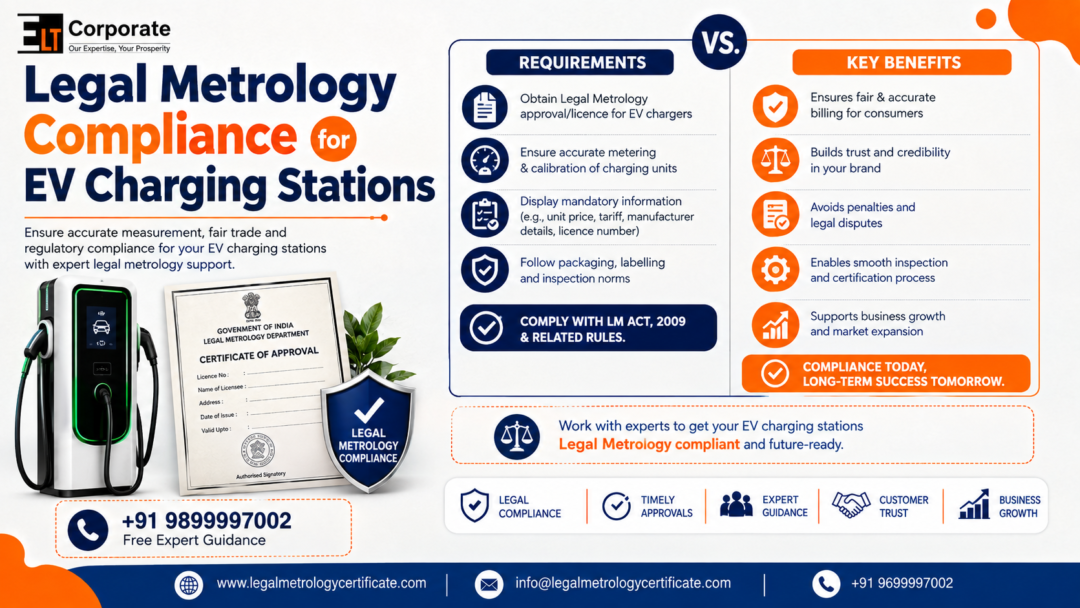
The revolution of electric vehicles in India is growing faster, and, as it does, an entirely new and unanswered compliance concern is emerging regarding charge point operators (CPOs) as well as mall owners, fleet owners, housing societies, mall developers, and highway plaza owners: is your charging station for electric vehicles legally metrology-compliant?
In contrast to weighing scales at the grocery store or dispensing units at a petrol station, the charging of electric vehicles is a new type of “sale by measure” in India. Since charging stations charge customers according to the amount of energy (kilowatt-hours) that they provide to them, the legality and accuracy of the meter used will directly determine whether the charge is legal, disputed, or penalizable. This guide explains precisely what metrology laws require of electric vehicle charging networks in India and the best way for operators to remain compliant as they expand their networks.
Need help with EV Charging Station Compliance? Our experts are just a click away.
WhatsApp Book Consultation Call NowWhy Legal Metrology Applies to EV Charging Stations
The Legal Metrology Act, 2009, was passed to ensure that every transaction that involves the sale of services or goods by weight measurement, measurement, or number is carried out using certified, exact, precise, and secure tools. If a charging point in public costs a consumer by the amount of electric power used (per kWh), this is, in essence, a measure-based sale and is no more different than an oil pump dispensing gasoline in liters or a storekeeper weighing rice using a scale.
The energy meter at the charging point is not just an electronic component. It is a legally enforceable measuring instrument, and its precision has direct consumer protection as well as revenue consequences. If the meter is overread, the consumer is charged. If it is underread, the operator will lose revenue, and disputes will increase. In any case, an uncertified or non-standard meter puts the owner at risk under regulatory regulations.
Although India is yet to have one specific, specialized “EV Charger Metrology Rules” notification that is comparable to the European Eichrecht framework The compliance requirement is based on a mix of frameworks that exist:
- The Legal Metrology Act, 2009, along with the Legal Metrology (General) Rules 2011, which govern stamping, verification, and accuracy of measurement instruments in commerce.
- Central Electricity Authority (CEA) regulations, including regulations, specifically the Installation and Operation of Meters Regulations that regulate the technical specifications for energy meters that are used to bill.
- Ministry of Power guidelines on public charging infrastructure (2022 and later revisions) that require the use of a meter that is tested and dedicated for each public charging station.
- Automotive Industry Standards (AIS-138 Parts 1 and 2) covering the safety and metering requirements of AC or DC chargers.
Compliance for any operator is a matter of ensuring that all four layers are satisfied and not just one.
Is Electricity a “Commodity” Under Legal Metrology?
One of the most frequent questions CPOs inquire about to determine if electricity, since it is intangible, is even within the remit of the Legal Metrology Act at all. The most important thing to remember in the real world is that the Act does restrict electricity’s use as a commodity. That is the subject of the Electricity Act, 2003, and CEA regulations. What metrology laws govern is the device used to determine the volume of that which is sold, i.e., an energy meter itself.
That is the thing that is (electricity) controlled by law governing the power sector, but the method of measuring and charging is based directly on the principles of legal metrology in terms of precision, verification, and fairness for consumers. This is important because it is the reason EV charging networks in India compliance requires companies to meet the requirements of both regulators for the electricity sector as well as the demands of metrology authorities in regard to the accuracy of meters, calibration, and traceability.
Need help with EV Charging Station Compliance? Our experts are just a click away.
WhatsApp Book Consultation Call NowMandatory Metering Requirements for Public Charging Stations
In accordance with the Ministry of Power guidelines for Public Charging Stations (PCS), each charging station is required to have a sub-meter or meter that records consumption with accuracy. Important requirements include:
- Tests that are accredited. The device must be examined by a certified laboratory prior to deployment, making sure that its accuracy level is within the standards required before it invoices a client.
- Conformity to the CEA’s Installation and Operating of Meters Regulations This is the foundational technical document that governs how energy meters should be installed and sealed. They must also be maintained.
- Separate metering arrangement Each PCS should have an individual metering arrangement that is distinct from the electrical supply to the building or property in order to make consumption and consequently billing identifiable and auditable.
- Sub-metering is permitted for existing connections to HT Distribution licensees to allow sub-metering for charging behind a high-tension connection, as long as the sub-meter is reliable and untamper-proof.
For businesses, this can translate into a straightforward compliance rule not to install a non-certified or uncertified meter simply because it’s less expensive or easier to locate. The price of a compliance issue, a consumer complaint, or a regulatory fine is far more than the savings that hardware can bring.
AIS-138: The Safety and Metering Standard for Charging Equipment
The Automotive Industry Standard AIS-138 is the most important technical standard for electric vehicle charging stations in India, divided into two components:
- The AIS-138 Part 1 is a guideline for AC charging stations, which addresses general safety and security standards, safety against electrical shocks, standard connectors, and metering requirements where applicable.
- AIS-138 Part 2 includes DC fast-charging stations. It also covers protocols for communication for the charging station and the vehicle standard connectors (such as GB/T and CCS2) and safety features.
Although AIS-138 is mostly an interoperability and safety norm instead of a legally enforceable metrology certificate, the compliance with it is now increasingly considered the standard for all operators who are seeking government tenders, corporate alliances, or fleet contracts. Charging equipment that incorporates an accurate, certified energy meter in AIS-138-compliant equipment gives the operator a legally enforceable conformity on safety and billing accuracy simultaneously.
Verification, Stamping, and Reverification Obligations
One of the least understood aspects of compliance with legal metrology is the continuous requirement. Verification isn’t just a one-off certificate that needs to be filed away; it is a continuous obligation.
According to the Legal Metrology (General) Rules in 2011, measuring devices that are used in trade are subject to periodic reverification, and any instrument used for measuring that has been removed or repaired and then reinstalled is required to be reverified prior to when it can be put back in commercial use. While the specific reverification procedure is for EV charge energy meters, which are controlled mostly by CEA and DISCOM metering frameworks, rather than a separate legal metrology notice, the fundamental principle is carried over: any meter used to bill customers must remain dependable all the time it is in use, not just at the time of installation.
Operators must incorporate the following into their operating checklists:
- Keep track of calibration and test results for each charging point meter.
- Re-test or update meters following the repair or relocation or change in firmware or hardware.
- Documents should be kept ready to be inspected by electricity inspectors, DISCOM auditors, or consumer affairs officers in the case of a dispute over billing.
- Avoid tampering with, bypassing, or even manually overriding the readings of meters at any time, since this is considered a serious crime in the law of electricity and metrology law.
Consumer Protection and Billing Transparency
A significant share of EV charging complaints in India relate not to the vehicle or the charger hardware, but to billing accuracy and transparency—customers questioning why a session cost more than expected or whether the units billed matched actual energy delivered. This is precisely in which the legal metrology rules safeguard both the user and the owner.
To keep a clear head of disputes, operators must ensure:
- The rate per kWh (per kWh) is clearly displayed at the charge point or in the app/interface for use in payment.
- The energy generated, as displayed on the bill or on the app, matches the reading of the meter, and there are no additional adjustments that can be made at a discretionary level.
- Additional charges (service fee, parking, service fee, or GST) are accounted for separately from the energy bill as a whole, and the “measured” component of the bill is separate and auditable.
- Redress mechanisms for grievances exist for customers who have a dispute with a session’s units billed.
Transparency isn’t only a good thing; it is the actual expression of what the law on legal metrology is intended to accomplish: fair, transparent trade that is not prone to dispute.
Need help with EV Charging Station Compliance? Our experts are just a click away.
WhatsApp Book Consultation Call NowCompliance Risks and Penalties Operators Should Know
Failure to comply with the metering and measurement field can result in serious consequences. In the context of the Legal Metrology Act, 2009, making use of an uncertified or non-standard measurement or weight—a classification that applies in principle to metering devices employed for billing—can result in fines, and in the case of repeated infractions, jail. In addition, failure to comply with CEA standards for metering and safety could result in the disconnection of grid connectivity approvals or the rejection of applications to build the development of a new infrastructure for charging.
When operators scale systems across different states, the burden of compliance is increased due to
- Legal metrology enforcement may differ according to state, with different requirements for inspections and expectations for documentation.
- DISCOM and CEA requirements are in sync with state electrical regulations that aren’t always the same.
- Equipment purchased from different vendors could have inconsistent certification documents, making audit trails difficult to maintain.
It’s exactly the kind of multi-layered cross-regulatory compliance problem where a planned, professionally managed approach can save operators from costly fines and reputational harm.
A Practical Compliance Checklist for EV Charging Station Operators
Before putting up a charging station, whether semi-public or public, in India the operators must confirm:
- The energy meter is verified by a laboratory that is accredited and meets the standards for accuracy class.
- The metering system is exclusively designed and is separate from the other consumption of a building or premises.
- Charging equipment is AIS-138 certified. Part 1 or Part 2 certification, if applicable.
- Installation was completed by a licensed electrician according to Indian Electricity Rules.
- Displays for billing are transparent and can be itemized and traceable to the official meter reading.
- Testing and calibration: The maintenance and calibration records are recorded and accessible to be inspected.
- Any repair or replacement will be followed up by reverification prior to beginning billing.
- NoCs that are required (fire security, DISCOM connection, and municipal authorizations for local municipalities) have been put in place along with meters that are in compliance.
Why Professional Compliance Support Matters
The infrastructure for charging EVs in India is situated between electric laws and standards for automotive vehicles, as well as legal metrology. Three regulatory streams that are not always in sync with one another in a unifying regulation book. For operators, this dispersed environment means that compliance can’t be viewed as a single checkbox when commissioning is completed; it is a continuous process of monitoring when standards change and state-level enforcement practices change and the infrastructure expands.
If you do this, it will cost you money—not only in fines, delays in approvals, disruption of operations, and the loss of trust among customers. If you do it correctly, however, it makes the operator an authentic, audit-ready partner for tenders from government agencies as well as corporate fleet contracts and long-term trust in consumers.
If you’re setting up, scaling, or auditing the EV charging networks in India and would like to know more about the legally binding metrology or metering obligations, a professional’s guidance will aid you to avoid costly errors and ensure that your business is audit-ready. Get in touch with a certified legal metrology expert prior to your next deployment to ensure that each charging point you install is analyzed, billed, and inspected in the correct way starting from the beginning.
⚠️ Is Your EV Charging Station Legally Compliant?
Avoid penalties, disconnection & compliance disputes — talk to our Legal Metrology experts today.
💬 WhatsApp Now 📅 Schedule Free Consultation 📞 Call Now: 9899997002Conclusion
The EV charging regulations with the laws of India have become more than an electrical engineering or safety issue. It is now an issue of legal metrology when the charging session is invoiced by the device. Operators who use their energy meters as authentic, verifiable instruments for trade rather than simply electrical fittings that are used for everyday use place themselves in front of audits, disputes, and even regulatory action.
As India’s charging infrastructure expands quickly across housing societies as well as commercial hubs, those who integrate transparency, accuracy, and verification into their metering strategies right from the start will be most well-positioned to compete in government-sponsored tenders, enterprise partnerships, and trust with consumers over the long term. This isn’t just an event that happens once; it’s a continual discipline. Getting expert guidance in the early stages is cheaper than resolving a problem later.
Frequently Asked Questions
Q1. Is a separate metrology license required for the operation of an electric vehicle charging facility in India?
There isn’t a separate “EV charging” license under the Legal Metrology Act at present. Compliance is based on ensuring the energy meter used to calculate billing is tested, accurate, certified, and installed according to CEA as well as Ministry of Power metering guidelines.
Q2. Can I use my existing building’s electric meter to bill customers who charge EVs?
If you want to charge at home, a separate meter isn’t necessary. For commercial or public charging stations that charge customers, a separate sub-meter or meter is required to ensure that consumption and billing are separate and easily auditable.
Q3. What happens when a charging station is using an uncertified or altered gauge?
The operator could be subject to sanctions pursuant to the Legal Metrology Act for unverified measuring instruments, in addition to possible action by the electricity distribution licensee, which could include denial or disconnection of access approvals for connecting.
Q4. Is AIS-138 certification the same thing as legitimate metrology verification?
No. Ais-138 is primarily concerned with safety, connector standards, and interoperability of AC/DC chargers. Legal metrology compliance also concerns the accuracy and authenticity of the accuracy of an energy meter that is used to bill. Operators usually require both.
Q5. What is the frequency at which EV charger station metering is updated?
There isn’t a single EV-specific cycle yet to be notified. Reverification is governed by CEA and DISCOM’s metering rules, and any meter that is replaced, repaired, or relocated must be retested prior to billing customers.
Need help with EV Charging Station Compliance? Our experts are just a click away.
WhatsApp Book Consultation Call Now