
Popup Form

Legal Metrology

Post-Registration Compliance & Amendments: What Packers / Manufacturers Must Do After Getting Registration
Legal Metrology

Post-Registration Compliance & Amendments: What Packers / Manufacturers Must Do After Getting Registration

Obtaining regulatory registration or licensing—whether under CDSCO, Legal Metrology, BIS, or other relevant frameworks—is a major milestone for any packer or producer. However, many corporations make a serious mistake: they treat registration because it is the last step rather than the beginning of ongoing compliance. In reality, post-registration compliance is what regulators pay the most attention to. Any negligence after approval can result in consequences, suspension, license cancellation, and even product confiscation. This website explains everything packers manufacturers need to do upon receiving registration, with compliance requirements, amendment procedures, and prudent strategies for staying fully compliant. Understanding Post-Registration Responsibility  Once the registration certificates are provided, your business is legally responsible for: Lack of compliance at this level can directly affect the operations of your marketplace. Label Compliance Maintenance  Even after approval, your product labels must always comply with new regulatory requirements. Avoid misleading claims or disclaimed statements For example: Failure to comply with labels is one of the most common causes of regulatory action. Record Keeping and Documentation  After registration, it is mandatory to keep correct data and frequently audited with the help of the authorities. You have to preserve: Authorities can deal with an additional inspection at any time, and lack of documentation can result in consequences or license suspension. Product Quality and Regulatory Compliance  Maintaining a consistent product exceptional isn’t optional—it’s far from a necessity of a crime. Moves required: For scientific instruments and cosmetics, compliance with requirements such as ISO 13485 and ISO 22716 is highly encouraged and often required. Handling Amendments in Registration  Businesses evolve, and changes are inevitable. However, any change related to your registration must be formally approved. Common amendments include: Important rule: You cannot implement major changes without prior approval from the authority. For example: Ignoring amendment requirements can make your existing license invalid. Renewal, Retention, and Validity Management  Most registrations are subject to validity conditions and require renewal or retention. Key compliance points: For example: A lapse in renewal can halt your business operations immediately. Inspection and Audit Preparedness Regulatory authorities such as the Central Drugs Standard Control Organization or the Department of Legal Metrology may also conduct inspections without prior notice. Get organized: Failed monitoring can have severe consequences, including suspension. Complaint Handling and Product Recall  Every registered entity must have a system for handling complaints and recalls. Mandatory requirements: This is especially critical in regulated sectors like medical devices and cosmetics. Legal Metrology Compliance for Packers  For packers managing pre-packaged goods, compliance under the Legal Measurements Act, 2009 continues even after registration. Key Responsibilities: Violations can result in fines, product confiscation, and prosecution. Common Mistakes to Avoid  Many businesses face regulatory issues due to avoidable mistakes: Avoiding these mistakes can save significant time, money, and legal trouble. Best Practices for Smooth Compliance  To ensure seamless post-registration compliance: A proactive approach is always better than reactive problem-solving. Conclusion Post-registration compliance is not just a criminal requirement—it is the backbone of sustainable commercial enterprise operations in regulated industries. Whether you’re a packer under Legal Metrology or a manufacturer under CDSCO regulations, the guarantee to stay in compliance: Businesses that proactively manage compliance and research not only avoid prison troubles but additionally take aggressive advantage within the marketplace.

Central vs State Registration for Packers / Manufacturers: When Is Central Registration Required?
Legal Metrology

Central vs State Registration for Packers / Manufacturers: When Is Central Registration Required?

Corporations concerned with packing, manufacturing, importing or distributing pre-packaged goods in India have to comply with the provisions of the Legal Metrology Act, 2009 and the Legal Metrology (Packaged Goods) Rules, 2011 One of the not uncommon compliance questions faced through companies is: Should I pursue for central registration or state registration? Understanding this distinction is essential to avoiding consequences, delays, or denials of applications. What is Registration under Legal Metrology? Any entity engaged in: must obtain registration under Legal Metrology before commencing operations. This registration ensures: State Registration: When Is It Applicable? State Registration is required when your operations are limited within a single state. You need State Registration if: Issuing Authority: State Legal Metrology Department Example: A Delhi-based company manufacturing and selling packaged food only within Delhi requires State Registration. Central Registration: When Is It Required? Central Registration becomes mandatory when your business has inter-state or import involvement. You need Central Registration if: 1. You are an Importer If you import pre-packaged commodities into India, Central Registration is compulsory. 2. You Operate in Multiple States If your business manufactures in one state and distributes across multiple states, Central Registration is required. 3. You Have Multiple Manufacturing or Packing Units Across India Businesses with pan-India operations must opt for Central Registration. 4. E-commerce or Nationwide Distribution If your products are sold across India (for example, through marketplaces like Amazon or Flipkart), Central Registration is advisable. Issuing Authority: Director of Legal Metrology under the Central Government Central vs State Registration: Key Differences Criteria State Registration Central Registration Area of Operation Single State Multiple States / Pan India Import Activity Not Allowed Mandatory for importers Authority State Government Central Government Business Scale Small / Local Medium to Large / Nationwide Compliance Complexity Lower Higher When Businesses Make Mistakes Many companies wrongly apply for State Registration when they actually require Central Registration. Common Errors: These mistakes can lead to: Label Compliance Still Mandatory Regardless of Central or State Registration, every packaged product must comply with labeling requirements such as: How to Decide the Right Registration? Ask yourself these questions: If your business is growing, it is often better to opt for Central Registration to avoid future amendments. Why Choosing the Right Registration Matters Selecting the correct registration: Pro Tip for Businesses Adopting a comprehensive and forward-looking scope in licensing will: Strengthen regulatory compliance, minimize administrative burden, and enable smooth scalability of operations. How ELT Corporate Can Help At ELT Corporate, we provide end-to-end support for: We ensure your business is fully compliant from day one, allowing you to focus on growth while we manage regulatory requirements. Conclusion Understanding the difference between Central and State Registration is essential for any business dealing with packaged commodities in India. If your business involves inter-state operations, imports, or expansion plans, Central Registration is not just a requirement but a strategic decision.

Rule 27 Explained: Understanding Packer & Manufacturer Registration under LMPC
Legal Metrology

Rule 27 Explained: Understanding Packer & Manufacturer Registration under LMPC

In today’s buyer-pushed market, transparency and accuracy in product labeling are not just precise practices—they are legal requirements. The Legal Metrology Framework in India guarantees that goods offered using weights, measures or numbers are properly standardized and classified. An important provision in this framework is Regulation 27, which governs the registration of manufacturers and packers. This blog breaks down Rule 27 in simple terms—what it is far from, who it applies to, and why it matters to organizations. What is LMPC? LMPC (Legal Metrology Packaged Commodities) refers to regulations under the Legal Metrology Act, 2009, and the Packaged Commodities Rules, 2011. These rules ensure that consumers receive accurate information about packaged goods—such as quantity, price, manufacturer details, and more. What is Rule 27? Rule 27 of the Legal Metrology (Packaged Commodities) Rules, 2011 mandates that: Every manufacturer, packer and importer of pre-packaged goods must be registered with the Director or Controller of Legal Metrology. This registry is commonly referred to as the LMPC registry. Who Needs to Register Under Rule 27? If your business falls into any of the following categories, Rule 27 applies to you: 1. Manufacturers Entities that produce goods and package them for sale. 2. Packers Businesses that package goods (even if they didn’t manufacture them). 3. Importers Companies importing pre-packaged goods into India. Even e-commerce sellers or private label brands may require registration if they qualify as packers. Why is Rule 27 Important? Rule 27 serves several important purposes: Key Requirements Under Rule 27 To comply with Rule 27, businesses must: Submit an application to the Legal Metrology Department. Including: Once approved, a Registration Certificate is issued. Documents Required Typically, you’ll need: Validity and Renewal Penalties for Non-Compliance Failure to comply with Rule 27 can result in: Common Mistakes to Avoid Practical Example Let’s say you run a brand that sources products from a third-party manufacturer and sells them under your label. Even if you did not manufacture the product, you are considered a packer or marketer, and Rule 27 applies to you. Final Thoughts Rule 27 may seem like just another compliance requirement, but it plays a vital role in building consumer trust and ensuring fair trade practices. For businesses, obtaining LMPC registration is not just about avoiding penalties—it is about operating responsibly and transparently. If you are dealing with packaged goods in India, understanding and complying with Rule 27 is essential for long-term success.

Consequences & Penalties of Operating with an Expired Weighing Machine License in India
Legal Metrology

Consequences & Penalties of Operating with an Expired Weighing Machine License in India

Running a business that uses weighing and measuring instruments without a valid license is not just a minor compliance issue—it is a serious legal violation under the Legal Metrology framework in India. Many businesses ignore license renewals for weighing machines (such as platform scales, weighbridges, and retail scales), assuming it is a small procedural lapse. In reality, this can lead to heavy penalties, seizure of equipment, and even prosecution. If your weighing machine license has expired—or is about to—this guide explains the consequences and how to avoid them. What is a Weighing Machine License? Under the Legal Metrology Act, 2009, any business involved in: must obtain a valid license from the Legal Metrology Department. Additionally, all weighing instruments must be: What Happens When Your License Expires? Once your license expires: Even if the machine is technically accurate, legal validity is mandatory. Major Consequences of Operating with an Expired License 1. Monetary Penalties Operating with an expired license can attract fines under Legal Metrology laws. Penalties may range from ₹2,000 to ₹50,000 or more depending on the nature of the violation. 2. Seizure of Weighing Equipment Authorities have the power to: This can immediately halt business operations. 3. Business Disruption If weighing equipment is seized: This leads to direct revenue loss and operational downtime. 4. Legal Action and Prosecution Repeated violations or intentional non-compliance may result in: This is particularly critical for manufacturers, importers, and large-scale businesses. 5. Loss of Customer Trust Using an unverified or expired weighing machine can: In sectors such as retail, pharmaceuticals, and manufacturing, trust is essential. 6. Impact on Other Compliance Requirements Non-compliance under Legal Metrology may affect: A single lapse can lead to multiple compliance issues. Applicable Legal Provisions Under the Legal Metrology Act, 2009 and related rules: Authorities frequently conduct inspections in: How to Avoid These Penalties 1. Track License Expiry Dates Maintain a compliance calendar for: 2. Renew License Before Expiry Apply for renewal at least 30–60 days before the expiry date. 3. Ensure Regular Verification Make sure all machines are: 4. Maintain Proper Documentation Keep the following records readily available: 5. Seek Professional Compliance Support Managing Legal Metrology compliance can be complex, especially for: Professional support helps ensure complete compliance and avoids penalties. Practical Example A retail chain operating across multiple cities failed to renew weighing machine licenses in several outlets. As a result: The financial loss far exceeded the cost of timely renewal. Why Businesses Delay Renewal Common reasons include: However, authorities treat such lapses as serious violations. Conclusion Operating with an expired weighing machine license carries significant legal and operational risks. The consequences extend beyond penalties to include business disruption, reputational damage, and potential legal action. Maintaining compliance is not optional—it is essential for smooth business operations.

When & How to Amend Your Weighing Machine License During Renewal
Legal Metrology

When & How to Amend Your Weighing Machine License During Renewal

In India, businesses dealing with weighing and measuring instruments must comply with the Legal Metrology Act, 2009 and related state regulations. Whether you are a manufacturer, dealer or repairer of weighing machines, maintaining a valid license is essential. However, many businesses face confusion when changes occur—such as address updates, additional products, or ownership changes – especially during license renewal periods. This guide explains when and how to amend your weighing machine license during renewal, helping you avoid penalties, delays and compliance risks. What is a Weighing Machine License? A weighing machine license is issued under Legal Metrology for businesses involved in: These licenses are typically valid for 1–5 years, depending on the state, and must be renewed before expiry. When Do You Need to Amend Your License? Amendments are required when there are material changes in your business. Common scenarios include: 1. Change in Business Address If your office, warehouse, or manufacturing unit shifts, you must update the license. 2. Addition of New Weighing Instruments If you start dealing with additional categories (e.g., electronic scales, weighbridges), amendment is mandatory. 3. Change in Ownership or Constitution 4. Change in Trade Name or Brand If your business name changes, it must reflect on the license. 5. Expansion to New Locations Operating in multiple states or districts requires license modification or additional licensing. Why Amend During Renewal? While amendments can be done anytime, doing it during renewal is strategic: Important Tip: Authorities often scrutinize renewal applications more strictly—so keeping data updated is critical.\ Step-by-Step Process to Amend License During Renewal Step 1: Identify Required Amendments Prepare a list of changes such as: Step 2: Prepare Documentation Typical documents include: Step 3: File Renewal + Amendment Application You need to: Step 4: Pay Government Fees Fees depend on: Step 5: Inspection (If Required) Authorities may conduct: Step 6: Approval & Updated License Issuance Common Mistakes to Avoid Not updating address before renewalMissing supporting documentsApplying after license expiryIgnoring state-specific rulesIncorrect product classification These mistakes can lead to rejection or penalties under Legal Metrology. Penalties for Non-Compliance Failure to amend your license can result in: State-Specific Considerations Each state (Delhi, Maharashtra, Gujarat, etc.) may have:  It is advisable to consult experts familiar with your state’s Legal Metrology Department. How ELT Corporate Can Help At ELT Corporate, we provide end-to-end Legal Metrology compliance support, including: Conclusion Amending your weighing machine license during renewal is not just a compliance requirement—it’s a strategic opportunity to update your business legally and avoid future risks.By combining amendment with renewal, you can save time, reduce costs, and ensure smooth operations without regulatory interruptions.

Legal Metrology

Why is Legal Metrology Registration in India Essential for Your Business? 

Operating a business that deals with pre-packaged goods or measuring instruments in India means navigating various regulations. Among these, Legal Metrology Registration in India stands as a critical requirement. It ensures fair trade practices and protects consumer interests, making it a cornerstone of compliant business operations.  This comprehensive guide will walk you through everything you need to know about Legal Metrology registration. We’ll cover who needs it, the benefits, the required documents, the step-by-step process, and crucial updates for 2026. Understanding these requirements is vital for smooth business operations and avoiding penalties.  What is Legal Metrology Registration and Who Needs It?  Legal Metrology refers to the legal requirements concerning units of measurements, methods, and measuring instruments. In India, it is governed by the Legal Metrology Act, 2009, and the Legal Metrology (Packaged Commodities) Rules, 2011. This framework ensures accuracy in weight, measure, and number in all commercial transactions.  If your business engages in any of the following activities, you likely need a Legal Metrology registration:  Essentially, any entity that sells products by weight, measure, or number, or uses weighing and measuring instruments for commercial purposes, must comply. This covers a broad spectrum of industries, from FMCG to medical devices and industrial equipment.  Benefits and Importance of Legal Metrology Compliance  Complying with Legal Metrology regulations offers numerous advantages beyond simply avoiding penalties. It builds a strong foundation for your business operations and market standing.  Required Documents/Prerequisites for Legal Metrology Registration  The specific documents needed depend on whether you are a manufacturer, importer, or packer. However, some documents are common across all categories. Always ensure your documents are current and accurately reflect your business details. For Manufacturers/Packers:  For Importers:  General Documents (Common to All):  It is crucial to have all documents readily available and correctly filled out. Incomplete applications are a common reason for delays.  Validity of Legal Metrology Registration and Licenses The validity period for Legal Metrology registrations and licenses varies depending on the type and the issuing authority. Generally, these registrations are not permanent and require periodic renewal.  Always keep track of your validity dates. Renewing on time is essential to avoid business disruption and potential penalties.  Process for Legal Metrology Registration in India: A Step by-Step Guide  The registration process involves several stages, from preparation to submission and final approval. While specifics might vary slightly by state, the core steps remain consistent.  Step 1: Preparation and Document Collection  Begin by identifying which type of registration applies to your business (manufacturer, importer, or packer). Gather all the necessary documents as listed above. Ensure all details are accurate and that documents are properly attested if required. This preliminary step saves significant time later.  Step 2: Application Filing  Applications are generally filed online through the respective state’s Legal Metrology portal or the central lm.doca.gov.in or eMaap system for certain approvals. You will need to fill out the appropriate application form (e.g., Form LM-A for manufacturers/packers, Form LM-I for importers). Carefully input all required information into the online portal. Upload scanned copies of your supporting documents. Accuracy is key at this stage to prevent rejections.  Step 3: Fee Payment  Once the application form is complete, you will be directed to pay the prescribed registration fee. Fees can vary by state and the type of registration. This payment is typically made online through secure payment gateways. Keep a record of your payment transaction.  Step 4: Submission and Verification  After successful submission, the application moves to the Legal Metrology Department for scrutiny. Officials will review your documents and application details. They may conduct a physical inspection of your manufacturing or packing unit, or your storage premises, to verify compliance.  Be prepared to answer any queries or provide additional documents if requested during this verification phase. Prompt responses can expedite the process.  Step 5: Approval and Certificate Issuance  Upon successful verification and satisfaction of all requirements, the Legal Metrology Department will approve your application. They will then issue the relevant registration certificate or license. This certificate is your official proof of compliance.  Make sure to download and securely store your certificate. Display it prominently at your business premises as required by law.  Step 6: Post-Registration Compliance and Renewal  Registration is not a one-time event. You must continuously adhere to Legal Metrology rules, including proper labeling, maintenance of weights and measures, and timely renewal of your registration. Set reminders for renewal dates to avoid any lapse in compliance.  Common Mistakes to Avoid in Legal Metrology Registration  Navigating the registration process can be tricky, and several common errors can lead to delays or rejections. Being aware of these pitfalls can help you ensure a smooth application. What Happens If You Ignore Legal Metrology Regulations?  Ignoring Legal Metrology compliance can have severe consequences for your business. The penalties are designed to deter non-compliance and protect consumers from unfair practices.  These consequences highlight why proactive compliance is not just a legal obligation but a strategic business decision. It safeguards your operations, finances, and reputation.  Cost Involved in Legal Metrology Registration  The cost for Legal Metrology registration varies based on several factors, including the type of registration (manufacturer, importer, packer), the number of products/models, and the state where you are applying. It generally involves official government fees and potentially professional service charges.  Here’s a rough breakdown of potential costs:  Expense Type  Approximate Cost Range (INR) Official Application Fee (initial)  ₹500 – ₹5,000 Renewal Fee (per year/multi-year)  ₹100 – ₹2,000 per year Model Approval Fee (if applicable)  ₹2,000 – ₹10,000+ Professional Consultation/Service Fee ₹10,000 – ₹50,000+ (depending on complexity and services) Label Designing/Compliance Audit  Variable (depends on service provider) Penalty for Late Renewal/Application  ₹1,000 – ₹5,000+ (per instance) Please note that these figures are approximate and can change. State governments often have different fee structures. Engaging a professional service can add to the cost, but it can also save you time, prevent errors, and avoid expensive penalties in the long run.  How ELT Corporate Pvt. Ltd. Can Help You Navigating the complexities of Legal Metrology Registration in India can be daunting, especially

Legal Metrology

Legal Metrology Labelling Requirements: Common Packaging Mistakes That Lead to Product Seizure

In the bustling Indian market, every packaged product tells a story. But beyond attractive branding, that story must also speak the language of compliance. For manufacturers, packers, and importers, understanding legal metrology labelling requirements is not just a regulatory hurdle; it’s a critical aspect of doing business.  The Legal Metrology Act, 2009, and the Legal Metrology (Packaged Commodities) Rules, 2011 (LMPC Rules), are designed to protect consumers and ensure fair trade practices. These laws dictate exactly what information must appear on pre-packaged goods, how it should be displayed, and what happens if you get it wrong. Ignoring these rules can lead to serious consequences, including product seizure and hefty fines.  This comprehensive guide will help you understand the crucial aspects of compliant packaging. We will cover common mistakes, the necessary steps for registration, and what can happen if you overlook these vital regulations. Our aim is to equip you with the knowledge to safeguard your products and your business.  Why Adhering to Legal Metrology Labelling Requirements Matters? Compliance with legal metrology rules offers numerous advantages beyond simply avoiding penalties. It builds a foundation of trust and efficiency for your business operations. Proper labelling ensures transparency and fairness in the marketplace.  Required Documents and Prerequisites for Compliance  Before you can ensure your labels are compliant, you often need to register your business under the Legal Metrology framework. The specific documents depend on whether you are a manufacturer, packer, or importer.  For Manufacturer/Packer Registration:  For Importer Registration (LMPC Certificate):  Importers of pre-packaged goods must obtain an LMPC registration, which is mandatory before importing products into India.  Validity of Legal Metrology Registrations and Declarations  The Process: Step-by-Step Procedure for Legal Metrology Compliance  Ensuring compliance can seem complex, but breaking it down into manageable steps makes it easier to follow. Here’s a practical approach to align with legal metrology labelling requirements.  1. Understand the Rules: Begin by thoroughly studying the Legal Metrology Act, 2009, and the Legal Metrology (Packaged Commodities) Rules, 2011. Pay attention to any recent amendments, such as the 2025-2026 updates, which can impact specific products or declarations.  2. Identify Applicability: Determine your role in the supply chain. Are you primarily a manufacturer, a packer, or an importer of pre-packaged goods? Your role dictates which specific registrations and rules apply to you.  3. Complete Registration: If required, apply for the necessary registration with the Legal Metrology Department. This involves submitting all prerequisite documents. For importers, securing an LMPC certificate is a critical initial step.  4. Design and Review Labels: Create your product labels to include all mandatory declarations. These include the name and address of the  manufacturer/packer/importer, net quantity, Maximum Retail Price (MRP inclusive of all taxes), month and year of manufacture/packing, and customer care details. For imported goods, the country of origin is also mandatory. Ensure font sizes, legibility, and placement meet the prescribed standards.  5. Implement Quality Control: Integrate label accuracy checks into your manufacturing and packaging processes. This ensures that every product leaving your facility adheres to the approved label design and contains correct information. Regular audits help catch errors early.  6. Maintain Records: Keep meticulous records of all registration documents, approved label artworks, and any internal compliance audits. This documentation is vital during inspections or in case of any query from regulatory authorities.  7. Stay Updated: Legal metrology rules are subject to amendments. Regularly monitor official government notifications and industry updates to ensure your practices remain compliant with the latest regulations.  Common Mistakes to Avoid That Lead to Product Seizure  Even small oversights in packaging can lead to significant penalties and product seizure. Here’s a checklist of common mistakes to actively avoid: What Happens If You Ignore It? Risks and Consequences  Disregarding legal metrology labelling requirements carries serious repercussions for businesses. The consequences extend beyond mere financial penalties, impacting reputation and operational continuity.  The most direct consequence is product seizure. Legal Metrology officers have the authority to seize entire batches of non-compliant products found at manufacturing units, warehouses, retail outlets, or even at customs ports for imported goods. This leads to immediate loss of inventory and significant operational disruptions.  Beyond seizure, businesses face substantial fines and penalties. For a first offence, the penalty might range from INR 2,000 to INR 25,000. However, subsequent offences or more severe violations can attract fines of up to INR 1,00,000 and even imprisonment for key personnel. The labeling violations penalties` can escalate quickly.  Ignoring these rules also leads to business disruption. Products might be held at customs, delaying market entry. This can lead to missed sales opportunities and disgruntled customers. The entire supply chain can grind to a halt due to a labelling issue.  Furthermore, non-compliance can severely damage your brand reputation. Publicized seizures or fines can erode consumer trust, making it difficult to regain market share. In severe cases, individual directors or key management personnel can be held personally liable under Section 49 of the Legal Metrology Act, 2009, leading to legal action.  The Cost Involved: A Breakdown of Official and Service Charges  Understanding the financial implications of compliance is crucial for budgeting and decision making. The costs include official fees, professional services, and the potential impact of non-compliance.  Here is a rough range of costs associated with legal metrology compliance in India: Item/Service  Rough Cost Range (INR) Legal Metrology Manufacturer/Packer Registration  5,000 – 20,000 Legal Metrology Importer (LMPC) Registration  10,000 – 50,000 Professional Consultation/Legal Advisory  15,000 – 75,000+ Label Design Review & Compliance Check  5,000 – 25,000 Penalties for First Offence (Minor Violations)  2,000 – 25,000 Penalties for Subsequent Offence/Major Violations  10,000 – 1,00,000+ Product Seizure (Economic Loss)  Varies, potentially 100% product value These figures are indicative and can vary based on the complexity of your products, the state where registration is sought, and the consulting firm engaged. The cost of non compliance, particularly product seizure, can far outweigh the cost of proactive compliance measures.  How ELT Corporate Pvt. Ltd. Can Help You  Navigating the intricate landscape of legal metrology labelling requirements can be challenging. This is especially true for

Legal Metrology

Legal Metrology for Franchise and Chain Stores: Who Is Responsible – Brand or Outlet Owner?

When it comes to legal metrology for franchise brands and chain stores in India, who truly holds the responsibility—the brand owner or the individual outlet owner? This question is crucial for manufacturers, importers, and packers supplying these growing networks. Navigating the Legal Metrology Act, 2009, and the Packaged Commodities Rules, 2011, can be complex, especially with recent amendments. This guide will clarify the roles, highlight key compliance needs, and offer practical strategies. Our goal is to help your business operate smoothly, avoid penalties, and maintain a strong reputation within the franchise ecosystem. Understanding these obligations is key to scalable growth and consumer trust.  Why Legal Metrology Matters for Franchise Brands  Compliance with legal metrology regulations goes beyond simply avoiding fines. It ensures fair trade practices across all your franchise outlets, guaranteeing consistent product quality and quantity for consumers. This consistency builds trust in your brand, which is vital for any franchise’s success. For manufacturers, importers, and packers, proper compliance at the source protects the entire supply chain. It prevents issues from arising at the retail level. Adhering to these laws also fosters a reputation for integrity and operational excellence. This can attract more franchise partners and customers.  Required Documents & Prerequisites for Compliance  Below, we mentioned required Documents for Legal Metrology Validity of Legal Metrology Registrations  Most legal metrology registrations and licenses, such as those for manufacturers, importers, or packers, are typically valid for a period of one to five years. Instrument verification certificates usually require annual renewal. It’s essential to track these expiry dates carefully to ensure continuous compliance and avoid last-minute issues.  The Compliance Process: Step-by-Step for Suppliers  Ensuring legal metrology compliance for franchise brands involves several steps for manufacturers, importers, and packers. Following a clear procedure minimizes errors and ensures all legal bases are covered. Common Mistakes to Avoid in Franchise Metrology Compliance  Avoiding common pitfalls can save significant time and money for your manufacturing, import, or packing business. These errors often lead to fines and reputational damage. Checklist for avoiding mistakes:  What Happens If You Ignore It?  Ignoring legal metrology compliance can lead to severe consequences. Non-compliance can result in substantial financial penalties for manufacturers, importers, and packers. Fines can range from a few thousand to several lakhs of rupees. Repeated violations may even lead to imprisonment for responsible persons. Products found non-compliant can be seized, leading  to significant financial losses and supply chain disruptions. Most importantly, it can severely damage your brand’s reputation and consumer trust.  The Cost Involved  The costs associated with legal metrology compliance are varied, covering official fees and professional service charges. These are rough estimates and can change based on the complexity of your operations.  Service/Registration Type  Approximate Cost Range (INR) LMPC Manufacturer/Packer Registration  ₹5,000 – ₹25,000 LMPC Importer Registration  ₹10,000 – ₹50,000 Annual Instrument Verification  ₹500 – ₹5,000 per instrument Model Approval  ₹20,000 – ₹1,00,000+ Consultancy/Compliance Services  Variable, based on scope How ELT Corporate Pvt. Ltd. Can Help You  Navigating the intricacies of legal metrology for franchise brands can be challenging, especially for manufacturers, importers, and packers. ELT Corporate Pvt. Ltd. offers comprehensive support to ensure your business remains fully compliant. We assist with initial registrations, including LMPC for manufacturers, importers, and packers. Our team helps you understand the latest amendments and ensure correct labeling and packaging declarations. We also guide you through instrument verification and model approval processes. Partner with ELT Corporate Pvt. Ltd. to streamline your compliance, mitigate risks, and focus on your business growth with confidence.  Conclusion  Understanding who is responsible for legal metrology within a franchise or chain store model is vital for any manufacturer, importer, or packer. While day-to-day compliance often rests with the outlet owner, the brand owner, and by extension, its suppliers, bear significant responsibility for initial product compliance and overall standards. Proactive compliance is not just a legal obligation; it is a strategic advantage. It protects your brand, builds consumer trust, and ensures sustainable growth across your franchise network.  FAQs  Who is responsible for Legal Metrology compliance in a franchise?  Responsibility is often shared. The brand owner (franchisor) sets standards and handles initial product registrations like LMPC. The outlet owner (franchisee) ensures daily operational compliance, such as instrument verification and correct display of packaged goods.  What specific LMPC requirements apply to suppliers for franchise brands?  Suppliers, as manufacturers, importers, or packers, must obtain LMPC registration for pre packaged goods. They must ensure accurate labeling with mandatory declarations like net quantity and MRP. Compliance with multi-state registration is crucial for wider distribution.  How do recent Legal Metrology amendments affect franchise operations?  Recent amendments, including those for QR codes and e-codes, impact labeling and declarations. They necessitate updates to packaging information and internal processes. Staying current helps manufacturers, importers, and packers avoid non-compliance issues.  What are the risks if a franchise outlet violates metrology standards?  If an outlet violates standards, the brand owner can face reputational damage and indirect liability. The manufacturer, importer, or packer might also be implicated if the non-compliance originates from their product. This could lead to fines, seizures, and legal action.  How can manufacturers ensure consistent compliance across all franchise outlets they supply?  Manufacturers can ensure consistency by providing compliant products with accurate labels. They should also recommend that brand owners establish clear operational guidelines and conduct regular audits for franchisees. Partnering with compliance experts like ELT Corporate Pvt. Ltd. is also beneficial.

Legal Metrology

LMPC Registration Documents: Exact Document List Most Businesses Miss During Application

Are you a manufacturer, importer, or packer dealing with pre-packaged goods in India? If so, Legal Metrology Packaged Commodities (LMPC) registration is not just a formality; it’s a legal necessity. Many businesses find the application process confusing, often missing crucial documents. This can lead to costly delays, penalties, or even rejection.  This article provides an exact, actionable list of LMPC registration documents required. We highlight the specific papers often overlooked by businesses, ensuring your application is complete and compliant the first time. Prepare to streamline your LMPC journey.  Why LMPC Registration is Non-Negotiable?  LMPC registration, governed by the Legal Metrology Act, 2009 and the Packaged Commodities Rules, 2011, ensures fair trade practices and consumer protection. It mandates accurate weight, measure, and count for all pre-packaged commodities. This compliance builds consumer trust and avoids legal disputes.  Securing LMPC registration is crucial for smooth business operations. It helps you avoid significant penalties and prevents product seizure or customs delays. Ultimately, it allows your products to move freely in the market, domestically and internationally.  LMPC Registration Documents Required: The Comprehensive List  Gathering the correct papers is the most critical step. Here’s a detailed list, including those often missed:  1. Business Entity & Statutory Proof  2. Applicant/Authorized Person KYC  3. Business Premises Proof  4. Product-Specific & Operational Documents (Often Missed)  Ensure that all documents are current and reflect consistent information across the board. Inconsistencies can trigger application rejections.  Validity of LMPC Registration  An LMPC registration is typically granted for a period of one to five years. The validity period depends on the state and the type of registration. It is crucial to monitor this validity to ensure timely renewal and continuous compliance, avoiding any lapse in legal authorization.  LMPC Registration Process: A Simple Overview The LMPC registration process generally involves these steps:  Common Mistakes to Avoid During Application Avoid these frequent errors to ensure a smooth application:  What Happens If You Ignore LMPC Registration?  Non-compliance with LMPC regulations carries serious consequences. Businesses operating without valid registration face significant legal and financial repercussions. Penalties can range from hefty fines to imprisonment for repeat offenders, as per the Legal Metrology Act, 2009.  For importers, non-compliance can lead to customs delays, detention, or even confiscation of goods. This causes severe disruptions to your supply chain and financial losses. Ignoring LMPC registration risks your business reputation and legal standing in the market.  The Cost Involved  The cost for LMPC registration typically includes government fees and professional consultation charges. Government fees are generally nominal, while professional charges vary based on the complexity of your business and product range. Expense Type  Rough Range (INR) Government Application Fees  ₹500 – ₹1,000 Professional Consultation Fees  ₹5,000 – ₹25,000+ How ELT Corporate Pvt. Ltd. Can Help You  Navigating the complexities of LMPC registration can be daunting. ELT Corporate Pvt. Ltd. offers expert guidance and support to simplify your compliance journey. Our team ensures that you have the exact document list, prepared correctly, for a seamless application process.  We assist manufacturers, importers, and packers across India, including major hubs like Delhi, Mumbai, Chennai, and Bengaluru. From initial documentation to final submission, ELT Corporate Pvt. Ltd. handles every step, helping you avoid common pitfalls and secure your LMPC registration efficiently. Let us be your trusted partner in compliance.  Secure Your Compliance, Avoid the Delays  LMPC registration is a critical aspect of doing business in India. By meticulously preparing the exact documents required and understanding the nuances, you can avoid common pitfalls. This ensures a smoother application process and continuous legal compliance for your pre-packaged goods.  Don’t let incomplete paperwork halt your business. Take proactive steps to gather all necessary documentation, including those often missed. For expert assistance, consider reaching out to professionals who can guide you through every stage of your LMPC registration.  FAQs What documents are required for LMPC registration in India?  You need business entity proof (e.g., Certificate of Incorporation, GST, IEC), authorized person’s KYC (PAN, Aadhaar), business premises proof, and specific product details. Crucial, often-missed documents include affidavits for import goods and consumer care details.  Is LMPC registration mandatory for importers of pre-packaged goods?  Yes, under Rule 27 of the Legal Metrology (Packaged Commodities) Rules, 2011, LMPC registration is mandatory for all importers of pre-packaged goods into India. Delaying it can lead to customs detention, fines, or even product seizure.  What is the step-by-step process for obtaining an LMPC certificate?  The process involves preparing all documents, submitting the application online or offline to the State Legal Metrology Department, undergoing verification which might include an inspection, and finally receiving your LMPC certificate upon approval.  Who is eligible for LMPC registration—importers, manufacturers, or packers?  All entities involved in importing, manufacturing, or packing pre-packaged commodities for sale in India are required to obtain LMPC registration. This ensures proper weights, measures, and labeling for consumer protection.  How can I ensure my LMPC application is approved on the first attempt?  To ensure first-attempt approval, provide a complete and accurate set of documents, including all affidavits and state-specific proofs. Verify consistency across all details and ensure your product labels comply with LMPC rules.

Legal Metrology

LMPC Requirements for Packaged Food Products: Labelling, MRP and Net Quantity Explained

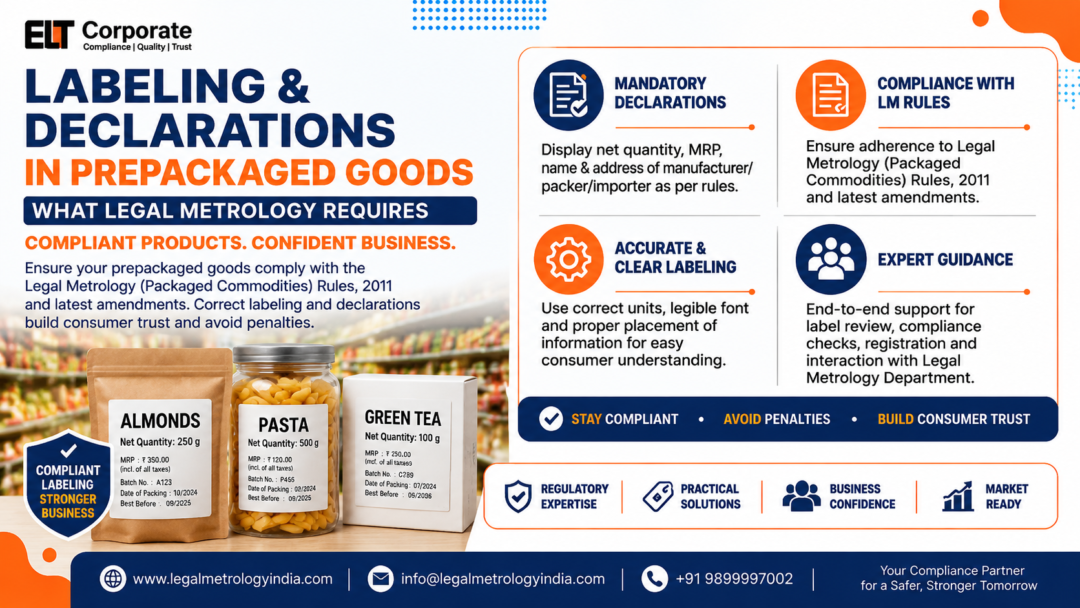
Navigating the world of packaged food products in India requires understanding several regulations. Among the most crucial is the Legal Metrology (Packaged Commodities) Rules, 2011, often called LMPC. These rules ensure fair trade practices and protect consumers by mandating clear and accurate information on product labels.For anyone involved in manufacturing, importing, or packing food products, LMPC compliance is non-negotiable. It’s not just about avoiding penalties; it’s about building trust with your customers and ensuring your business operates smoothly within the law. This guide will simplify the LMPC requirements, focusing on essential aspects like labeling, Maximum Retail Price (MRP), and net quantity declarations.  Understanding LMPC for Packaged Food Products  What exactly is LMPC, and why is it so important for the food industry? The Legal Metrology Act, 2009, and its accompanying Packaged Commodities Rules, 2011, govern all pre- packaged commodities sold in India. This framework ensures that consumers receive accurate information about the quantity and price of products they buy. For food items, this means every packet, bottle, or container must display specific details precisely. This includes anything from a bag of chips to a carton of juice or a jar of spices. Adhering to these rules helps prevent unfair trade practices and gives consumers confidence in their purchases.  Key Elements of LMPC Compliance for Food Labeling  The LMPC rules mandate several declarations on every pre-packaged food item. Getting these right is vital for compliance.  1. Net Quantity Declaration: This is perhaps the most fundamental requirement. You must declare the exact quantity of the product inside the package, whether by weight, volume, or number. For solids, use weight (grams, kilograms); for liquids, use volume (milliliters, liters). Semi-solids might use either, depending on their nature. It’s crucial to account for permissible errors and tolerances, which vary by product type, ensuring your declared quantity is within acceptable limits. Always use the standard International System of Units (SI Units). 2. Maximum Retail Price (MRP): Every packaged food item must clearly state its MRP, inclusive of all taxes. This declaration ensures price uniformity across retailers and prevents overcharging. If you sell combo packs, the MRP for the entire combo must be declared, not just individual items. Any re-packaging or re-labeling also requires careful recalculation and re-declaration of MRP. 3. Name & Address of Manufacturer/Packer/Importer: Transparency is key. For domestically produced goods, the name and complete address of the manufacturer or packer are mandatory. For imported food products, the importer’s name and address, along along with the country of origin, must be clearly displayed. This helps trace the product back to its source. 4. Date of Manufacture/Packing/Import: This date is crucial for consumers to assess product freshness and for regulatory bodies to monitor shelf life. It provides a timestamp for when the product was packaged or entered the Indian market. 5. Common or Generic Name of the Commodity: The label must include the common name of the food item inside. This ensures consumers clearly understand what they are purchasing. For example, “Potato Chips” or “Orange Juice.” 6. Consumer Care Details: Providing a way for consumers to reach out is a mandatory requirement. This includes the name, address, phone number, and email of the person who can address consumer queries or complaints. 7. Readability: The declarations must be printed in a clear, legible font size and style. The text should be easily readable against the background, ensuring all consumers can access the information without difficulty.Read More: Food Labeling Regulations in India Documents Required for LMPC Registration  To ensure your food business is legally compliant, several documents are typically required for LMPC registration. These help verify your business legitimacy and operational details. The LMPC Registration Process: A Step-by-Step Guide  Getting your LMPC registration for packaged food products involves a structured process. This ensures all legal requirements are met.  1. Application Submission: Prepare and submit the application form (Form A for manufacturers/packers, Form B for importers) to the respective Legal Metrology Department. This can be at the State or Central level, depending on your business’s scope.  2. Document Attachment: Attach all the required documents as listed above. Ensure all copies are self-attested or notarized as needed.  3. Fee Payment: Pay the prescribed application and registration fees. These fees vary based on the type of registration and the state.  4. Verification and Inspection: The Legal Metrology Department will review your application and documents. They may conduct an inspection of your premises to verify details and check compliance with packaging and labeling standards.  5. Grant of Certificate: Once satisfied, the department will issue the LMPC registration certificate. This certificate signifies your compliance with the necessary legal metrology standards.  Common LMPC Mistakes to Avoid  Even with the best intentions, businesses can sometimes overlook critical details. Avoiding these common mistakes can save you from potential penalties.  The Cost of LMPC Compliance (Rough Range)  Understanding the financial aspect of LMPC compliance helps in budgeting. Costs generally include government fees and potential professional assistance.  Expense Type  Rough Cost Range (INR) Official Government Fees (Registration)  ₹500 – ₹5,000 (Varies by state/type) Professional Consultancy Fees  ₹10,000 – ₹50,000 (Depends on complexity & services) Label Design & Printing Costs  Variable (Depends on volume & design) What Happens If You Ignore LMPC Rules?  Non-compliance with LMPC rules can lead to severe consequences for your food business. These penalties are designed to deter violations and ensure consumer protection. Authorities can impose hefty fines for incorrect declarations, often ranging from several thousand to lakhs of rupees, depending on the nature and repetition of the offense. In serious cases, products can be seized, and stop-sale orders might be issued, leading to significant financial losses and operational disruptions. Repeated offenses can even result in imprisonment for responsible personnel. Beyond legal troubles, non-compliance severely damages your brand’s reputation and consumer trust, which is often harder to recover from than financial penalties.  How ELT Corporate Pvt. Ltd. Can Help You? Navigating the complexities of LMPC for packaged food products can be challenging. This is where expert guidance becomes invaluable. ELT Corporate Pvt. Ltd. specializes in Legal Metrology

Scroll to Top