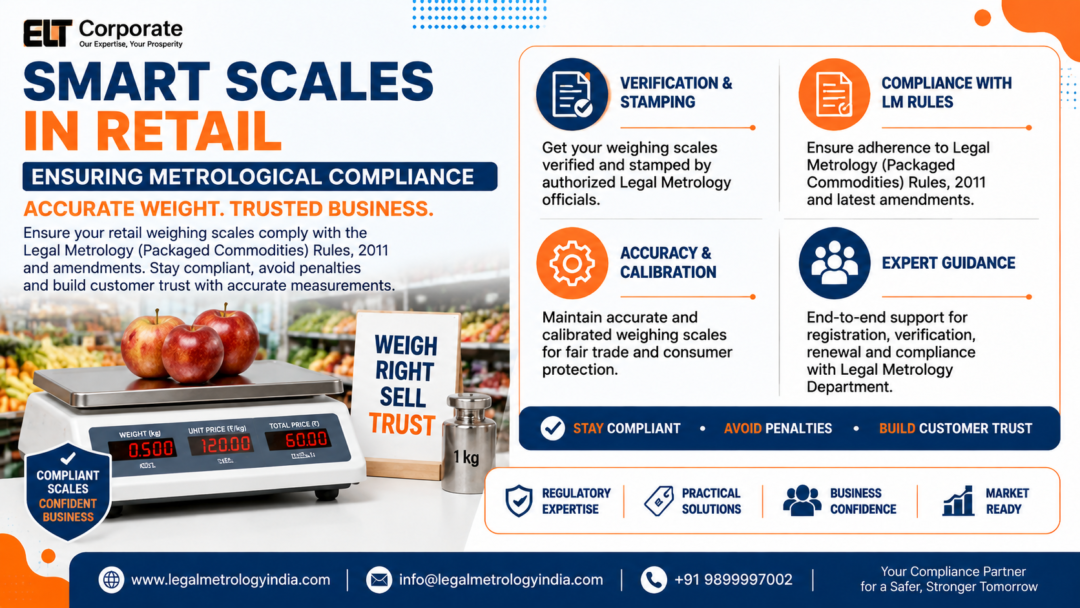
Walk into any modern retail store, supermarket, or mandi today and you’ll likely spot a weighing scale that looks nothing like the mechanical beam scales of a decade ago. Touchscreen displays, barcode printing, cloud connectivity, automated price computation, and even AI-assisted fraud detection at self-checkout counters—smart scales have transformed how retail businesses weigh, bill, and track inventory.
But here’s what many retailers overlook: no matter how advanced the technology inside a scale, if it’s used to weigh goods for a commercial transaction in India, it remains fully subject to the Legal Metrology Act, 2009, and its subordinate rules. A scale doesn’t stop being a “legal weighing instrument” just because it has a touchscreen and Wi-Fi. This guide explains exactly what metrological compliance looks like for smart scales in retail and where businesses most commonly get it wrong.
Not sure if your retail scales meet Legal Metrology standards? Let’s check together.
WhatsApp Us Free ConsultationWhat Makes a Scale “Smart”?
Smart scales typically combine traditional weighing mechanisms with digital and connected features such as
- Price-computing functionality—automatically calculating the total price based on weight and a pre-set price per unit
- Barcode and label printing—generating compliant product labels at the point of weighing
- Cloud connectivity (IoT)—transmitting weight and transaction data in real time to a central system, ERP, or POS software
- Touchscreen interfaces—replacing physical buttons with configurable digital displays
- Remote monitoring and self-calibration alerts—flagging drift or maintenance needs before they cause measurement errors
- Integration with billing and inventory systems—feeding weight data directly into GST-compliant billing and stock management software
These features genuinely improve retail efficiency, reduce billing errors, and support real-time inventory accuracy. But every one of these features sits on top of a weighing mechanism that must still meet India’s legal metrology standards—and it’s the underlying weighing function, not the smart features, that regulators care about.
Get Compliant, Stay Compliant
The Legal Metrology Framework That Still Applies
Smart or not, every weighing scale used in trade in India must satisfy the same core compliance chain established under the Legal Metrology (General) Rules, 2011:
- Manufacturer License—The entity manufacturing the scale must hold a valid legal metrology manufacturing license.
- Model Approval—Before a specific scale model can be sold or used in trade, its design must receive model approval from the Director of Legal Metrology or the relevant state authority, confirming it meets prescribed accuracy and construction standards.
- Verification and Stamping—Each individual unit sold must be verified and stamped by a legal metrology officer or authorized verifier before it can be legally used in a commercial transaction.
- Periodic Re-Verification—Stamped scales must be periodically re-verified (commonly on an annual cycle, though this varies by state and instrument category) to confirm they remain accurate over time.
This chain—manufacturer license → model approval → manufacture/supply → verification & stamping → customer use → periodic re-verification—applies identically whether the scale is a basic mechanical platform scale or a Wi-Fi-connected smart terminal with a built-in printer. Adding smart features doesn’t create an exemption; it just adds a new layer of technology on top of an already-regulated instrument.
Compliance Challenges Unique to Smart Scales
While the legal framework hasn’t changed, smart scales introduce practical compliance risks that traditional mechanical scales never had to deal with.
📋 Worried about firmware updates or PLU misconfiguration? Get a free compliance check.
Get Free Checklist Talk to Expert1. Firmware and Software Updates
A scale’s model approval covers its certified configuration—including its firmware. When a smart scale receives an over-the-air software update, that update can, in principle, alter how the instrument calculates or displays weight and price. If an update changes functionality beyond what was originally approved, the scale may technically fall out of compliance with its approved model—even though nothing “physical” changed. Retailers using connected scales should confirm with their supplier whether firmware updates are metrology-safe and whether any update requires re-verification.
2. Price-Computing Configuration
Smart scales that calculate a final price based on weight and a stored price-per-unit (PLU—Price Look-Up) must have this price-computing functionality itself covered under the approved model. Misconfigured PLU settings, or price-computing features added after approval without being part of the certified model, are a common—and easily overlooked—compliance gap.
3. Data Connectivity and Tamper Risk
IoT-enabled scales that transmit data to POS or ERP systems introduce a new question: can the weight reading be intercepted or altered between the scale’s certified measurement and the final billing record? While this is more of an operational/security concern than a strict legal metrology requirement, tampered or manipulated readings that result in incorrect billing can still trigger liability under the Act’s fair-trade provisions, regardless of whether the tampering happened in the scale itself or downstream in the software.
4. Multi-Location and Multi-State Deployment
Retail chains deploying the same smart scale model across stores in multiple states need to confirm verification and stamping compliance in each state, since legal metrology enforcement operates through state-level controllers, and re-verification schedules or minor procedural requirements can differ from state to state.
5. Treating “Smart” as a Substitute for “Certified”
Perhaps the most common misconception: assuming that because a scale is digital, accurate to the gram, and manufacturer-certified for quality (ISO 9001, for instance), it is automatically legal metrology compliant. Digital precision and legal metrology certification are not the same thing. A highly accurate uncertified scale is still non-compliant if it hasn’t been through model approval and verification/stamping.
Why This Matters for Retail Businesses Specifically
Retail is one of the sectors where legal metrology enforcement is most visible to the public—a customer who suspects they were shortchanged on weight can file a complaint directly, and several states now offer digital complaint-tracking systems that make this easier than ever. For a retail business, this means:
- Reputational exposure is immediate. A single flagged transaction at a billing counter can escalate into a public complaint, a social media post, or a formal inspection—especially at busy supermarkets and quick-commerce dark stores where high transaction volumes increase the odds of Legal Metrology Compliance Auditan isolated error being noticed.
- Penalties apply per instrument, not per store. A retail chain with dozens of unverified or improperly configured smart scales across multiple outlets can face cumulative penalty exposure that scales with store count.
- E-commerce and quick-commerce integration adds scrutiny. As grocery and retail businesses increasingly weigh products for online orders (loose produce, bulk staples), the same weighing instrument now feeds both in-store billing and digital order fulfillment—meaning a compliance gap affects two sales channels simultaneously.
Get Compliant, Stay Compliant
A Practical Compliance Checklist for Retailers Using Smart Scales
- Confirm model approval—Ask your scale supplier for the specific model approval certificate covering the exact configuration you’re purchasing, including any price-computing or connectivity features.
- Verify individual unit stamping—Every unit deployed in-store should carry its own verification stamp, not just a manufacturer’s quality certificate.
- Track re-verification schedules—Maintain a calendar for periodic re-verification across every location, especially for multi-store chains.
- Document firmware update history—Keep records of software/firmware updates pushed to your scales, and confirm with your vendor whether any update affects the certified configuration.
- Audit PLU and pricing configurations—Periodically check that price-per-unit settings match what’s approved and displayed to customers.
- Train frontline staff—Ensure store staff understand that a scale showing a “connectivity” or “sync” error should not be used for billing until resolved, since displayed weight or price could be affected.
- Maintain a centralized compliance record—for multi-location retailers, keep verification certificates, model approval documents, and re-verification dates in one accessible system rather than scattered across individual store files.
Penalties for Non-Compliance
Using an unverified, unstamped, or improperly configured weighing instrument in trade—smart or otherwise—is treated as a serious offense under the Legal Metrology Act, 2009. Consequences can include:
- Fines that escalate for repeat offenses
- Seizure of the non-compliant instrument during inspection
- Potential imprisonment for continued or deliberate violations
- Disruption to billing operations if scales are confiscated pending compliance verification
For retail chains, the operational cost of a seized scale at a high-traffic store — even briefly — can significantly outweigh the cost of proactive compliance.
⚠️ Avoid Fines & Seizures
A single non-compliant scale can disrupt your entire billing operation. Let’s fix it before an inspection does.
📞 Call: 9899997002 📅 Schedule NowFrequently Asked Questions
Q1. Does a smart scale need separate approval for its “smart” features, like connectivity or barcode printing?
The core weighing and price-computing functionality must be covered under the model approval. Purely peripheral features (like Wi-Fi connectivity for data syncing) are generally not themselves subject to metrology approval, but any feature that affects how weight or price is calculated or displayed should be part of the certified model.
Q2. If my smart scale receives an automatic software update, do I need to get it re-verified?
It depends on whether the update changes the certified measurement or pricing functionality. As a precaution, retailers should ask suppliers to confirm whether an update is “metrology-neutral” or requires re-verification.
Q3. Can I use the same smart scale model across stores in different states?
Yes, but verification and stamping must be completed in each state where the scale is deployed, since enforcement and administrative processes are handled at the state level.
Q4. Is a scale with an ISO 9001 or CE certification automatically legally compliant in India?
No. Quality management certifications like ISO 9001 relate to manufacturing quality systems, not legal metrology approval. A scale still requires Indian model approval and individual verification/stamping to be legally used in trade.
Q5. How often should smart scales be re-verified?
Re-verification cycles are typically annual but can vary by state and instrument category—check with your local Legal Metrology office or a compliance consultant for your specific requirement.
🔍 Not Sure If Your Scales Are Compliant?
Get a FREE preliminary compliance audit of your retail weighing setup — model approval, stamping status, and more, reviewed by our experts.
🔍 Get Free AuditGet Compliant, Stay Compliant