
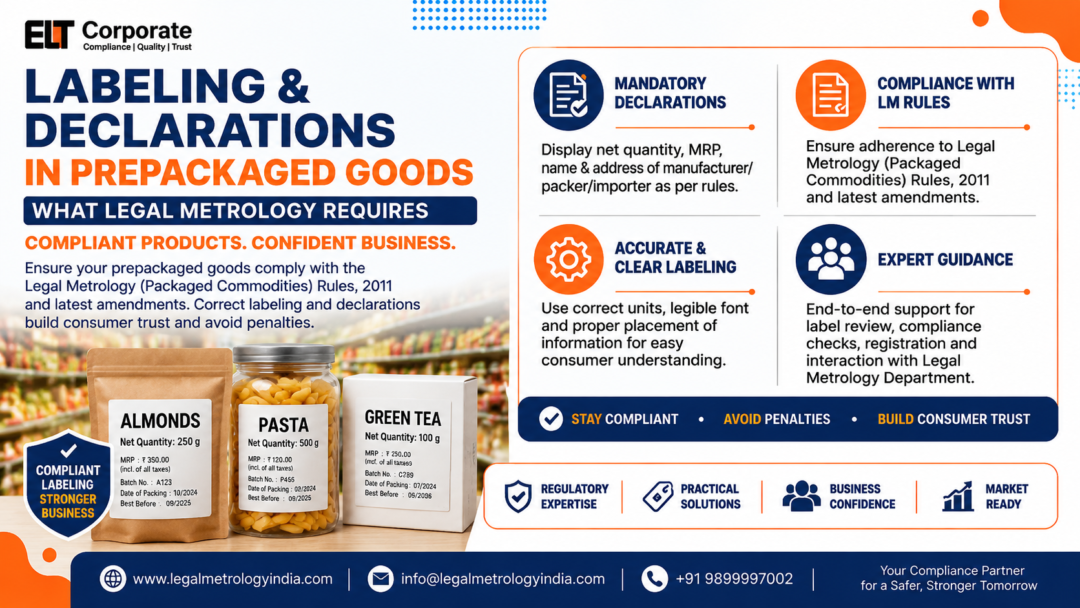
Pick up almost any packaged product in an Indian store—a bag of rice, a bottle of shampoo, a box of biscuits—and you’ll find the same cluster of information printed somewhere on the pack: manufacturer details, quantity, price, and a manufacturing date. This isn’t a marketing choice. It’s a legal obligation under the Legal Metrology (Packaged Commodities) Rules, 2011, and getting it wrong — even in small, seemingly cosmetic ways — is one of the most common compliance failures businesses face in India.
This guide breaks down exactly what labeling and declarations the law requires for pre-packaged goods, how they must be displayed, and where businesses most often go wrong.
⚡ Don’t Risk Penalties or Delays
Get Compliant, Stay Compliant
Talk to our Legal Metrology experts today — fast approvals, zero guesswork, complete peace of mind.
✅ 1000+ Businesses Trust Us | ✅ Fast Turnaround | ✅ Expert Guidance
What Counts as a “Prepackaged Commodity”?
Under the Legal Metrology (Packaged Commodities) Rules, 2011, a pre-packaged commodity is any commodity placed in a package of any nature, in the absence of the purchaser, with a predetermined quantity. In simple terms: if you package a product before the customer sees or requests it—whether it’s a 1 kg pack of flour or a shrink-wrapped electronics accessory—it falls within these rules.
This is a deliberately broad definition, and it’s why the labeling requirements apply across virtually every consumer product category: food and FMCG, cosmetics and personal care, electronics, stationery, hardware, and more.
The Mandatory Declarations (Rule 6)
Rule 6 of the LM (PC) Rules, 2011, is the core provision specifying what every prepackaged commodity must declare. At a minimum, every package must carry:
- Name and address of the manufacturer, or, if the manufacturer is not the packer, the name and address of the packer or importer.
- Common or generic name of the commodity contained in the package, and where the commodity is packed in a combination of more than one item, the total number of items.
- Net quantity, expressed in standard metric units of weight, measure, or number, as appropriate to the commodity.
- Month and year of manufacture, packing, or import, as applicable.
- Retail Sale Price (MRP), which must be inclusive of all taxes, expressed as “Maximum Retail Price ₹___ (inclusive of all taxes).”
- Unit sale price—the price per specified unit of weight, measure, or number—rounded off to the nearest two decimal places.
- Consumer care details—a name, address, telephone number, or email address that a consumer can use to register a complaint or seek clarification.
A useful nuance worth knowing: for brand owners who market (rather than manufacture) a product, simply stating the complete name and address with the words “Marketed by” or “Brand Owner” satisfies the identity declaration requirement under Rule 6(1)(a)—you don’t necessarily need to separately name the actual manufacturer if you are the brand owner taking responsibility for the product.
Where and How Declarations Must Appear: The Principal Display Panel
Simply printing the required information somewhere on the package isn’t enough—the rules are specific about where and how prominently it must appear.
⚡ Don’t Risk Penalties or Delays
Get Compliant, Stay Compliant
Talk to our Legal Metrology experts today — fast approvals, zero guesswork, complete peace of mind.
✅ 1000+ Businesses Trust Us | ✅ Fast Turnaround | ✅ Expert Guidance
What Is the Principal Display Panel (PDP)?
The Principal Display Panel is the part of the package most likely to be displayed or examined at the point of retail sale. How it’s calculated depends on the shape of the package:
- Rectangular packages—one side of the package is treated as the PDP, with its area being the surface area of that side.
- Pipe-shaped or cylindrical packages—40% of the total surface area is treated as the PDP.
- Other shapes—also generally 40% of the total surface area.
Certain areas are excluded when calculating this area—the top, bottom, and flanges of cans, and the shoulders and neck of bottles and jars do not count toward the PDP.
Under Rule 7, mandatory declarations must be grouped together and displayed on this panel—they cannot be scattered across multiple, hard-to-find parts of the package. That said, the rules do allow some flexibility: declarations can be split between pre-printed information and information added at the packing stage (such as a batch-specific manufacturing date sticker), as long as both sets remain legible and correctly sized.
Interestingly, any leftover space on the Principal Display Panel—after the mandatory declarations are placed—can be freely used by the manufacturer or brand for other declarations, branding, or promotional content. The rules only dictate what must be there and how it must be sized; they don’t restrict the rest of the panel.
Font Size Requirements
This is where many businesses unintentionally fall out of compliance—especially when brand design teams prioritize aesthetics over legibility. Under Rule 7(3):
- The height of any declaration should generally not be less than 1 mm.
- Where a declaration is embossed, perforated, molded, blown, or formed as part of the package itself (rather than printed), the minimum height increases to 2mm.
- Separate, more detailed tables prescribe minimum numeral heights based on the declared net quantity—larger packages require proportionally larger numerals for weight and price declarations.
Importantly, these are minimum requirements—using a larger font than prescribed is always permissible and often advisable, especially for products aimed at older consumers or where labels are printed in low-contrast colors.
A recurring compliance issue flagged by regulators and legal commentators alike: businesses that print brand names and marketing copy in large, bold fonts while squeezing mandatory declarations like MRP or net quantity into barely legible, undersized text on an inconspicuous part of the package. This is treated as a violation regardless of whether the required information is “technically” present somewhere on the pack—the regulatory intent is that consumers can actually read and rely on this information at the point of sale.
Net Quantity and Permissible Error
Declaring net quantity isn’t just about stating a number—that number must be accurate within a prescribed tolerance. The rules apply a Maximum Permissible Error (MPE) framework, meaning small variations between declared and actual quantity are allowed within defined limits, but systematic underfilling beyond that tolerance is a violation. Per Rule 11, the weight of packaging materials themselves must be excluded from the declared net quantity of the product—you can’t declare a net weight that actually includes the wrapper, box, or container.
Exemptions and Relaxations: Rule 26 and Rule 33
Not every package needs to carry every declaration in full. Two provisions provide flexibility:
- Rule 26 (Exemptions)—exempts specific categories of packages from certain declaration requirements altogether. Examples historically include packages weighing less than 10 grams or 10 ml and food items packed and sold directly by hotels and restaurants for immediate consumption. However, these exemptions are periodically narrowed—for instance, pan masala was specifically excluded from a small-package exemption under a 2025 amendment, closing a loophole that previously benefited that category.
- Rule 33 (Relaxations)—allows the Director of Legal Metrology or state authorities to relax specific declaration requirements in individual cases, typically where strict compliance is impractical for a particular product or packaging format. This is also the provision businesses can apply under if they inadvertently missed a declaration and want to seek relief before facing prosecution—though this is a case-by-case remedy, not a blanket exemption.
Businesses should never assume an exemption applies indefinitely without checking current notifications—as the pan masala example shows, categories once covered by Rule 26 can be specifically carved out later.
E-Commerce and Online Listings
A growing area of enforcement focus is the consistency between a product’s physical packaging and its online listing. Regulators increasingly expect e-commerce sellers to display the same mandatory declarations—net quantity, MRP, manufacturer details, and consumer care information—on the product listing page itself, not just on the physical package the customer receives. Discrepancies between what’s shown online and what’s printed on the actual package are a rising source of consumer complaints and regulatory scrutiny, particularly as quick-commerce and D2C brands scale rapidly across multiple online marketplaces.
Common Labeling Mistakes Businesses Make
- Undersized mandatory text paired with oversized branding—a direct Rule 7 violation even if all required information is technically present.
- Declaring net quantity inclusive of packaging weight, inflating the apparent quantity beyond what Rule 11 permits.
- Relying on an exemption that no longer applies, especially after a category-specific amendment like the ones affecting medical devices or pan masala in 2025.
- Inconsistent online vs. physical declarations, especially for e-commerce sellers managing large product catalogs across multiple platforms.
- Missing or outdated consumer care details—a contact number or email that’s no longer active is treated the same as not providing one at all.
- Assuming a design/marketing review is the same as a legal metrology compliance review—the two serve very different purposes, and a label that looks polished can still be non-compliant.
Penalties for Non-Compliance
Failing to meet labeling and declaration requirements under the LM (PC) Rules, 2011, carries real consequences under the Legal Metrology Act, 2009:
- Fines for non-standard or incorrectly declared packages, with escalating penalties for repeat violations
- Separate penalties specifically for net quantity discrepancies between declared and actual contents
- Potential imprisonment for continued or willful non-compliance
- Stock seizure and forced product withdrawal during inspection, disrupting distribution and retail relationships
A Practical Labeling Compliance Checklist
- Confirm all seven Rule 6 declarations are present—identity, product name, net quantity, manufacture date, MRP, unit sale price, and consumer care details.
- Verify Principal Display Panel placement—mandatory declarations grouped together, not scattered across the package.
- Measure your font sizes against Rule 7 minimums—don’t rely on “looks readable”; check actual millimeter height against the prescribed tables.
- Recalculate net quantity to exclude packaging weight, per Rule 11.
- Cross-check any exemption you rely on against the latest notified amendments—exemptions can be narrowed without much public notice.
- Match your online listings to your physical packaging declarations, especially for multi-platform e-commerce sellers.
- Test your consumer care contact periodically to confirm it’s active and monitored.
Conclusion
Labeling and declarations under the Legal Metrology (Packaged Commodities) Rules, 2011, look simple on the surface—a few lines of text on a package—but the underlying requirements around what to declare, where to place it, and how large to print it are precise, and non-compliance is treated seriously regardless of intent.
For businesses, the safest path isn’t reacting after a complaint or inspection flags a gap; it’s building labeling compliance into your packaging design process from the start and revisiting it whenever exemptions, formats, or your product line change. A polished, on-brand label and a legally compliant one aren’t automatically the same thing—but with the right checks in place, they don’t have to be in conflict either.
Get Compliant, Stay Compliant
Talk to our Legal Metrology experts today for a complete compliance review — fast, reliable, and hassle-free.
💬 WhatsApp Now 📅 Schedule Free Consultation 📞 Call: 9899997002 🎯 Get Free QuoteFrequently Asked Questions
Q1. Can I use a QR code instead of printing all declarations directly on the package?
Certain declarations may be supplemented with digital or QR code-based disclosures in specific circumstances, but core mandatory declarations generally still need to appear in the prescribed physical format on the principal display panel. Businesses should not assume a QR code alone satisfies the requirement without confirming the specific rule provision it falls under.
Q2. Is there a minimum package size below which labeling rules don’t apply?
Certain small packages have historically been exempt under Rule 26, but these exemptions are subject to change and don’t apply uniformly across all product categories—always verify current applicability for your specific product.
Q3. What happens if my declared net quantity is slightly off from the actual quantity?
Small variations are permitted within the Maximum Permissible Error framework, but systematic or significant underfilling beyond the allowed tolerance is treated as a violation.
Q4. Do e-commerce sellers need to follow the same labeling rules as physical retailers?
Yes. E-commerce sellers of pre-packaged goods are expected to display the same mandatory declarations on their listings as required on physical packaging, and inconsistencies between the two are an increasing area of scrutiny.
Q5. Can I fix a labeling mistake after products are already in the market?
Businesses that discover a labeling gap can apply for relaxation under Rule 33, but this is assessed case-by-case and isn’t a guaranteed remedy—proactive compliance review before distribution is always the safer approach.
⚡ Don’t Risk Penalties or Delays
Get Compliant, Stay Compliant
Talk to our Legal Metrology experts today — fast approvals, zero guesswork, complete peace of mind.
✅ 1000+ Businesses Trust Us | ✅ Fast Turnaround | ✅ Expert Guidance