
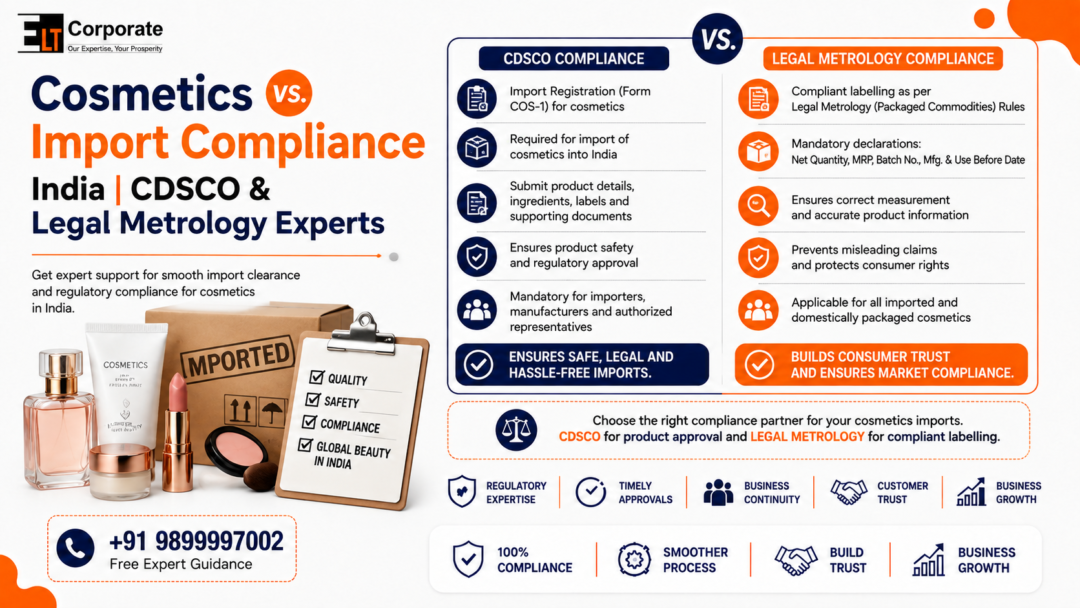
The market for personal care and cosmetics is one of the fastest-growing segments for consumer spending all over the world. It has attracted brand names for cosmetics, skincare, and personal-care companies across the globe. But before a single unit of foreign-manufactured lipstick, sunscreen, or shampoo can legally reach an Indian shelf or a customer’s doorstep, it has to clear two distinct—and often misunderstood—regulatory gates: CDSCO cosmetic import registration and legal metrology labeling compliance.
In case you don’t, the consequences will be immediate shipping held at ports and customs clearance denied. products that are confiscated during inspections at the market or fines in accordance with laws like the Legal Metrology Act. For international importers and cosmetics brands that are entering India, it is important to understand that import compliance isn’t a luxury. It’s an essential element in ensuring a simple market entry and a product held in a warehouse with bonded locks for a long time.
This guide will show you the specific requirements that compliance for imports of cosmetics into India is, so that you are aware of what to expect and how professional assistance can save your time, money, and also the risk to your regulatory.
Why Cosmetics Import Compliance in India Is a Two-Part Process
Many importers believe that a single certification covers the cosmetics’ compliance. In actuality, India regulates imported cosmetics by establishing two legal frameworks, which operate independently of one another:
The Drugs and Cosmetics Act, 1940, and the Cosmetics Rules, 2020—which were enacted by the Central Drugs Standard Control Organisation (CDSCO)—oversee the security of cosmetics as well as an approval process for ingredients and also an application for registration to each SKU for cosmetics before its introduction into the nation.
The Legal Metrology Act, 2009, together with the Legal Metrology (Packaged Commodities) Rules 2011, which are enforced by states’ Legal Metrology departments, which regulate the way cosmetics are packed in pre-packaged containers, must be identified as products for sale to consumers. They also require the declaration of price, amount, and origin.
A product could be registered with CDSCO but still not be compliant in its retail store if the label does not meet the standards for legal metrology—and reverse. Compliance with the law requires both at the same time, and that’s exactly where the majority of importers get into issues.
Don’t Let a Compliance Gap Delay Your Shipment
Get a free review of your CDSCO registration and Legal Metrology labeling from our compliance experts — before your product reaches port.
500+ businesses helped | PAN India service | Response within 2 hours
CDSCO Cosmetic Import Registration: What the Law Requires
In accordance with Rule 129 under the Cosmetics Rules, 2020, any cosmetic made outside of India that is designed for sale and import in India must be registered. An Indian marketplace must have a registration with CDSCO, also known as the Central Licensing Authority, before it is allowed to be imported. This is the case whether you’re bringing cosmetics, skincare products, hair perfumes, or personal hygiene products.
Who Can Apply
The application for registration can be filed by:
- The foreign manufacturer directly
- An authorized agent of the manufacturer
- The Indian subsidiary of the manufacturer
- The Indian importer bringing the product into the country
Whichever route is used, the applicant must have an authorized Indian representative to liaise with CDSCO through the process.
The Registration Process
- Product categorization—Every product and its variants must be classified under the correct category listed in the Cosmetics Rules, 2020 (the Fourth Schedule lists over 80 distinct cosmetic categories, from lip and eye makeup to hair and skin preparations).
- Document compilation—This includes a Free Sale Certificate or Certificate of Pharmaceutical Product from the country of origin, a complete ingredient list, product labels, manufacturing site details, a non-animal testing declaration, and a Power of Attorney if filed through an agent.
- Filing through the SUGAM portal—As of the current framework, all cosmetic import registration applications must be submitted digitally through CDSCO’s SUGAM online portal in Form COS-1. Physical submissions are no longer accepted for new applications.
- Fee payment—Registration fees are charged per product and per variant and must be paid through the designated government payment channel.
- Review and approval—CDSCO reviews the application, and on approval, issues a Form COS-2 registration certificate, valid for five years from the date of issue.
How Long Does It Take?
The timeframe for processing varies based on application quality and the product type. Importers must anticipate anywhere from 30 to 60 working days for basic applications and up to a month for more complicated multi-variant and complex filings. Incomplete documentation, notarizations that aren’t in order, and incorrect product classification are among the most frequent reasons why applications are rejected or delayed.
Legal Metrology Compliance for Imported Cosmetics
Once a cosmetic product clears CDSCO registration, it still has to satisfy India’s packaging and labeling law before it can be sold to consumers. This is where the Legal Metrology (Packaged Commodities) Rules, 2011, come in—and it’s a step many international brands underestimate because their home-market packaging simply doesn’t meet Indian declaration standards.
Every pre-packaged cosmetic sold in India must carry the following mandatory declarations on its label:
- Name and address of the manufacturer, packer, or importer—for imported goods, the Indian importer’s name and complete address must appear on the label.
- Common or generic name of the product
- Net quantity—expressed in standard units of weight, measure, or number, following the rules for how this must be displayed relative to the rest of the label.
- Month and year of import—distinct from the manufacturing date, this reflects when the product entered India.
- Maximum Retail Price (MRP)—inclusive of all taxes, in the prescribed format.
- Country of origin—mandatory for all imported prepackaged goods.
- Consumer care details—a contact address, phone number, or email where consumers can raise complaints.
- Dimensions and declaration size—the rules prescribe minimum font sizes and placement standards depending on the surface area of the package.
Importers are permitted to affix a supplementary label carrying these India-specific declarations after the goods land at a customs bonded warehouse, rather than requiring the original manufacturer to reprint packaging for every export market. But that supplementary label still has to comply precisely with the rules—approximate or partial compliance is treated the same as non-compliance during inspection.
Registration Fees and Timeline Planning
Cosmetic import registration fees under CDSCO are charged on a per-product, per-variant basis, so a brand bringing in a full range — say, twelve shades of a single foundation line — should budget for each variant separately rather than assuming one flat fee covers the entire product family. Fees are paid through the government’s designated online payment channel at the time of filing, and it’s worth confirming the current fee schedule directly on the SUGAM portal before submission, since these figures are revised periodically.
Timeline planning matters just as much as budgeting. The registration process can range from a few weeks up to several months, depending on the quality of documentation and the complexity of the product. Importers that wait until their shipment is booked prior to beginning the registration process often find themselves with inventory sitting in storage, either on the premises or in transit, while approval is in the process.
The firms that make the most rapid progress in India are those that move the fastest into the Indian market and are those that treat CDSCO filing and the design of legal metrology labels as pre-launch actions, which begin at the same time as the logistics and sourcing planning, instead of following the time when placing the initial purchase order has been placed.
It’s also worth noting that registration certificates need to be tracked for renewal well ahead of their five-year expiry, and any new SKU or shade variant introduced after the original registration typically requires its own filing. Building this into your product launch calendar—rather than treating it as a one-time task—is what keeps a growing cosmetics catalog compliant as it scales in India.
Where Importers Commonly Go Wrong
After years of working with cosmetic importers and brands entering India, a handful of recurring compliance gaps show up again and again:
- Misclassifying products—treating a product with active therapeutic claims as a cosmetic when it should be classified (and regulated) as a drug, which triggers rejection or enforcement action.
- Overlooking legal metrology entirely—assuming CDSCO registration is the only requirement and only discovering the labeling gap when a shipment is flagged.
- Non-compliant net quantity declarations—incorrect units, missing declarations, or font sizes that don’t meet the prescribed standards.
- Prohibited or restricted ingredients—failing to check products against Appendix A of the Cosmetics Rules, 2020, which lists substances banned or restricted for use in cosmetics sold in India.
- Making prohibited claims—words like “cure,” “treatment,” or “permanent” on cosmetic packaging can trigger regulatory scrutiny and reclassification risk.
- Expired or mismatched documentation—Free Sale Certificates or manufacturing authorizations that have lapsed or don’t match the exact product variant being registered.
Each of these is avoidable with the right compliance review before goods ever reach an Indian port.
Ready to Import Your Cosmetics Into India Compliantly?
Talk to our Legal Metrology & CDSCO compliance experts for a free review of your product documentation and packaging.
Schedule Free ConsultationWhat Non-Compliance Actually Costs
Skipping or rushing compliance isn’t a minor administrative risk. Non-compliant cosmetic imports can face:
- Customs detention—goods held at port pending proof of registration, with demurrage and storage costs accumulating daily.
- Denial of clearance—shipments that cannot be released without a valid CDSCO registration certificate.
- Seizure during market surveillance—Legal Metrology inspectors regularly audit retail and e-commerce listings for compliant packaging, and non-compliant stock can be seized.
- Monetary penalties—fines under both the Drugs and Cosmetics Act and the Legal Metrology Act for unregistered or mislabeled products.
- Reputational damage—for brands building a presence in India, a public compliance failure early on undermines retailer and marketplace trust.
Given that a straightforward CDSCO registration alone can take weeks to months, and that legal metrology labeling has to be finalized before goods clear customs, compliance planning has to start well before your first shipment is booked—not after it’s already in transit.
How We Help Cosmetics Importers Get It Right, End to End
This is exactly the gap our team closes for cosmetic brands and importers bringing products into India. Rather than treating CDSCO registration and legal metrology compliance as two separate problems for you to solve with two different consultants, we manage the full compliance journey under one roof:
- CDSCO cosmetic import registration—product categorization, documentation review, SUGAM portal filing, and follow-up through to your COS-2 certificate.
- Legal Metrology label review and correction—auditing your existing packaging against the Packaged Commodities Rules, 2011, and designing compliant supplementary labels where needed.
- Ingredient and claims screening—checking formulations against restricted substance lists and flagging label claims that could trigger regulatory issues.
- Ongoing compliance support—renewal tracking, variant registration for new SKUs, and representation if questions arise from CDSCO or state legal metrology departments.
We work with international manufacturers, Indian subsidiaries, and importers directly, so wherever you sit in the supply chain, we can act as your compliance partner and point of contact with Indian regulators.
Conclusion
Cosmetics in India is an excellent business opportunity, but one that rewards hard work and punishes shortcuts. CDSCO Registration under the Cosmetics Rules, 2020, and the legal metrology labeling required under the Packaged Commodities Rules, 2011 They’re not checkboxes competing for your attention. They’re both parts that share the exact compliance requirement, and both must be completed prior to your product being legally sold to an Indian buyer.
Make sure you have the classification of your product as well as the documentation and SUGAM filing correct, and get your India-specific label declarations in order and eliminate the two main causes of delays in shipment as well as customs detention and enforcement risks that trip the importers each day.
The companies that have a smooth transition in the Indian market for cosmetics aren’t necessarily the ones with the flashiest packaging. They’re those who have made compliance an initial requirement rather than an afterthought. With the proper documents, the proper timeframe, and the appropriate regulatory partner, there’s no reason that the import of your cosmetics to India is anything else.
Don’t Let a Compliance Gap Delay Your Shipment
Get a free review of your CDSCO registration and Legal Metrology labeling from our compliance experts — before your product reaches port.
500+ businesses helped | PAN India service | Response within 2 hours
Frequently Asked Questions
Q1. Is CDSCO registration compulsory to import all cosmetics, or is it only for specific categories?
It is required for every product that falls within the requirements of cosmetics according to the Drugs and Cosmetics Act, 1940, regardless of the category: skin care, makeup, cosmetics, hair care, and products for personal hygiene are all covered.
Q2. How do you keep a CDSCO cosmetic registration valid?
The registration certificate for Form COS-2 is valid for 5 years starting from the date it’s issued, following which renewal is required.
Q3. Can I include Indian-required label information once my product is produced and packaged in India?
Yes. Importers are permitted to use an additional label that includes specific India-specific declarations when the goods arrive at a warehouse bonded to India in the event that the label complies with the legal standards of metrology in full.
Q4. How will I proceed if my makeup product is imported with no CDSCO registration?
Unregistered goods can be refused clearance from customs authorities, detained at ports, or subjected to enforcement actions, which could include seizures and penalties.
Q5. Do I need to have a separate metrology registration that is legal, or does CDSCO also cover compliance with packaging?
There are two distinct conditions. CDSCO registration is a requirement for product safety and market approval. Legal metrology compliance is the way that packages are identified for consumers. Both have to be happy.