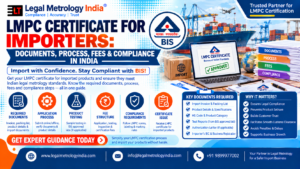
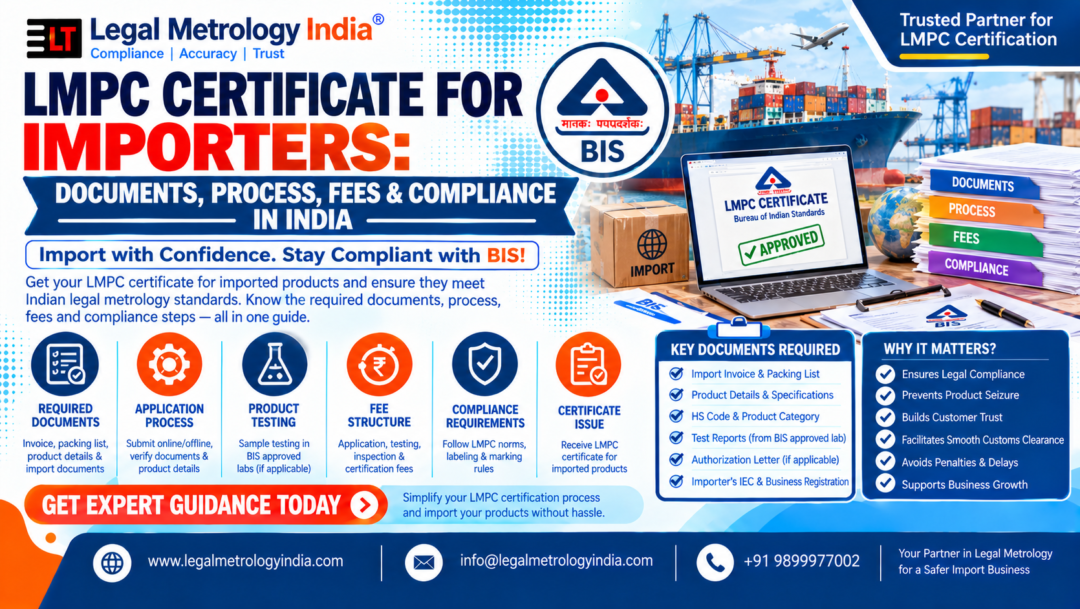
Importing packaged goods into India involves more than customs clearance and shipping arrangements. Importers must also understand the applicable labelling, registration, and consumer protection requirements before selling or distributing products in the Indian market. One important compliance requirement for businesses importing pre-packaged commodities is the LMPC Certificate for Import.
The LMPC Certificate is commonly used to refer to registration under Rule 27 of the Legal Metrology (Packaged Commodities) Rules, 2011. Depending on the nature of the imported product, businesses may also need to comply with additional requirements under the Legal Metrology Act, 2009, and other applicable regulations.
Understanding the registration process, documentation requirements, and package declarations can help importers avoid preventable compliance issues and prepare their products for the Indian market.
Need an LMPC Certificate for Import in India?
Simplify your import compliance with expert guidance on LMPC registration, required documents, and packaged commodity labelling requirements.
LMPC Certificate for Import | LMPC Registration | Import Compliance India | Legal Metrology
What Is an LMPC Certificate for Import?
An LMPC Certificate for Import refers to the registration of an importer under Rule 27 of the Legal Metrology (Packaged Commodities) Rules, 2011, where the rule applies to the imported commodities.
The registration framework covers businesses that import or pre-pack commodities for sale, distribution, or delivery. Applications are made to the relevant registering authority, such as the director or controller, according to the applicable procedure.
The primary purpose of this registration is to identify the responsible business and support compliance with packaging and declaration requirements.
Businesses should understand that LMPC Registration and product-specific permissions are not necessarily the same. Depending on the goods involved, additional approvals, registrations, or import conditions may apply.
Who Needs an LMPC Certificate for Import?
Businesses importing pre-packaged commodities for sale, distribution, or delivery in India should assess whether registration under Rule 27 is applicable to their operations.
The following businesses may need to examine their registration obligations:
- Importers of packaged goods: Businesses bringing pre-packaged consumer products into India for commercial sale.
- E-commerce sellers: Businesses importing packaged products for sale through online marketplaces or their own websites.
- Distributors and trading companies: Businesses involved in the import and distribution of packaged commodities.
- Private-label businesses: Companies importing finished products under their own brand, subject to their specific role and applicable requirements.
- Retail product importers: Businesses importing packaged household products, accessories, personal care items, or other covered commodities.
The precise requirement depends on the product, packaging arrangement, business role, and applicable exemptions. Importers should confirm the relevant rules before relying on a general checklist.
Documents Required for an LMPC Certificate
Preparing the correct documentation is an important part of the LMPC registration process. Missing information or inconsistent business details can lead to application queries and delays.
Commonly requested documents and information may include:
- Business registration documents: Certificate of incorporation, partnership deed, or other applicable proof of business constitution.
- PAN card: PAN details of the business or applicant, as applicable.
- GST registration certificate: GST details where applicable to the business.
- Importer Exporter Code (IEC): Importer identification details issued by the Directorate General of Foreign Trade, where applicable.
- Address proof: Evidence of the registered office or premises from which the import business operates.
- Identity and address proof: Documents for the proprietor, partners, directors, or authorized signatory, as applicable.
- Product details: Names and descriptions of the commodities being imported.
- Packaging information: Details of the packaging, net quantity, and proposed declarations.
- Authorization letter: Authorization for a representative to submit or manage the application, where required.
- Application and supporting declarations: Forms and documents prescribed by the relevant authority.
This is a general preparation checklist, not a universal statutory document list. The exact requirements can differ depending on the application route, state or central authority, product category, and current instructions. Before submission, verify the latest checklist published by the competent authority.
How to Apply for an LMPC Certificate for Import in India
The LMPC Certificate for Import application process should be approached systematically. The following steps provide a general overview.
Step 1: Identify the Applicable Registration Requirement
First, determine whether the imported goods fall within the scope of the Legal Metrology (Packaged Commodities) Rules, 2011.
Review the product category, intended use, packaging format, and whether the goods are being imported for sale, distribution, or delivery. Check whether a specific exemption applies.
Step 2: Prepare Business and Import Details
Collect the business registration documents, applicable tax details, IEC information, and address proof.
Ensure that the business name, registered address, and other particulars are consistent across the supporting documents.
Step 3: Prepare Product and Packaging Information
Create an accurate list of the commodities being imported. Include the product description, packaging format, and net quantity details where relevant.
Review the proposed labels to identify any missing declarations before the products are dispatched or offered for sale in India.
Need an LMPC Certificate for Import in India?
Simplify your import compliance with expert guidance on LMPC registration, required documents, and packaged commodity labelling requirements.
LMPC Certificate for Import | LMPC Registration | Import Compliance India | Legal Metrology
Step 4: Complete the Prescribed Application
Submit the application using the applicable official process and prescribed form.
The Department of Consumer Affairs provides information and application facilities relating to the registration of manufacturers, packers, and importers. The appropriate application route should be confirmed for the applicant’s circumstances.
Step 5: Pay the Applicable Government Fee
Pay the fee prescribed for the relevant application and retain the payment acknowledgement.
Government fees and procedures should be verified against the current rules and official application instructions. Professional service charges, if any, are separate from government fees.
Step 6: Respond to Queries From the Authority
The registering authority may review the application and supporting information. If clarification or additional documents are requested, respond with accurate and consistent information.
An incomplete application may be returned for correction, so review the submission carefully before filing.
Step 7: Obtain Registration and Maintain Compliance
After the application is accepted and the applicable requirements are fulfilled, the authority may issue the registration certificate.
Keep the registration details and supporting documents accessible. Also review whether any changes in business address, product range, or other particulars require an amendment or further intimation.
Important: Registration does not automatically establish that every imported product meets all applicable labeling, safety, customs, or product-specific requirements.
What Is the Government Fee for an LMPC Certificate?
The fee for an LMPC Certificate for Import should be checked against the current applicable rules and the relevant authority’s instructions.
Rule 27 of the Legal Metrology (Packaged Commodities) Rules, 2011 has historically prescribed a government registration fee of ₹500. The rule also provides for a fee for alterations to registration details. However, importers should verify the current applicable amount and any subsequent amendments before filing.
The total cost of obtaining registration may also depend on professional assistance, document preparation, correction of application details, and any additional compliance requirements relevant to the imported goods. Avoid relying on an unofficial quotation as proof of the statutory government fee.
Mandatory Labelling Requirements for Imported Packaged Goods
Obtaining an LMPC Certificate is only one part of compliance. Imported pre-packaged commodities must also meet the applicable declaration requirements under the Legal Metrology (Packaged Commodities) Rules, 2011, subject to relevant exemptions and product-specific provisions.
Depending on the commodity and applicable rules, declarations may include:
- Name and address of the manufacturer, packer, or importer, as applicable.
- Country of origin for imported products.
- Common or generic name of the commodity.
- Net quantity expressed in the applicable standard unit or number.
- Month and year of manufacture, packing, or import, as applicable under the relevant provisions.
- Maximum Retail Price (MRP) inclusive of all taxes, where required.
- Consumer care details prescribed by the rules.
- Unit sale price, where applicable.
- Best-before or use-by information, where applicable to the commodity.
The exact declarations depend on the product and the current legal provisions. Some products may be governed by additional regulations, and certain exemptions may apply.
Importers should review the packaging artwork before shipment and ensure that declarations are accurate, legible, and consistent with the applicable requirements.
Common Mistakes Importers Should Avoid
Businesses can reduce compliance risks by addressing common documentation and labeling errors before importing products.
1. Incorrect business information: Differences in the business name or address across documents can trigger queries.
2. Incomplete product descriptions: Generic descriptions may not adequately identify the commodities covered by the application.
3. Missing package declarations: Incomplete or inaccurate declarations may create compliance problems when goods are inspected or offered for sale.
4. Confusing registration with other approvals: An LMPC registration does not replace customs documentation, BIS certification, FSSAI licensing or other approvals where separately required.
5. Assuming every product follows the same process: Product categories, exemptions and applicable authorities may differ.
6. Ignoring amendments: Changes in business or registration particulars should be reviewed to determine whether an amendment is required.
Early compliance checks can help businesses minimise avoidable delays and improve the accuracy of their import documentation.
How Professional Assistance Can Help
Navigating the LMPC Certificate for Import process can be challenging for businesses unfamiliar with packaging regulations and registration procedures.
Professional compliance assistance may help importers identify the relevant registration route, organise supporting documents, review package declarations and prepare an application for submission.
Before engaging a service provider, clarify the scope of work, applicable government fees, expected documentation and whether any additional product-specific approvals are required.
The final decision on registration rests with the competent authority. No consultant can guarantee approval irrespective of the facts or documentation.
Conclusion
The LMPC Certificate for Import is an important registration consideration for businesses importing covered pre-packaged commodities into India. Understanding Rule 27, preparing accurate documents and reviewing mandatory declarations can help importers establish a more reliable compliance process.
Businesses should confirm the current requirements for their product category, use the appropriate official application route and check the latest amendments before submitting an application.
For assistance with LMPC Registration, document preparation and packaging compliance, businesses can seek professional guidance tailored to their products and import operations.
Need an LMPC Certificate for Import in India?
Simplify your import compliance with expert guidance on LMPC registration, required documents, and packaged commodity labelling requirements.
LMPC Certificate for Import | LMPC Registration | Import Compliance India | Legal Metrology
Frequently Asked Questions
Q1. What is an LMPC Certificate for Import?
It commonly refers to registration of an importer under Rule 27 of the Legal Metrology (Packaged Commodities) Rules, 2011, where applicable.
Q2. Who needs an LMPC Certificate?
Importers bringing covered pre-packaged commodities into India for sale, distribution or delivery should assess their registration obligations under Rule 27.
Q3. What documents are required for LMPC Registration?
Common documents include business registration proof, PAN, applicable GST and IEC details, address proof, product information and prescribed application documents.
Q4. What is the government fee for an LMPC Certificate?
Rule 27 has historically prescribed a ₹500 registration fee. Verify the current applicable fee and procedure with the relevant authority before applying.
Q5. Does an LMPC Certificate replace BIS or FSSAI approval?
No. Separate product-specific approvals or licences may be required depending on the commodity and applicable regulations.
Q6. Can I sell imported packaged goods without checking labelling compliance?
Importers should verify the applicable registration and packaging declaration requirements before selling or distributing covered products. Non-compliance may lead to enforcement action under the relevant law.