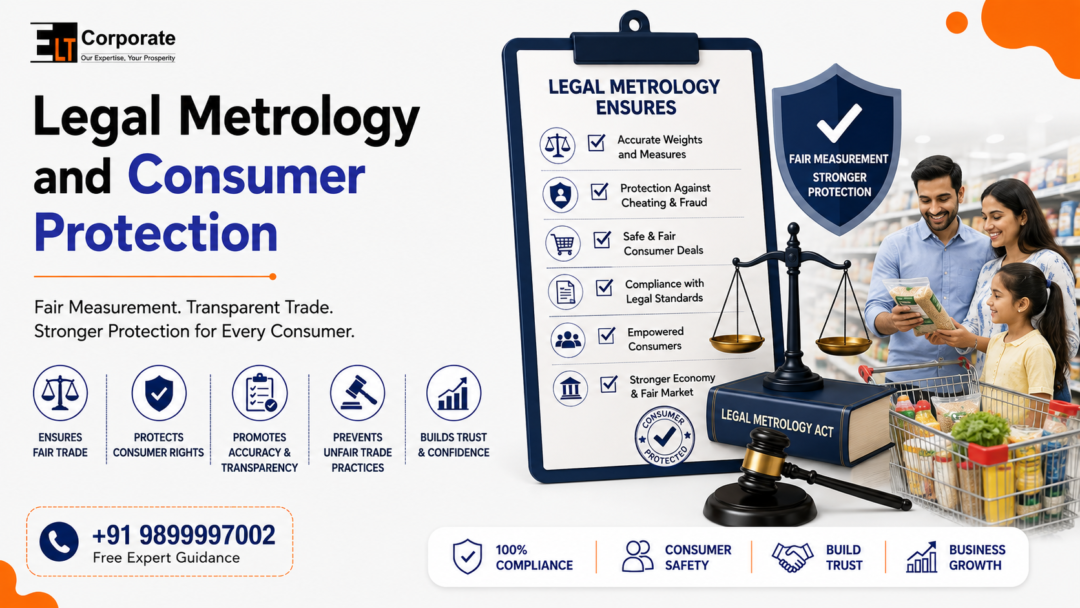
The role of legal metrology in consumer protection & fair trade is essential for ensuring accurate weights, measurements, pricing, and transparent business practices. Legal metrology laws protect consumers from short quantity, incorrect measurements, overcharging, and misleading product declarations while promoting fairness in trade.
In India, the Legal Metrology Act of 2009 establishes the rules for measures and weights, while goods sold and distributed by weight, measure, or number are regulated by the law, which is accompanied by several regulations, including the Legal Metrology (Packaged Commodities) Rules, 2011. Legal metrology protects consumers, providing them with accurate measures, correct amounts, clear prices, and useful information about the products they purchase.
Importance of Legal Metrology in Consumer Protection
Legal metrology consists of measurement science that deals with the measurement of weights and measures that are controlled by laws.
It means that:
- One kilogram equals what it is supposed to mean.
- One liter of commodity equals what it is supposed to be.
- All measuring devices provide the measurement that has been stated.
- Every packaged product has the volume that has been stated.
- Necessary information is mentioned on the package.
- There is no misleading of the customer in terms of product quantity or product price.
Legal metrology is applicable for many transactions, including purchasing packaged food, cosmetics, household goods, refueling stations, weighing balances, weighing stations, measuring tape, and any other measuring or weighing devices used for trade. Special rules have been created for every aspect under the Legal Metrology Act, including regulations for packaged goods.
🌾 Legal Metrology and Consumer Protection Are Legally Compliant
Need assistance with Model Approval, Verification & Stamping, Manufacturer License, Dealer License, Repairer License, or Legal Metrology Compliance? Our experts provide end-to-end compliance support across India.
📞 Get Free Consultation 💬 WhatsApp NowHow Legal Metrology in Consumer Protection Fair Trade
Most of the general public does not have the ability to determine if a scale, petrol pump, or food packaging is operating correctly. A person getting fuel will look at the meter for fuel dispensed. Similarly, the person buying the vegetables will trust the seller’s scale. Likewise, the consumer purchasing a packaged item will not check its weight. Legal Metrology offers assurance that the measurements and weighing tools fulfill certain requirements and that packaging holds the significant data. Thus, it provides two primary functions:
- It safeguards the client from shortages, wrong measures, and false information.
- It prevents honest enterprises from being undermined by competitors who follow dubious strategies to lower their expenses or increase their income.
Importance of Legal Metrology in Consumer Protection
1. Correct Weighing and Measuring
Legal metrology plays an essential role in consumer protection by ensuring that the buyers get the exact amount they pay for. For example, if a store charges the customer for one kilogram of rice but gives only 950 grams of rice, it might seem like a minor loss, but it could result in a big profit for the store over time. Legal metrology helps prevent such practices through controlling and monitoring the weighing instruments. According to Section 24, a person is required to get a weight or measure verified for all transactions subject to applicable provisions of law.
Verification serves the purpose of assuring that the device:
- Measures correctly;
- Was not changed unlawfully;
- Complies with the said technical requirements;
- Is suitable for use in business; and
- Has a verification stamp or certificate.
Role of Legal Metrology in Consumer Protection Fair Trade
Legal metrology also safeguards consumers who buy packaged goods. For example, a package labelled “Net Quantity: 1 kg” needs to have such quantity present in its package, allowing for the permissible variations as per the applicable regulations. Hence, the manufacturers and packers must have a suitable quantity control system in place. The authorities of legal metrology can inspect the packages and conduct quantity testing. If the actual quantity is less than what is claimed on the label and exceeds the allowed threshold
To illustrate this point, it can be explained that if a packet states that it contains 500 grams, but the actual quantity is significantly less than that, then the consumer has been charged for the quantity that he has not received. That is why, by regulating such deficiencies, legal metrology makes sure that the information printed on the package actually means something in trade.
How Legal Metrology Ensures Fair Trade and Consumer Rights
Consumers require reliable information for making choices in purchasing. Section 18 of the Legal Metrology Act regulates packaged commodities and mandates certain disclosures before the production of packaging. The kind of information that a retail package has to specify depends on the product and exemptions applicable under the jurisdiction but may typically consist of:
- Manufacturer/packer/importer’s name and place of business,
- Common name (generic name) of the commodity,
- Net quantity,
- Price of the commodity,
- Month and year of information,
- Consumer complaints contact, and
- Size/weight or dimensions (if applicable).
The above-mentioned details make the product clear to the consumer, providing the necessary information on what and how much the consumer is getting, who is responsible for the product, and whom one should contact in case of making a complaint.
Consumer Rights Against Overcharging
Making pricing information available is important in consumer protection. Where required, packaged products must show retail prices or MRP in specific terms. This helps consumers track the highest retail price. For example, if a packaged drink has an MRP of ₹100, the seller cannot charge ₹120 just because it sells in a good location. MRP declaration:
– Holds businesses accountable for setting prices;
– Helps consumers compare prices; and
– Reduces conflict at the point of sale;
Businesses can sell a product for less than its MRP, but when it comes to products with an MRP, their price should also be in line with the MRP.
Honest Product Packaging
Large packages can mislead consumers into thinking that they are purchasing a larger amount of a product, regardless of the fact that the package is mostly empty. Likewise, it may happen that a package has been specifically produced in order to make the actual amount less than that of a competitor product.
Legal metrology legislation helps prevent misleading packaging and false indications of the amount of the product. This is crucial because deceiving consumers can occur not only due to incorrect written instructions but also because of the design of the packaging itself. Companies should be careful and monitor that their packaging is not misleading regarding the amount, size, or value of the product.
How Legal Metrology Ensures Fair Trade and Consumer Rights
Correct statements related to quantity and price make comparison easier. Let’s take two products:
- Product A weighs 500 grams and is priced at ₹150.
- Product B weighs 750 grams and is priced at ₹195.
In the absence of clear net quantity information, it is possible that a consumer will buy a huge package because of its size. However, when net quantity and price are clear, the consumer can compare the given products and make a well-thought-out decision. Clear statements create competition among the companies for the real aspects of their products such as quality, price, functionality, and service.
How Companies Follow Legal Metrology Rules
By implementing a few uncomplicated methods, companies can avert compliance issues. Initially, they need to identify the legal metrology regulations applicable to their products and business operations.
Secondly, they need to have the product labels legally vetted before proceeding with mass production. The importers should verify the foreign labels as well before the goods arrive in India.
Thirdly, the measuring and weighing instruments need to be tested and retested in accordance with regulations.
Fourthly, the manufacturers must utilize adequate quality control measures in order to ensure that the packages have the required quantity.
Lastly, the businesses should perform internal audits from time to time, as it may be that a process or a label was compliant once but requires changes due to amendments in regulatory documents.
| Area Description | Role of Legal Metrology | Benefits of consumers |
| Correct weight | Make sure that instruments give accurate results. | Prevent short-weight delivery. |
| Correct Measurement | Checks measuring instruments used in trade | Consumers receive the quantity they pay for. |
| MRP Declaration | Requires MRP on packaged products | Protects consumers from overcharging |
| Net Quantity | Requires correct weight, volume, or number on packages | Helps buyers know the actual quantity |
| Manufacturer Details | Requires name and address of manufacturer | Makes the responsible business identifiable |
Legal Metrology in Consumer Protection and Fair Business Practices
One of the prime roles of legal metrology is the protection of consumers against short weight. For instance, if a consumer buys one kilogram of rice, one liter of petrol, or 500 grams of any packaged food item, the actual weight delivered must match the weight claimed or charged. Legal metrology officials check and stamp the weighing and measuring instruments used in commercial dealings. Periodic checking ensures that these weighing and measuring instruments maintain their accuracy up to permissible levels of error. Protection from short weights includes protection against:
- Manipulation of weighing scale
- Short delivery of fuel
- Faulty meter
- Short weight of any packaged food item
- Incorrect measurement of construction material
- Usage of unverified measuring instruments
Through checking and verifying these measuring devices, legal metrology protects against short weights and measures.
Consumer Protection Legal Metrology and Fair Trade Practices
The customers should be provided with sufficient information prior to making purchases of packaged goods. The Legal Metrology (Packaged Commodities) Rules, 2011, prescribe the requirements concerning declarations that should be made by the retailers. The Packaged Commodities Rules are officially recognized as rules under the Legal Metrology Act. In accordance with the applicability of the goods to the rules, the package should include particulars like
- Name and address of the manufacturer, packer, or importer
- Generic name of the commodity
- Net quantity in standard units of weight, measure, or number
- Date of manufacture, packing, or import, as the case may be
- Maximum Retail Price including taxes
- Customer care details
- Origin country in case of imported products, as the case may be
- Number of units in the package
These declarations will enable consumers to compare different products and make their buying decisions wisely.
Why Legal Metrology Protection Measurement Is Important
Guaranteed Accuracy in Weights and Measures: Reference standard units are checked against other recognized reference units (if kept in a standardizing lab); the second standards are checked against the reference standard units and are kept at an appropriate enforcement center. Before the prescribed weighing or measuring instrument can be used for a transaction.
Since the person purchasing the commodity is not present during its packing, he/she tends to place trust in the declarations made in the printed form over the packaging. Section 18 of the Legal Metrology Act has provisions regulating manufacturing, packing, sale, import, distribution, delivery, and offering for sale of any pre-packed commodity unless the package indicates required declarations and details and has to ensure compliance with any public advertisements regarding their RSP.
How Package Labels Protect Consumers
The declarations commonly specified in the Legal Metrology (Packaged Commodities) Rules, 2011, under the said act for a retail package include the name and address of the manufacturer, packer, or importer; the name of the country of origin in case of an imported commodity; the name and common/general name of the commodity; the net quantity of the commodity; relevant date declarations like the date of manufacturing, date of expiry or import, packaging date, etc.; and retail sale price and consumer care details for a particular commodity depending upon applicable rules. These types of declarations assist the consumer in making an informed choice.
Understanding MRP and Product Prices
The net quantity helps in determining how much of a product they are getting, whereas the maximum retail price helps in preventing the customer from getting fleeced, whereas consumer care no. Acts as a recourse if there is any issue, and the manufacturer and importer details help to maintain a trace of the commodities.
Maximum retail price and the Price Transparency Declaration of Maximum Retail Price, inclusive of all taxes, are two of the most obvious protections accorded to a customer by the packaged commodity. It indicates the ultimate ceiling price generally charged. “No manufacturer, packer, importer, wholesaler, or retailer shall sell or distribute a package of consumer products in quantity in excess of one liter, one kilogram, or one set and shall declare to the consumer through his advertisement. It is made an offense to alter, smudge, or obliterate any printed price, in addition to the penalty for selling it above the declared MRP of retail sale.
Equal rules and also legal metrology services
Businesses competing fairly means competition based on quality of goods or services, innovation, and competitive prices—not fraud. But a trader with a dishonest scale or who delivers less product to customers than the measuring indicator states can set seemingly lower prices but hold an illicit advantage.
Legal metrology establishes this common playing field by imposing common standards and rules for all players in measured sales/supply transactions. Producers of measuring devices may be subject to model approval, licensing schemes, or other requirements. Repairers, distributors, and importers may face mandatory registration, licensing, and reporting requirements. Legal metrology limits the use of unreliable equipment and encourages companies to comply with minimum legal and technical requirements for measuring devices. This protects businesses that use and supply compliant equipment, provides consumers with confidence in purchases, and improves business competition.
Why Legal Metrology in Consumer Protection Inspection Is Important
Standards are only enforced when they are applied. Legal metrology officers have the power to inspect premises, check on weights and measures, demand production of records, and, with the support of the law, seize instruments, goods, or documents associated with alleged contravention of standards.
Section 15 of the Legal Metrology Act empowers officers or persons authorized in writing by the Director to enter premises at all reasonable times to inspect weights and measures, inspect or examine goods, commodities, or articles, inspect or examine records, and seize evidence if an offense has or is likely to have been committed. It also empowers the forfeiture of unverified or non-standard instruments and packages that do not conform to requirements. Inspections can involve verification mark checks, examining fuel dispensers, inspecting package labels, interviewing complainants, and assessing actual vs. declared quantity. Enforcement may extend to instruments used in charging for services where measurement establishes the payable quantity.
The Importance of Legal Metrology for Consumer Protection. To keep it simple, legal metrology exists to protect the average consumer from getting cheated, intentionally or not, in their daily transactions.
How does it do that?
1. Ensuring Accurate Quantity and Weight: This is the raison d’etre for the legal metrology department, which is entrusted with monitoring that all weighing and measuring equipment—from tiny scales in the vegetable shop to massive industrial weigh bridges—are calibrated, verified, and stamped as accurate through periodic checks. Any underweight or undersized delivery is an act of consumer exploitation, and this is one area where legal metrology ensures honest transactions.
2. Standardizing Packaged Products: From that bag of flour you buy for daily consumption to the luxury shampoo you pamper yourself with, most items come in standard packs. Legal metrology regulations require that all pre-packed commodities carried contain specific information on the package, including the name and address of the manufacturer or packer, net quantity in standard units (like kg, litre, metre, piece), month and year of manufacture, and maximum retail price (MRP) inclusive of taxes.
3. Combating Fraud and Malpractice: Unscrupulous traders often resort to manipulation of weights and measures—be it adjusting a weighing machine scale, tampering with a fuel dispenser, or using measuring instruments of inaccurate calibration to short-change customers. Legal metrology officials conduct inspections in markets, workplaces, and various other places at their regular and surprise checks to detect and punish such malpractices. Such people are punished, and their license is cancelled for their criminal acts.
4. Developing Consumer Confidence and Market Stability: Building enduring trust between consumers and the marketplace, through assurance that transactions were conducted honestly on reliable weights and measures, is vital for sustainable and healthy economic growth.
Legal Metrology for Fair Business
Legal metrology is significant not only in the protection of consumer interests but also in fair trading among businesses.
- Ensuring Level Playing Ground for Businesses
- Fostering Cross-Border Business
- Supporting Government Taxation and Revenue Collection
- Enabling E-Commerce and Modern Retail Compliance
- Encouraging Technological Advancement in Measurement
Preventing Short Quantity in Packaging Legal Metrology
Labelling is not enough when there is no agreement between the quantity contained in a package and the labelled quantity. The Legal Metrology Officers have the authority to check packaged commodities and test samples to see if there is an agreement between the actual quantity and the labelled quantity. Those packages with excessive shortages and lacking any necessary labels will be confiscated or punished in any other manner.
Legal metrology is concerned with deception through packaging as well. The package shall not be designed in such a way that creates an impression regarding the quantity contained in it if its size is not needed for protection purposes or any other technical reasons. It is especially true in cases where oversized cartons, thick false bottoms, unused space, and irregular containers mislead consumers into thinking that the package contains more than consumers usually associate bigger packaging with higher quantity. Legal metrology makes sure that packaging is not used instead of factual information. Honest packaging makes it possible for consumers.
Role of Government Inspections
Regulatory requirements remain effective only in conjunction with inspections and enforcement. Under the Legal Metrology Act, powers related to inspection, search, production of documents, and seizure of non-standard instruments or non-compliant products are granted to authorized officers. It is also possible that manufacturers, repairers, and sellers of weights and measures shall keep prescribed documents and produce them upon inspection. Among other things, enforcement measures may involve the following activities:
- Testing weighing scales of stores and markets
- Verifying fuel dispensers at petrol pumps
- Inspection of packed products in factories and warehouses
- Label checking in wholesale and retail shops
- License and registration verification and certification checks
- Import declarations examination
Penalties, seizure, forfeiture, compounding (where appropriate), and prosecution depend on the type and frequency of violation under the law. Such measures discourage companies from purposeful misconduct and encourage them to create internal compliance systems. Label checking, verification, and document keeping should be regarded as continuous obligations, not as one-off procedures.
Legal Metrology in E-commerce
With e-commerce, the point at which consumers will inspect the product information has been moved. In a physical store, consumers have the option of reading the package information before buying the product. Online, the purchase is generally done after checking the information provided on a website or a mobile application. Mandatory requirements for legal metrology thus include mandatory labeling for packaged goods sold via e-commerce. Amendments by governments and directives from governments require that the prescribed product information be accessible to consumers online before the purchase. It ensures that consumers check vital information such as net quantity, MRP, manufacturer/importer details, and product identity before they order the product.
Legal Metrology and Fair Trading Practices in India
Legal metrology is an essential part of everyday life in almost any home or industrial facility. It applies to food sales, gas station jewelry purchases, packaging, cosmetics, home items, textiles, building materials, agricultural dealings, industrial supplies, jewelry supplies, and utilities. Farmers need reliable weighing facilities during the sale of their produce. Sellers need precise measuring units when purchasing from manufacturers.
- Retail Shops: Ensure customers receive the correct weight and quantity of products.
- Petrol Pumps: Help confirm that the fuel delivered matches the amount displayed on the machine.
- Packaged Food Industry: Ensures correct net quantity, MRP, manufacturing details, and consumer information on packages.
- Agriculture: Protects farmers through accurate weighing of grains, fruits, vegetables, and other agricultural products.
- Jewellery Sector: Ensures precious metals and jewellery are weighed accurately during buying and selling.
- Pharmaceutical and Cosmetic Industry: Helps maintain correct quantity declarations on medicines, creams, shampoos, and other products.
- Textile Industry: Ensures fabrics and materials sold by length or weight are measured correctly.
- Construction Sector: Supports accurate measurement of cement, steel, sand, and other building materials.
Business Rules and Duties
Businesses must regard legal metrology as a continuous compliance process. Before introducing a product into the market, they need to ascertain whether it is a pre-packed product, exemptions, if any, sector-specific laws, and the need for registration/license. The labels need to be checked for proper wording, usage of standard units, font size, positioning, contrast, MRP, net quantity, dates, importer details, and consumer care details.
In addition, businesses need to ensure that:
- Declarations as per the requirements are present on e-commerce pages
- The instruments used are duly verified and stamped
- Re-verification is done after the stipulated time period
- Properly labelled artworks with supporting documents are maintained
- Address changes, pack size changes, importer changes, MRP changes, and packaging changes are examined
- Consumer complaints are recorded and properly investigated
- This training can be extended to those who deal with packaging, warehousing, sales, retailers, and consumer care executives.
How Consumers Can Protect Their Rights
Consumers are advised to read declarations on packages, compare net quantity and prices, check MRP, and keep the invoice in case of a significant purchase. When purchasing products based on weight, consumers must ensure that the weighing equipment starts at zero and the weight of the packing material is not included in the weight of the product. Any lack of declarations, under-delivery, overcharging, and false packaging can be reported to the seller, producer, consumer service, State Legal Metrology Department, and respective consumer complaint authority.
Documents Required for LM Registration
1. Documents Related to Business Registration
- Documents Related to Business Registration
- Certificate of Incorporation, Deed of Partnership, or Proprietorship Proof
- Memorandum and Articles of Association, if any
- PAN card of the business organization supplies,
- GST Registration Certificate
- Udyam Registration Certificate, if any
- IEC number of the importer
2. Documents related to premises
- Ownership documents of the business premises
- Lease/Rent agreement of the premises, if on rent
- NOC from the owner of the premises
- Latest electricity bill or any other proof of address
- Premises layout plan, if required
Conclusion
Legal metrology is crucial to the protection of consumers and fair trade practices through ensuring the accuracy of weights, measures, pricing, and product information. It ensures that consumers get what they pay for in terms of quantity and value without falling victim to unfair trade practices such as inaccurate measurement, labeling, and pricing. In relation to business, legal metrology promotes fair business practices since it encourages transparency and customer trust. For manufacturers, importers, packers, dealers, and retailers, it means adhering to the legal requirements for registration, labeling, verification, and record keeping. Efficient enforcement, inspections, and consumer education are critical.
🌾 Legal Metrology and Consumer Protection Are Legally Compliant
Need assistance with Model Approval, Verification & Stamping, Manufacturer License, Dealer License, Repairer License, or Legal Metrology Compliance? Our experts provide end-to-end compliance support across India.
📞 Get Free Consultation 💬 WhatsApp NowFrequently Asked Questions
Q1. What is legal metrology?
It deals with weights, measures, packed commodities, and measuring instruments.
Q2. How does it help consumers?
It protects consumers in terms of quantity, pricing, and labeling of commodities.
Q3. Who needs to follow legal metrology regulations?
Manufacturers, importers, packers, dealers, and retail vendors of goods and online retailers.
Q4. What information must be written on packaged commodities?
Information about MRP, net quantity, product name, manufacturer or importer information, and consumer information.
Q5. Are packaged commodities sold above MRP?
No, packaged commodities cannot be sold above the MRP stated by the manufacturers.
Q6. What is the use of verification of weighing instruments?
The verification of weighing instruments makes sure that the instrument gives accurate measurements.