
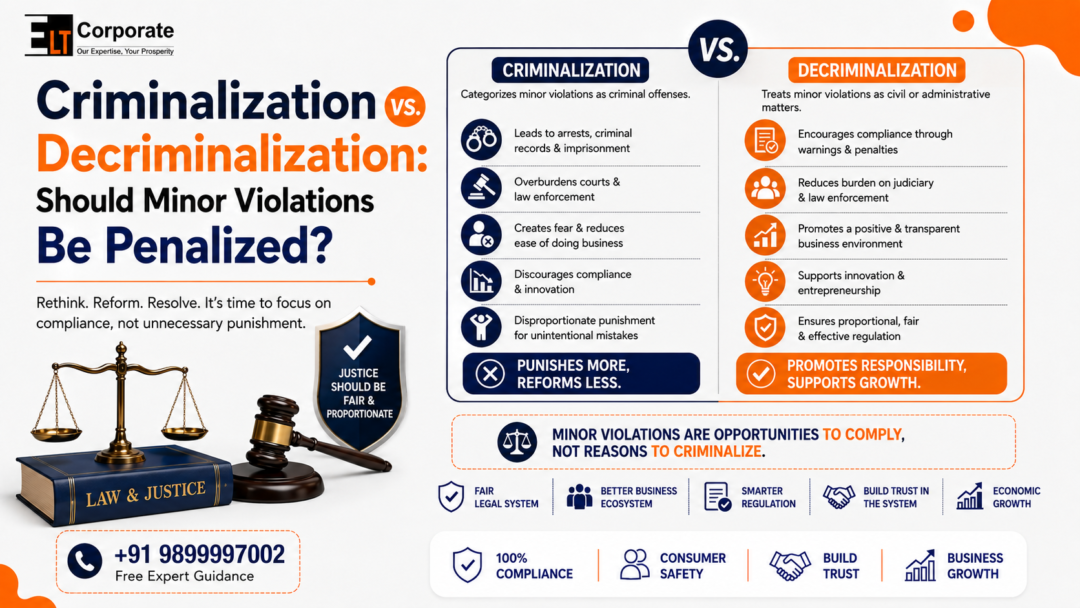
Regulators today are faced with a dilemma—whether every crime committed should be prosecuted under the law or whether only minor cases should be transformed into administrative decisions. This has prompted interest in the issues of decriminalization of minors violations in India.
For both companies and individuals, even a minor mistake due to noncompliance, for example, late filing, not keeping certain records, or incorrectly providing information, may entail penalties according to the legislation. Traditionally, many laws provided for criminal liability for such offenses as well. The decriminalization of minor violations has been aimed at relieving people from excessive legal metrology criminal liability for minor or technical offenses.
Currently, the policy in India is favouring the idea of decriminalization of minor violation offences, especially if they do not involve fraud, intentional or reckless behavior, danger to public safety, or serious damage.
What Is Criminalisation and Decriminalization of Minor Violations?
Criminalization is defined as treating behavior or acts of omission as a crime. However, the decriminalization of minor violations takes the opposite approach by trying to lessen the ramifications of crime for minor, procedural, or technical infractions. Depending on legislation, criminalization may imply:
– Prosecution
– Jail time
– Monetary fines
– Court proceedings
– Conviction
– Damaging reputation
– High litigation and compliance-related expenses
Criminal penalties are relevant in cases where behaviour is bad, intentional, fraudulent, or dangerous for society. Meanwhile, the decriminalization of minor violations is a matter of discussion when a powerful legal metrology crime apparatus is used for minor violations of a more administrative or housekeeping nature.
For instance, a genuine error in paperwork should not be treated in the same way as a deliberate falsification of the documents. Decriminalisation of minor violations allows for a more adequate approach towards crime by distinguishing between minor violations and serious crimes.
What Is Decriminalization of Minor Violations?
The term “decriminalization of minor violations” refers to the process in which criminal penalties are either removed or diminished for minor crimes, and the legal framework is shifted to various other regulatory methods. Some examples of the methods of decriminalisation are as follows:
- Warnings
- Advice notices
- Fines
- Administrative decisions
- Settlements
- Opportunity for solving problems
- Increasing punishments
The new concept of decriminalization is not to be confused with legalization. legalization. As long as the requirement exists, people and organizations are expected to comply with it. The main difference is in how they face their transgressions.
Why Is Decriminalization of Minor Violations Important?
There are, of course, many different definitions of decriminalization of minor violations, but the main commonality among them is proportionality. Not all violations should be treated the same since varying levels of intent distinguish between compliance failures. Consider the following example:
Example 1: A company accidentally submits a statutory return a few days late.
Example 2: A company intentionally gives false safety records for the sale of an endangered product.
In both cases, the companies are non-compliant; decriminalization of minor violations applies to completely different degrees and with different intentions behind each act. Thus, a properly constructed regulatory system should include the distinction between:
- Mistake in reporting and purposeful criminal act
- First-time non-compliance versus repeated infraction
- Light non-compliance versus serious misconduct
- Correctable non-compliance versus irreversible harm
- Administrative infraction versus public safety issue
India is actively promoting legislative reforms to ensure decriminalization of minor violations in its system of laws. Recently, this policy has gained a lot of significance in the Indian context.
India’s Move Towards Decriminalization of Minor Violations
The main legislative action taken in this area is the Jan Vishwas (Amendment of Provisions) Act, 2023. Through the new legislation, the government has amended 42 Central Acts and decriminalized 183 provisions by replacing the criminality of these acts with monetary fines and administrative action. This is a momentous step in the process of decriminalization of minor violations and minimizing the unnecessary burden of a criminal case due to minor technical defects.
These reforms brought about a shift in government legal metrology policies by introducing the concept of trust-based governance along with a smoother process for doing business and proportionality in regulatory enforcement. The decriminalization of minor violations aims to ensure that no minor procedural or administrative mistakes are equated with serious crimes.
Benefits of Decriminalization of Minor Violations
1. Promotes Ease of Doing Business
Businesses work under many compliance obligations related to government licenses, registrations, filings, etc.
Having to worry about criminal liability for technical faults may deter successful business practice.
Instead of using criminal procedures for minor violations, administrative systems could employ different sanctions.
2. Reduces Unnecessary Court Proceedings
Judicial resources are used unnecessarily for minor offenses when they could be used on more severe disputes.
Using administrative systems for petty violations avoids the necessity of litigation.
3. Encourages Voluntary Compliance
The regulatory system should, as much as possible, allow the curing of mistakes instead of hiding them.
If every mistake potentially leads to criminal prosecution, it would be quite difficult for organizations to communicate with regulators.
The process of issuing warnings, measures of correction, and different penalties helps organizations correct their mistakes willingly.
4. Protects Businesses from Disproportionate Consequences
Criminal prosecution can exert influence upon more than what kind of penalty the company has to pay. Company managers, supervisors, and owners may experience the following:
- Need to appear in person
- Legal expenses
- Loss of reputation
- Disruption of management
- Problems with due diligence
- Higher investor anxiety
Such effects can be disproportionate, especially if the violation is minor.
5. Supports MSMEs
Big companies usually have special legal compliance, regulatory, and legal departments. Small companies may not possess such departments.
An MSME may commit a procedural breach not wishing to break the law but just by misunderstanding, lack of qualified personnel, or administrative negligence.
A scaling approach to enforcement allows real companies to fix these mistakes.
Decriminalization of Minor Violations and Doing Business
The absence of penalties might create an impression among businesses that they can disregard regulations. Minor transgressions might still imply public consequences, for instance:
Decriminalization should not be confused with the removal of accountability.
– First mistake—a warning
– Second mistake—a fine
– Abusive re-offenders—higher fine
– Deliberate violation— a tougher fine and criminal liability
The way the government acts these days is based on warnings for first-time offenses, proportionality of penalties, and administrative trials.
Therefore, the better principle is
Correct minor mistakes, penalize repeated defaults, and criminally prosecute serious misconduct.
How Decriminalization of Minor Violations and Voluntary Compliance
Although the decriminalization of minor violations offers a number of benefits, that doesn’t mean that the process should take place in all cases. Criminal laws are still needed whenever the behavior is serious, intentional, fraudulent, or results in potential serious damage.
The main idea of the decriminalization of minor violations is to remove excessive criminal responsibility in the case of minor and technical violations. Nevertheless, some cases may still justify the application of criminal responsibility:
Fraud
Cases involving intentional falsification of documents, licenses, test reports, certificates, or declarations are very different from simple clerical mistakes. This is the reason why the decriminalization of minor violations should be applied only in cases of substantial compliance failures.
Public Health and Safety Risks
Cases where consumers, employees, or patients are exposed to serious health or safety risks require strong enforcement measures. This is the point where the use of the decriminalization of minor violations doesn’t make sense, as the serious consequences go beyond the violation of a procedure.
Counterfeit or Adulterated Products
Cases involving the manufacture and sale of counterfeit products or knowingly selling contaminated, adulterated, or dangerous products may lead to serious consequences. Such behavior.
Environmental Damages
Significant pollution or environmental offenses can have a long-lasting impact on societies and the environment. Hence, the decriminalization of minor violations should exclude cases of substantial, intentional, or irreversible environmental damage.
Repeated Non-Compliance
A business that has been persistently disobeying a set of rules after warnings and penalties is in a different position from a first-time offender. The decriminalization of minor violations should apply only to primary violations.
Obstruction of Regulators
Wrecking the evidence, deliberately hiding the information, or obstructing an investigation should be penalized severely. Such actions go beyond the decriminalization of minor violations since they stand in the way of effective law enforcement.
To sum up, the decriminalization of minor violations should be selective and not implement an absolute decriminalization of crime, as there is still a need for criminal penalties in case of serious violations.
Criminal vs. Civil Penalties under Decriminalization of Minor Violations
The distinction between criminal and civil punishment is crucial for a proper understanding of the notion of decriminalization of minor violations.
Criminal punishment originates in the criminal justice system and may encompass prosecution, conviction, imprisonment, and the imposition of fines.
On the other hand, civil or administrative punishment usually implies the application of
Better Model for Decriminalization of Minor Violations: Graded Enforcement
A balanced approach to regulation is not about either criminalizing everything or decriminalizing everything. The decriminalization of minor violations will be most effective only when implemented through a gradual enforcement scheme that depends on the severity of the transgression. Instead, enforcement can be divided into several stages.
Level 1 – Advisory
In the case of an insignificant procedural mistake committed for the first time, the regulatory body can just provide advice and ask for corrective action. This approach supports the decriminalization of minor violations since it allows taking corrective action for genuine errors without imposing any immediate punishment.
Level 2 – Warning
In case when enforcement is unavoidable, a warning can be issued stating that compliance is expected to be achieved by a certain deadline. In this case, under the decriminalization of minor violations, a warning can be viewed as a good first step before any harsh sanctions can be implemented.
Level 3 – Monetary Penalty
Failure to fix the problem or a significant violation might result in imposing an administrative penalty. It allows the regulators to maintain the accountability of the businesses while continuing the process of decriminalization of minor violations.
Level 4 – Higher Fine
In cases of repeated violations, businesses will be punished with higher fines. The decriminalization of minor violations should not be a means to protect companies that do not comply with regulations.
Level 5 – Crime
Criminal prosecution will be enforced in cases of fraud, deliberate misconduct, severe violation of safety regulations, obstruction of law enforcement, and/or repeated intentional violations. The decriminalization of minor violations should not stop from applying substantial criminal penalties in such cases.
Level 5 – Criminal Action
In cases of fraud, deliberate misdoing, grave security hazards, blocking or persistent and purposeful violations, prosecution is deemed warranted. In the decriminalization of minor violations, instances of this nature, the legalization of minor infractions should not hinder firm prosecution of crime.
Impact of Decriminalization of Minor Violations on Corporate Compliance
The process of decriminalization of minor violations should not encourage businesses to abandon their compliance systems. Enforcement of applicable compliance regulations may change, but the responsibility for legal metrology compliance remains. Importantly, companies are still obliged to follow these practices:
- Compliance calendars
- Trackers for licenses and registrations
- Regulatory Standard Operating Procedures
- Maintenance of the required records by law
- Internal audits
- Employee training
- Documentation controls
- Corrective actions and preventive measures
Though fines incurred for administrative violations can be quite substantial, especially in the case of multiple violations, decriminalization of minor violations should be perceived not as a relaxation of compliance rules but rather as an advancement towards reasonable enforcement.
The process of decriminalization of minor violations changes the way enforcement takes place but does not get rid of the need for compliance.
Is Decriminalization of Minor Violations Good for Consumers?
The decriminalization of minor violations can also benefit consumers, as it allows regulators to resolve minor matters quickly and concentrate enforcement resources on serious risks.
However, consumer protection should remain central to regulatory reform. The decriminalization of minor violations should not weaken safeguards where non-compliance may affect consumer health, safety, financial interests, or essential rights. Violations affecting:
- Product safety
- Health
- Quality
- Fraud
- Misrepresentation
- Financial loss
- Essential consumer rights
may require stronger consequences than minor technical defaults.
The correct approach to the Decriminalisation of minor violations should therefore be based on the risk, seriousness, intention, and impact of the violation, rather than merely categorizing every offense as criminal or non-criminal.
Documentation Required for Decriminalization of Minor Violations
Proper documentation is important for legal metrology understanding and implementing the decriminalization of minor violations, especially when legal metrology is determining whether a violation is minor, technical, repeated, intentional, or serious. Important things to document include:
- Acts, rules, and regulatory provisions
- Relevant provisions dealing with decriminalization of minor violations
- Jan Vishwas (Amendment of Provisions) Act 2023
- Jan Vishwas (Amendment of Provisions) Act 2026, where applicable
- Government notifications and amendment notifications
- Details of the original offense and prescribed punishment
- Inspection reports and compliance observations
- Internal compliance audit reports
- Corrective and Preventive Action (CAPA) records
- Evidence showing correction of the violation
Future of Decriminalization of Minor Violations in India
India’s regulatory framework for decriminalizing minor violations is gradually being transformed into a system based on proportionality, administrative adjudication, and trust-based governance.
One example of this change is the Jan Vishwas reforms, which eliminated criminal penalties from many provisions in the year 2023. A further step to advance the regulatory framework is taken in 2026.
The broader aim is not to make law enforcement weaker, Decriminalization of Minor Violations but rather to generate a system where any implications of potential violation are proportional to the seriousness of the offense in question.
Conclusion
The discussion about whether to allow or prohibit something should not be reduced to the question of whether punishment should be imposed in a particular case. The decriminalization of minor offenses creates an environment in which genuine procedural violations in legal metrology will be addressed through admonitions, fines, and administrative penalties rather than through unnecessary criminal proceedings. At the same time, serious violations such as fraud, conscious wrongdoing, or repeated violations must be punished harshly. It follows that the framework established must be based on a simple principle:
Minor offense → minor correction or proportional punishment.
Repeated offense → increased punishment.
Fraud and severe harm → criminal prosecution.
Frequently Asked Questions
Q1. What is the meaning of the decriminalization of minor violations?
The meaning of decriminalization of minor violations is that prosecution for minor/technical offenses is replaced with appropriate action like a warning, a fine, or administrative action.
Q2. Does decriminalization mean no punishment?
No, decriminalization does not absolve a person of the law. Minor violations may still incur fines, corrections, or warnings.
Q3. Why is India adopting decriminalization of minor violations?
The country is adopting decriminalization of minor violations so as to better ease of doing business, cut down on unnecessary litigation, and ensure that the penalties match the seriousness of the crime.
Q4. Are serious offenses also to be decriminalized?
No, serious offenses like the ones involving fraud, public safety risk, environmental damage, repeated non-compliance, or willful misconduct should still receive criminal punishment.
Q5. What is the distinction between a criminal and an administrative penalty?
A criminal penalty can include prosecution, conviction, jail time, or criminal fines, whereas the administrative penalty usually results in fines or corrective measures from a regulatory body.
Q6. Can recurrent minor violations result in harsher punishment?
Yes. If a person continues to break the law, the authorities may differ their response according to the type of violation and its severity.