
The Legal Metrology Act, 2009, and the rules made thereunder control weight, measures, weighing and measuring instruments, packaged commodities, and trading on weight, measure, or number. It aims at protecting the consumer from any deficiency in quantity, false measures, misleading statements, and any unfair trade practices. Jan Vishwas Act, including those that will take effect on 1st May 2026. Noncompliance with the requirements can lead to the issuance of an improvement notice, fine, compounding procedure, suspension/reverse of registration, prosecution, and in some cases imprisonment.
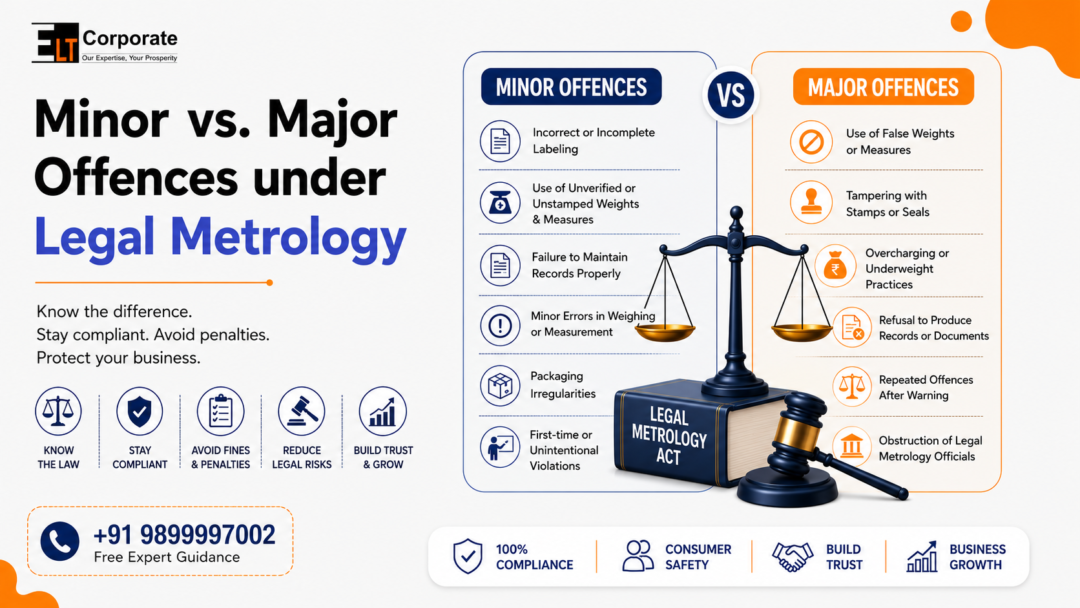
But there is no categorisation of offences as minor offences and major offenses as per the Act. However, the terms “minor offences” and “major offences” are used in compliance practice for technical or rectifiable contraventions and deliberate, repeat, or fraudulent conduct, respectively. It would, therefore, be important to assess the legal metrology seriousness of the offence based on the concerned section, intention, consumer consequence, repetition number, and punishment.
🍽️ Need Help with Minor and Major Offences?
Our experts assist with Minor and Major Offences, Legal Metrology Compliance, LMPC Certificate, Product Label Review, Import Compliance, and other regulatory requirements across India.
📞 Get Free Consultation 💬 WhatsApp NowWhat Is Meant by Minor Offences?
Minor offences usually include legal metrology compliance errors that are either procedural or technical or occur for the first time and such that they can be remedied without creating a consumer loss or compromising the measurement system. Minor offences may result from:
- An accidental mistake in labeling
- Failing to maintain records
- Using the wrong unit of measurement
- Failure to register the necessary registration on time
- Failing to provide any documents during inspection
- A remediable error in the packaging commodity statement
- A compliance failure without an intention to commit dishonesty
After the amendments of 2026, some minor first-time contraventions will be solved using an improvement notice. This will allow the enterprise a chance to remedy the contravention without having to pay money. A legal metrology improvement notice is not an exemption or total pardon. It is a formal process.
Common Examples of Minor Offences
1. Usage of Non-standard Unit: Section 29 of the Act deals with the quoting or publication of a non-conforming unit in relation to the prescribed standard units. In the case of a first-time offence, an improvement notice may be issued to the offender. For a second offense, it may carry a fine of up to ₹50,000, while subsequent offences may be fined up to ₹1 lakh to ₹2 lakh. For instance, a business may have quoted the amount of a commodity using a locally used unit instead of a prescribed standard unit. In the case of an isolated mistake that is rectifiable, such an instance may generally be considered to be a minor compliance issue offenses.
2. Failure to Produce Records: Section 31 relates to failure, without any reasonable excuse, to submit returns, maintain records, or produce documents, registers, weights, or measures for inspection. In the case of a first offence, an improvement notice will suffice as the action to take. A second offense may attract a fine of up to ₹25,000, while subsequent offences may attract higher fines. Intentional failure to present records to conceal fraud is not the same as failure due to poor judgment.
3. Error in First-Time Declaration for Package: Section 36(1), as amended, deals with packaging of goods that fail to meet the declaration requirements. The section applies to all the people involved in manufacturing, packing, import, sale, distribution, and sale using digital or electronic means. The first violation might be issued an improvement order. A second violation will face a fine of a maximum of ₹5 lakh. Further violations can lead to penalties from ₹25 lakh to ₹50 lakh.
4. Manufacturing or Sale without Registration: Sections 45 and 46 are relevant to the manufacture, repair, or sale of weights and measures without the required registration. In case of a first violation, an improvement notice may be issued. As per section 45, a second violation would be punishable by a fine of up to ₹20,000. As per section 46, a second violation could invite a penalty of up to ₹5,000. Subsequent violations of either provision may entail fines between ₹2 lakh and ₹5 lakh.
What Are Major Offenses?
Generally, major offenses refer to acts where there is intention to deceive, tampering, fraud, interference with authority, fake seals, significant shortages in quantities, multiple offenses, or those that lead to imprisonment. The following are usually characteristics of a major offense: offense:
- Honesty or fraudulence
- Direct financial loss for the consumers
- Intentional short delivery
- Tampering with weighing or measuring instruments
- Use of fake or incorrect stamps of verification
- Interference with the authorized officer
- Repetition of offense despite the improvement notice
- False records meant to deceive the authority
- Mass-scale offense involving many consumers
- Imprisonment offense
Major offenses not only harm an individual consumer but also the reputation of the entire measurement and verification.
Examples of Major Offences
1. Deliberate Manipulation of a Weight or Measure
Section 26 deals with the offense of manipulation or alteration of a standard, weight, or measure by a person with the intent of deceiving any other person or with the knowledge of the likelihood of deception. A fine not exceeding ₹50,000 can be imposed for the first offense. offense. A fine not exceeding ₹1 lakh can be imposed for a second offense. offense. Imprisonment of six months to one year, along with a fine, or both, can be imposed for the third or subsequent offense. offense.
2. Failure to Produce Records: Manufacturers, repairers, and dealers of weights or measures must keep records and show them when asked. Not providing a register, certificate, or document without a reason can result in action under the Act. First-Time Package Declaration Error: A package might not follow the rules because the declaration is wrong, missing, or shown incorrectly. Examples are
- An address for the manufacturer or importer;
- No details for customer service;
- The net quantity shown in the format;
- Not enough information about the maximum retail price;
- No country-of-origin information, when needed; or
3. Mandatory information not shown properly on an online listing.
Under Section 36(1), the first time a package has a declaration problem, the company gets an improvement notice. This rule also applies to selling products through stores, e-commerce sites, and other electronic ways.
4. Failure to Obtain Model Approval
If a model needs approval before being made or brought into the country, not getting that approval can lead to an improvement notice at first. If the company keeps doing this or makes the mistake, the penalties can be much worse.
5. Registration-Related Failure
Making, fixing, or selling weights and measures without the registration can start with an improvement notice. If the company keeps going after being told to stop, the problem becomes much more serious.
What Are Major Offenses?
Major offenses involve mistakes, bad intentions, tricking customers, changing things, fake marks, big amounts missing, doing the same thing again, or stopping the people in charge. An offense is more likely to be treated as serious where:
- The action was done on purpose;
- Customers lost money;
- A scale was changed;
- The amount said was not true;
- Fake official marks or seals were used;
- Wrong information was given on purpose;
- An officer was stopped during a check;
- The same problem happened again;
- A notice to fix things was not followed.
- The law says someone can go to jail.
Common Examples of Major Offences
1. Tampering with Weights or Measuring Instruments
Deliberately altering an electronic scale, fuel dispenser, weighbridge, or other measuring instrument to provide an incorrect reading is a serious offense. offense. Such conduct involves an intention to deceive and may result in direct financial loss to consumers. It cannot be treated as a simple documentation mistake.
2. Short Delivery: A seller commits a serious violation where the quantity delivered is less than the quantity purchased or paid for. Examples include:
- A fuel dispenser delivering less fuel than displayed;
- A retailer supplying less weight than charged;
- A packaged product containing less than the declared quantity; or
- A service provider delivering a measured service below the contracted quantity.
- Section 30 covers short delivery and fraudulent receipt of excess quantity in transactions conducted by weight, measure, or number.
3. Net Quantity Error in Packaged Commodities
A mistake in the way a label is formatted is not the same as having less product than what is stated. Under Section 36(2), if a person manufactures, packs, or imports a packaged item that has an incorrect net quantity, it can lead to:
- A fine ranging from ₹10,000 to ₹1 lakh for the first time;
- A fine of up to ₹5 lakh for the time; and
- A fine of up to ₹50 lakh or imprisonment for up to one year or both for the third time or more.
4. Counterfeiting Verification Stamps or Seals
Making, having, or using a legal metrology seal or stamp is one of the most serious violations under the Act. Section 44 includes actions like
- Creating an official seal;
- Keeping or selling fake seals;
- Taking off or changing a verification stamp;
- Putting a removed stamp on something; or
- Selling an item that is known to have a fake stamp.
The rule says that for the first offense, the punishment can be between six months and one year in jail. For a second offense, the punishment can be between six months and five years in jail.
Documents Required for Legal Metrology Compliance
If the person does not want to compound the offense, then a magistrate will deal with it under the Bharatiya Nagarik Suraksha Sanhita, 2023. To follow the rules for legal metrology compliance, businesses need to have papers. This helps them avoid getting in trouble and deal with inspections or notices.
- PAN card,
- a GST Registration Certificate,
- an Import Export Code if they bring things into the country
- proof of where the office and other buildings are
- Model Approval Certificate;
- Verification and stamping certificates;
- Renewal or amendment approvals; and
- Director nomination documents under Section 49.
Compounding of Legal Metrology Offences
So legal metrology offenses can be settled by paying an amount of money. This is called compounding. You pay this amount instead of going through a court case. The rules for compounding changed in 2026. Now Section 48 says that some offenses can be compounded. These are the ones listed:
- Sections 25 to 39
- Section 41
- Sections 45 to 47
- Rules made under Section 52(3)
- Rules made under Section 53(3)
Conclusion
The difference between minor and major offenses under the Legal Metrology Act and Rules is a functional one and not essentially based on statutory wording. Minor offenses are usually technicalities and are remediable by an improvement notice. The amendment that comes into force from 1st May 2026 gives businesses a window to remedy minor violations on first-time detection. At the same time, major violations attract extremely stringent penalties. Repeat offenders will be penalized not just for continuing to default but also will face severe penalties. Businesses must not consider relatively minor violations as inconsequential and fail to take corrective action. A range of penalties, including closure, deregistration, huge fines, and/or prosecution, is possible for repeat violations.
🍽️ Need Help with Minor and Major Offences?
Our experts assist with Minor and Major Offences, Legal Metrology Compliance, LMPC Certificate, Product Label Review, Import Compliance, and other regulatory requirements across India.
📞 Get Free Consultation 💬 WhatsApp NowFrequently Asked Questions
Q1. Does the Legal Metrology Act define minor and major offenses?
No. These are generally common terminologies that refer to technical irregularities and deliberate or fraudulent offenses. offenses.
Q2. What is a minor legal metrology offense?
This offense is committed by a person or business for the first time. It also causes lesser consequences, such as simple correction and minor penalties and sanctions.
Q3. What is a major legal metrology offense?
A major offenseoffense involves fraud, tampering, short-weight delivery, repeat violations, and consumer deception.
Q4. Can a minor offense become serious?
Yes. It becomes severe if the offender repeats it or if the initial violation requires longer correction.
Q5. What is an improvement notice?
An improvement notice requires businesses to correct a minor and first-time violation within a specified time limit.
Q6. What are common major legal metrology offenses?
They include tampering with the weighing scale, using falsified verification stamps, short-weight delivery, and obstructing legal metrology officers during inspections.
Q7. Can legal metrology offenses be compounded?
Yes. Some minor offenses can be compounded by paying the prescribed amount.
Q8. How can businesses avoid legal metrology offenses?
Businesses can avoid legal metrology offenses by ensuring they have maintained proper registration and labeling, using authorized weighing balances, and maintaining comprehensive documentation.