If you pack, repack, or private-label any product for sale in India—whether you manufacture it yourself, outsource it to a contract packer, or simply relabel someone else’s product under your own brand—you legally need a packing license. It’s one of the most misunderstood requirements in Indian business compliance, largely because so many businesses assume that outsourcing manufacturing also outsources this responsibility. It doesn’t.
This guide explains exactly what a packing license is, who needs one, how to get it, and what happens if you skip it—so you can package and sell with confidence, not guesswork. At ELT Corporate—your one-stop legal metrology partner—we’ve helped businesses of every size navigate this exact registration, and this guide reflects what we’ve learned handling it firsthand.
⚡ Don’t Risk Penalties or Delays
Get Compliant, Stay Compliant
Talk to our Legal Metrology experts today — fast approvals, zero guesswork, complete peace of mind.
What Is a Packing License in India?
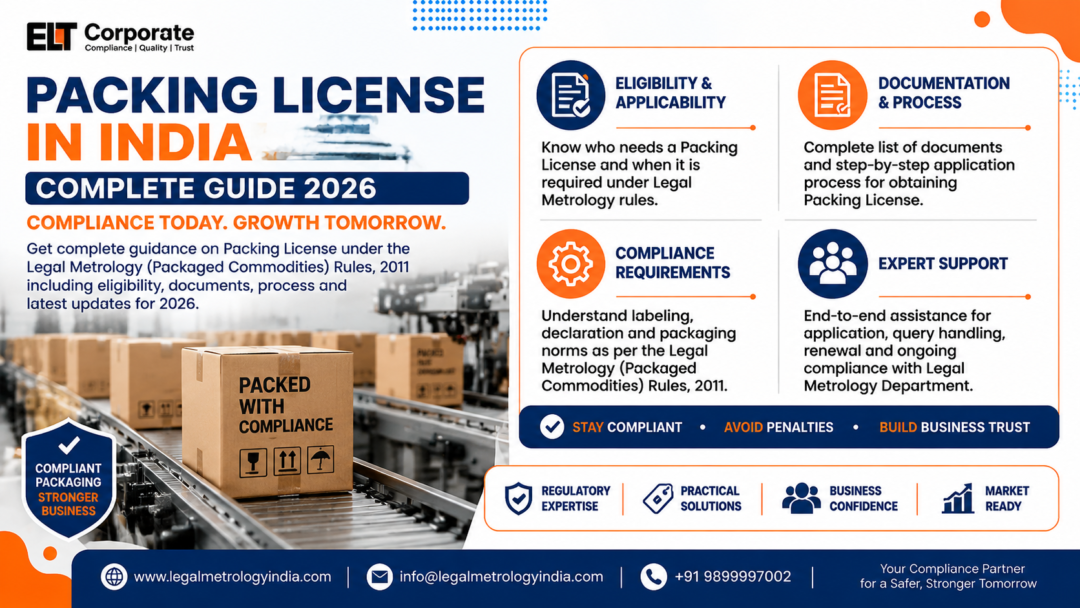
A packing license, more formally known as packer registration or LMPC (legal metrology packaged commodities) registration, is a mandatory approval issued under Rule 27 of the Legal Metrology (Packaged Commodities) Rules, 2011. It authorizes a business to pack, manufacture, or import pre-packaged commodities for sale, distribution, or delivery in India.
The rules define a “packer” broadly—under Rule 2(g), if you pre-pack a commodity for sale, you’re a packer, regardless of whether you manufactured that commodity yourself. This single definition is why the requirement catches so many businesses off guard: private-label brands, D2C sellers, and contract packers frequently assume that because someone else physically manufactures the product, compliance is someone else’s problem. Under the law, it isn’t—the act of pre-packing for sale triggers the obligation, not the scale of your operation or who made the underlying product.
Who Needs a Packing License in India?
You need to register under Rule 27 if you fall into any of these categories:
- Manufacturers who produce and pack goods themselves for retail or wholesale sale
- Packers who pre-pack goods manufactured by someone else—including contract packers and co-packers
- Importers bringing pre-packaged goods into India for distribution or sale
- Private-label and D2C brands who have products manufactured externally but sell under their own brand name and packaging
- Marketers whose name and address appear on the package as the entity responsible for the product
A common misconception worth addressing directly: even a small D2C brand packing a modest volume of orders each week carries the same Rule 27 obligation as a large-scale contract packer running multiple production shifts. The requirement is triggered by the act of pre-packing for sale—not by your business’s size or revenue.
Types of Packer Registration
Rule 27 registration is issued under a few distinct categories, and choosing the correct one matters:
- Manufacturer Registration—for businesses that both produce and pack a commodity themselves.
- Packer Registration—for businesses that pack a commodity produced by someone else, including contract packing arrangements.
- Importer Registration—for businesses bringing prepackaged commodities into India from abroad.
- Permission for Short Address—a specific provision allowing certain businesses to use an abbreviated address declaration on their packaging, subject to approval.
If your business sells prepackaged goods across more than one state, you may additionally need a packer license from the central government, rather than relying solely on state-level registration—this is a detail businesses scaling into multi-state distribution frequently overlook until it becomes a compliance gap.
Documents Required for a Packing License
While specific requirements can vary by state and applicant category, most Packer Registration applications require:
- Trade license or business registration proof
- Proof of ownership or a valid rent/lease agreement for the business premises
- GST Registration Certificate
- PAN card of the business
- Partnership Deed (for partnership firms) or Memorandum & Articles of Association (for private/public limited companies)
- List of items to be packed, along with the different packing sizes intended for each
- List of Directors or Partners, to be updated whenever there’s a change
- Identity proof of the applicant/authorized signatory
Packing License in India—Fee Breakdown
Government fees for Packer Registration are modest and predictable:
- Base registration fee: approximately ₹500, payable to the Director or Controller of Legal Metrology
- Amendment fee: approximately ₹100, applicable whenever you need to update details on an existing registration certificate (such as adding a new product category or changing business address)
- State-specific charges: many states levy additional processing charges, which can range from roughly ₹500 to ₹5,000 depending on the state and product category
These are government fees; professional consultancy charges for documentation, filing, and follow-up are separate and depend on the complexity of your registration.
Step-by-Step Process to Get a Packing License
- Determine your registration category—confirm whether you’re registering as a manufacturer, packer, or importer based on your actual business activity.
- Create an account on the relevant portal—your state’s Legal Metrology portal or the central registration system if you plan to sell across multiple states.
- Complete the application form—commonly filed as Form-I (or the state-specific equivalent), covering your business details, packaging information, and the list of products and pack sizes.
- Upload supporting documents—trade license, GST certificate, premises proof, and other required documents, self-attested as specified.
- Pay the applicable fee—the base government fee plus any state-specific charges.
- Application review—if the application is incomplete, the department typically returns it within about seven working days for correction; if complete, it proceeds to processing.
- Site inspection (where applicable)—a legal metrology officer may visit the declared premises to verify the details submitted.
- Registration certificate issued—once approved, you receive your registration number, which must then be printed on every product package you sell.
Timeline: When to Apply
This is one of the most commonly missed details. Businesses are expected to apply for and secure their Packer Registration before or very shortly after commencing pre-packing operations—official guidance and departmental references cite windows ranging from 30 to 90 days from the date pre-packing activity begins, depending on the specific provision and state practice. Rather than relying on the outer edge of any grace window, the safest approach is to apply before your first packaged product reaches the market, ensuring your registration number is already in hand when you need to print it on your packaging.
Validity and Ongoing Obligations
Unlike many licenses that require annual renewal, Packer Registration under the Legal Metrology (Packaged Commodities) Rules generally has no fixed expiry—once granted, it remains valid indefinitely unless the government amends the framework or the registration is specifically revoked. However, this doesn’t mean the certificate is “set and forget”:
- Any change in registered details—new product categories, additional pack sizes, change of business address, or a change in directors/partners—must be reported to the Registrar in writing, along with the applicable amendment fee.
- Your printed registration number must appear correctly on every package, and any lapse in maintaining this—such as launching a new product line without updating your registration—can create a compliance gap even though your original certificate remains technically valid.
- Labeling obligations under Rule 6 continue to apply regardless of when you registered—holding a valid Packer Registration doesn’t exempt you from getting your mandatory declarations (MRP, net quantity, manufacturing date, etc.) right on every package.
What Happens If You Skip Registration?
Operating as a packer, manufacturer, or importer without the required Rule 27 registration exposes your business to real consequences:
- Direct penalties—violations of the provisions under Rules 27 to 31 attract fines, with the specific fine amount and escalation depending on the nature and repetition of the violation.
- Product seizure—non-compliant packaged goods can be seized during inspection, disrupting both your inventory and your retail or distribution relationships.
- Deemed manufacturer status—a subtle but significant risk: businesses that pack products without correctly registering or without accurately reflecting “packed by” wording on their labels can be treated as a deemed manufacturer under the law—carrying full manufacturer-level liability even if they never physically produced the goods.
- Retail and e-commerce onboarding barriers—as organized retail chains and e-commerce marketplaces increasingly verify compliance documentation before onboarding sellers, missing registration can become a practical barrier to market access, not just a legal risk.
⚠️ Avoid Fines & Product Seizure
Get Your Packing License Before It Becomes a Problem
Our experts handle the entire Rule 27 registration process for you — start to finish.
✅ 1000+ Businesses Trust Us | ✅ Fast Turnaround | ✅ Expert Guidance
Common Mistakes Businesses Make
- Assuming outsourced manufacturing means outsourced compliance—the packer, not just the manufacturer, carries the Rule 27 obligation.
- Registering under the wrong category—filing as a packer when your actual activity fits manufacturer (or vice versa)—can create downstream labeling and liability issues.
- Forgetting to amend registration when adding new products or pack sizes—your registration certificate needs to reflect what you’re actually packing and selling.
- Overlooking the multi-state distribution requirement—scaling from one state to national distribution without securing the appropriate Central Government registration.
- Missing “packed by” labeling wording—a labeling gap that can shift legal responsibility onto the packer as a deemed manufacturer.
Conclusion
A packing license isn’t a bureaucratic afterthought—it’s the legal foundation that determines whether your packaged products can be sold, distributed, or delivered in India at all. With a modest government fee, a defined registration process, and no recurring renewal burden once granted, there’s little reason to delay registration or assume it doesn’t apply to your specific business model.
Whether you manufacture in-house, work with a contract packer, or run a fast-growing D2C brand, getting your Rule 27 registration right—in the correct category, with accurate product and pack-size details—protects you from penalties, keeps your products moving through retail and e-commerce channels, and builds the kind of consumer trust that comes from operating fully within the law. Not sure where your current setup stands? A legal metrology compliance audit can confirm your exact position before an inspection does.
⚡ Don’t Risk Penalties or Delays
Get Your Packing License, Right the First Time
Talk to our Legal Metrology experts today — fast approvals, zero guesswork, complete peace of mind.
✅ 1000+ Businesses Trust Us | ✅ Fast Turnaround | ✅ Expert Guidance
Frequently Asked Questions
Q1. Do I need a packing license if I only pack products occasionally, not as my main business?
Yes. The requirement is triggered by the act of pre-packing a commodity for sale—not by the scale, frequency, or primary nature of your business. Even occasional or small-volume packing for sale requires registration.
Q2. I outsource manufacturing to a third party—do I still need to register?
Yes, if you are the one packaging the final product under your brand or for sale, you are a “packer” under Rule 2(g) regardless of who manufactured the underlying commodity, and you carry the Rule 27 obligation independently.
Q3. Is packing license registration valid across all of India or state-specific?
Registration granted by the Director or Controller can generally be used across India without needing separate state-by-state registration for the same activity—however, if you distribute across multiple states, a Central Government Packer License may still be required in addition.
Q4. How long does it take to get a packing license?
Processing timelines vary by state and completeness of the application, but a complete, well-documented application generally moves through review and inspection within a matter of weeks—incomplete applications are typically returned within about seven working days for correction, which can extend the overall timeline if documentation isn’t right the first time.
Q5. What’s the difference between a manufacturer registration and a packer registration?
A manufacturer registration applies when you produce and pack the commodity yourself. A Packer registration applies when you pack a commodity that was manufactured by someone else—for example, a private-label brand using a contract manufacturer.
Latest Posts

Role of Calibration Labs & Third-Party Verifiers under Legal Metrology: A Complete Compliance Guide
LMPC Certificate in Bangalore: Complete Guide for Importers, Manufacturers & Businesses
Measurement Accuracy in Online Grocery & Bulk Delivery Services