LMPC registration is important for importers, manufacturers, and packers dealing in pre-packaged commodities in India.
Under Rule 27 of the Legal Metrology (Packaged Commodities) Rules, 2011, manufacturers, packers, and importers of packaged commodities are required to apply for registration with their name, complete address, and commodity details.
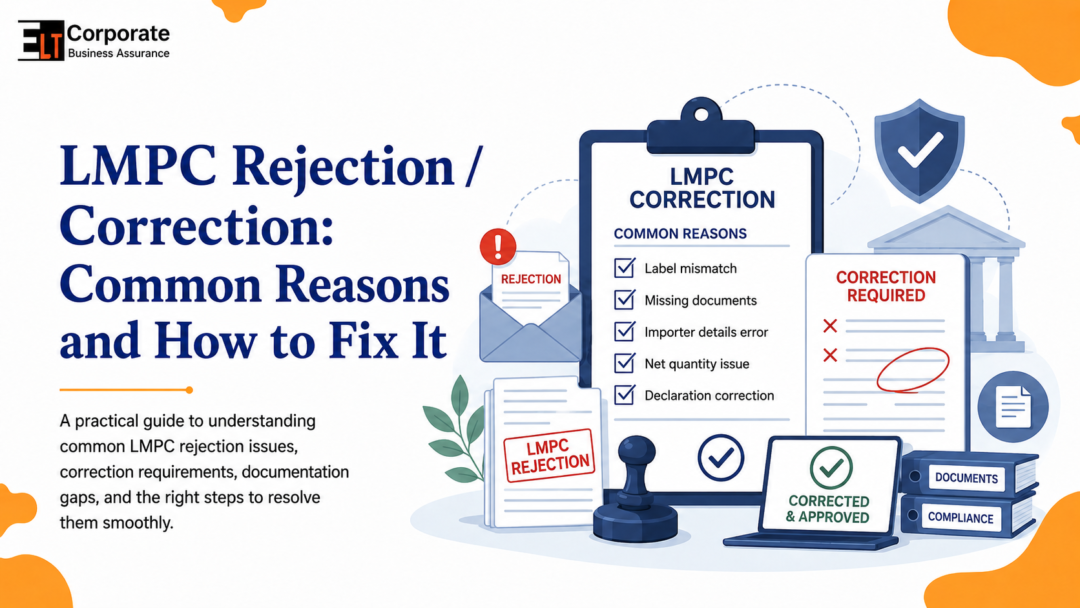
However, many LMPC applications get rejected or sent for correction due to small mistakes in documents, label declarations, business details, or product information.
A rejection does not always mean the application is permanently refused. In many cases, the applicant can correct the issue and resubmit the application.
What is LMPC Rejection?
LMPC rejection means the Legal Metrology Department has not accepted the application in its current form.
This may happen due to:
- Incomplete documents
- Incorrect business details
- Mismatch in address
- Improper label declaration
- Wrong product details
- Missing importer/manufacturer/packer information
- Incorrect application category
- Non-compliance with Legal Metrology rules
If the application is incomplete, Rule 27 provides that the registering authority may return the application within seven working days from receipt.
What is LMPC Correction?
LMPC correction means the department has raised an objection or asked the applicant to modify certain details.
This can be related to:
- Application form
- Business documents
- Product list
- Label artwork
- Address proof
- Importer details
- Commodity description
- Supporting declarations
Once the correction is made properly, the application can usually be resubmitted for further processing.
Common Reasons for LMPC Rejection / Correction
1. Name Mismatch in Documents
One of the most common reasons for rejection is mismatch in the company name.
For example:
- GST certificate has one name
- IEC has a different name
- PAN has a spelling variation
- Application form has incomplete name
Even a small spelling mistake can lead to correction.
2. Address Mismatch
The business address must be consistent across all documents.
Mismatch may occur in:
- GST certificate
- IEC certificate
- Rent agreement
- Electricity bill
- Application form
- Label declaration
If the complete address is not clear, the application may be returned.
3. Incorrect Product / Commodity Details
The product details should be clear and specific.
Avoid vague words like:
- General goods
- Electronics
- Household items
- Plastic items
- Imported products
Instead, mention proper commodity names such as:
- Electric kettle
- Bluetooth speaker
- Kitchen storage container
- Cosmetic product
- Packaged food item
4. Improper Label Declaration
The Legal Metrology Packaged Commodities Rules require mandatory declarations on pre-packaged commodities, including manufacturer/packer/importer details, country of origin, commodity name, net quantity, month and year, MRP, unit sale price, expiry/use-by details where applicable, and consumer care details.
If the label is incomplete or wrongly drafted, the department may raise an objection.
5. Missing Importer Details on Label
For imported packaged commodities, importer details must be properly shown.
Common mistakes include:
- Importer name missing
- Importer address incomplete
- Country of origin not mentioned
- Customer care details missing
- MRP not properly declared
6. Wrong Application Category
Some applicants select the wrong category while filing.
For example:
- Importer applying as manufacturer
- Packer applying as importer
- Manufacturer not mentioning packing activity
- Wrong state jurisdiction selected
This can result in rejection or correction.
7. Incomplete Supporting Documents
The department may ask for additional documents if the file is incomplete.
Common missing documents include:
- GST certificate
- IEC certificate
- PAN card
- Incorporation certificate
- Address proof
- Label artwork
- Product list
- Authorization letter
- Rent agreement or ownership proof
8. Wrong or Unclear Label Artwork
The label should be readable and properly formatted.
Common issues include:
- Blurred label image
- Missing MRP
- Net quantity not mentioned
- Wrong font size
- Incomplete consumer care details
- Incorrect unit of measurement
- No month and year declaration
9. Incorrect Fee or Payment Issue
In some cases, rejection may happen due to wrong fee payment, incomplete challan, or payment proof not uploaded correctly.
Rule 27 mentions the application fee for registration and a separate fee for alteration in the registration certificate.
Documents Required for LMPC Correction
The exact document list depends on the objection raised.
Generally, these documents may be required:
- Copy of rejection / objection letter
- Corrected application form
- GST certificate
- IEC certificate, for importers
- PAN card
- Certificate of incorporation / partnership deed
- Address proof
- Rent agreement or ownership proof
- Corrected label artwork
- Product / commodity list
- Authorization letter, if filed through consultant
- Existing LMPC certificate, in case of amendment/correction
Step-by-Step Process for LMPC Correction
Step 1: Read the Rejection Reason Carefully
First, check the exact reason mentioned by the department.
Do not resubmit the same file without understanding the objection.
Step 2: Identify the Type of Error
The error may be related to:
- Document
- Label
- Address
- Product details
- Category selection
- Fee payment
- Form filling
Step 3: Prepare Corrected Documents
Update the documents as per the objection.
Make sure all details match across documents.
Step 4: Prepare a Clarification Letter
A simple clarification letter can be attached.
It should mention:
- Application details
- Objection raised
- Correction made
- Request for reconsideration
Step 5: Upload / Submit the Corrected File
Submit the corrected documents on the portal or before the concerned Legal Metrology Department, as applicable.
Step 6: Track the Application
After resubmission, keep checking the application status.
If another query is raised, respond quickly.
How to Avoid LMPC Rejection
Before filing the LMPC application, check these points:
- Business name should match in all documents
- Address should be complete and consistent
- Product list should be clear
- Label should contain all mandatory declarations
- Importer details should be correct
- MRP and net quantity should be properly mentioned
- Consumer care details should be available
- Correct application category should be selected
- All documents should be clear and readable
Why Professional Help is Important
LMPC rejection may delay import clearance, product sale, and market launch.
A professional consultant can help in:
- Reviewing documents
- Checking label compliance
- Preparing corrected application
- Drafting clarification letter
- Coordinating with department
- Reducing chances of repeated rejection
Conclusion
LMPC rejection or correction is common, but it can be resolved if the reason is properly understood and corrected.
Most rejections happen due to document mismatch, incomplete label declarations, wrong product details, or incorrect application filing.
To avoid delay, businesses should ensure that their LMPC application, product label, and supporting documents are complete and legally compliant before submission.