Every packaged product that leaves a food, pharmaceutical, or FMCG production line carries a promise printed right on its label: this much net quantity, this precisely. This is not just another marketing slogan but an official statement that has been made keeping in mind provisions from the Legal Metrology Act of 2009 and the Legal Metrology (Packaged Commodities) Rules of 2011 and backed by weights and measuring devices that follow stringent standards of verification.
For manufacturers operating at scale, this creates a compliance challenge that’s easy to underestimate. A single miscalibrated filling line, an outdated weighbridge, or a labeling error repeated across a production run of lakhs of units doesn’t just risk a warning—it can trigger product recalls, consignment seizures, and penalties that scale with the volume of goods involved. Food, pharma, and FMCG businesses face this risk more acutely than almost any other sector, simply because of the sheer transaction volume and the tight tolerances their products are held to.
This blog breaks down where weighing and measurement compliance actually gets difficult in these three sectors and what businesses need in place to stay ahead of it.
Is Your Production Line Weighing-Compliant?
Get your weighbridges, check-weighers, and net quantity declarations reviewed by Legal Metrology experts — before an inspection or recall does the damage.
500+ businesses helped | PAN India service | Response within 2 hours
Why These Three Sectors Face Disproportionate Measurement Scrutiny
Food, pharmaceutical, and FMCG products share a few characteristics that make legal metrology volume—a compliance especially demanding compared to other industries:
- High production volume—a single formulation error or scale drift affects thousands or millions of units before anyone notices.
- Direct consumer health and safety implications—under-filled medicine strips or inconsistent active ingredient dosing carry risks far beyond a pricing dispute.
- Multi-stage weighing—raw material intake mixing in-process and finally packaging all require distinct weighing steps, increasing the number of devices that have to be accurate and confirmed.
- Rapidly moving SKUs and frequent reformulations—FMCG brands are particularly known for launching and changing sizes of packs on a regular basis; each new SKU creates fresh labels and net quantities.
- Cross-border sourcing and import—many food, pharma, and FMCG inputs or finished goods are imported, layering legal metrology packaging rules on top of whatever compliance regime governed the product in its country of origin.
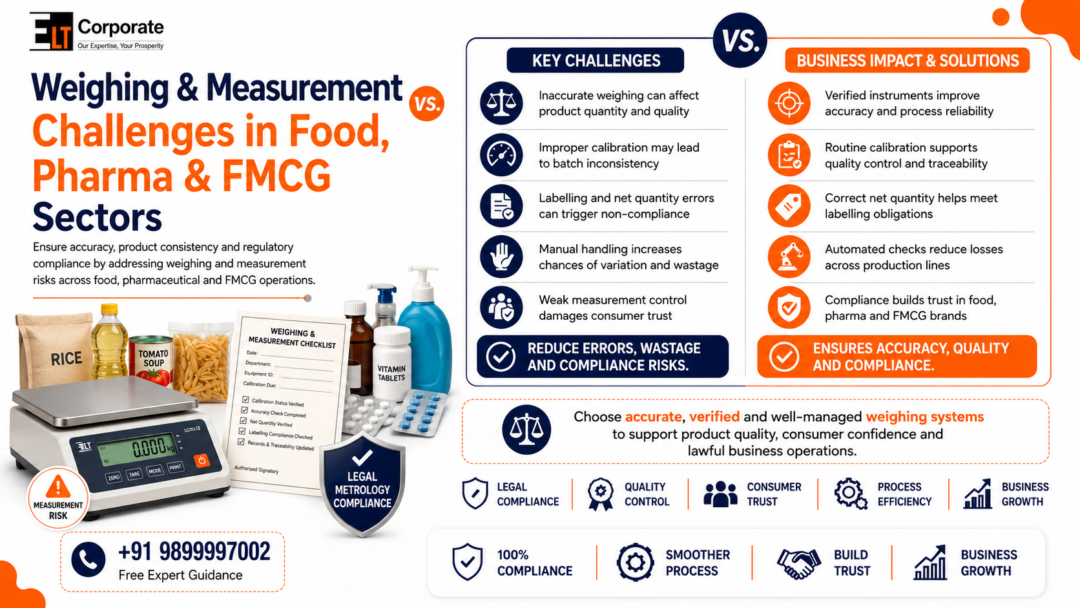
Weighing & Measurement Challenges in the Food Sector
Food manufacturers deal with measurement compliance at nearly every stage of production, and the challenges compound as product lines diversify:
- Net quantity accuracy under the “average system” and tolerance limits—the Packaged Commodities Rules allow small permissible errors around declared net quantity, but businesses running lean on fill weights to control costs frequently drift outside compliant tolerance ranges, especially for moisture-sensitive products like snacks, spices, and packaged staples that lose or gain weight after packing.
- Multi-ingredient batch weighing—bakeries, packaged food manufacturers, and processed food units weigh dozens of raw ingredients per batch, and elimits—the individual weighing errors compound into inconsistent finished product weight and quality.
- The accuracy of weighbridges for large-scale intake of raw materials—grain, oilseeds, sugar, and dairy processors—depends on weighbridges to determine the price of the raw materials they receive by weight. An unreliable or drifting weighbridge can cause distortions to procurement costs for each side of the deal.
- Speed and speed of packaging lines—high-speed filling and packing lines are available for powders, liquids, and semi-solids, which are more difficult to verify manually, which makes the automated check-weighing in line and regular inspections of the instruments necessary rather than an option.
- Seasonal and regional SKU variation—brands that alter pack sizes for regional pricing or festive packaging need every new declared quantity checked for compliance before launch, not after a legal metrology inspection flags it.
Weighing & Measurement Challenges in the Pharmaceutical Sector
Pharma manufacturing is subject to some of the strictest tolerances for measurement of any other industry. The risk of a mishap is high:
Dosing accuracy of active ingredient—precision in the weighting of active pharmaceutical ingredients (APIs) directly impacts the efficacy and safety of a drug. Even minor calibration shifts can lead to dosing beyond the acceptable limits of the pharmacopoeia.
- Strip, vial, and bottle fill-weight consistency—tablets, capsules, syrups, and injectables all carry declared quantities that must match actual content within narrow tolerances, and packaging-line weighing equipment needs frequent verification to hold that consistency across long production runs.
- Dual compliance with drug regulatory and legal metrology frameworks—pharma Products must satisfy both the labeling and quantity requirements of drug regulatory authorities and the net quantity declaration rules under the Legal Metrology Act, and these two frameworks aren’t always perfectly aligned in how they expect information to be presented.
- Cold-chain and temperature-sensitive weighing—biologics and temperature-sensitive formulations sometimes require weighing under controlled environmental conditions, adding another variable that instrument calibration protocols have to account for.
- Import and export documentation—pharma companies importing bulk drugs or finished formulations must reconcile country-of-origin labeling, net quantity, and batch documentation with Indian Legal Metrology declarations before goods clear customs.
Weighing & Measurement Challenges in the FMCG Sector
FMCG companies operate at a scale and SKU velocity that creates its own distinct set of measurement compliance pressures:
- High SKU turnover—from personal care to packaged snacks to home care products, FMCG brands frequently launch new pack sizes, combo packs, and promotional “extra quantity” variants, each requiring a fresh, accurate net quantity declaration.
- Combo and multi-pack declarations—bundled or multi-unit packaging has specific declaration rules under the Packaged Commodities Rules, and getting the format wrong on a promotional pack is one of the most common labeling violations inspectors flag.
- Declared vs. actual quantity discrepancies at retail—FMCG products move through long, multi-tier distribution chains, and quantity discrepancies that originate at the manufacturing stage often surface much later, during a retail-level legal metrology inspection, by which point significant volumes are already in the market.
- E-commerce and quick-commerce packaging—products packed for direct-to-consumer delivery sometimes use secondary packaging that must still carry all mandatory declarations clearly, a requirement that gets overlooked when packaging teams focus purely on shipping durability.
- High-frequency instrument use in filling and packing lines—FMCG production lines run continuously at high speed, and the weighing and filling instruments on those lines need more frequent verification cycles than lower-volume operations to catch drift before it affects large batches.
The Common Thread: Instrument Verification and Documentation Discipline
Across all three sectors, the businesses that stay compliant share the same underlying discipline: they treat weighing and measuring instrument verification as a scheduled operational task, not a reactive one triggered by an inspection notice. That means:
- Every instrument used for trade—from raw material weighbridges to final packaging check-weighers—carries a valid, current verification stamp.
- Net quantity declarations are checked against actual tolerance limits before a new SKU or pack size goes to market, not after a complaint or inspection.
- Verification and calibration records are centrally logged and easy to produce, since inspectors can request proof of the most recent verification for any instrument on the spot.
- Repairs and recalibrations go through licensed repairers only, with resealing and re-verification completed before the instrument returns to production use.
- Labeling teams and compliance teams work from the same current net quantity data, so a formulation or pack-size change on the production floor is reflected accurately on the label before printing, not corrected after a print run is already complete.
Why Getting This Wrong Is Expensive at Scale
For a small retailer, a labeling or scale-verification lapse might mean a modest fine. For a food, pharma, or FMCG manufacturer running production in the hundreds of thousands or millions of units, the same lapse multiplies dramatically:
- Batch-wide recalls if a systemic weighing error is discovered after distribution.
- Consignment holds at customs for imported inputs or finished goods with non-compliant declarations.
- Escalating penalties under the Legal Metrology Act for non-compliant net quantity declarations found during market surveillance, calculated per violation and per unit in some enforcement scenarios.
- Retailer and marketplace delisting—large retail chains and e-commerce marketplaces increasingly run their own compliance checks and will pull non-compliant SKUs rather than risk their own regulatory exposure.
- Brand trust erosion, particularly for food and pharma products where consumers associate accurate quantity and dosing directly with safety.
Avoid recalls and penalties — get a weighing compliance audit →
How We Help Food, Pharma & FMCG Manufacturers Stay Compliant
Our team collaborates with manufacturers across these three industries to incorporate weighing and measuring compliance into daily processes, rather than merely making it a regular scramble. This includes: Weighing and measuring instrument verification support—coordinating verification and re-verification with the relevant Legal Metrology Department for weighbridges, check-weighers, and packaging-line scales.
- Label compliance and net quantity audits—reviewing declarations on packs to determine tolerance limits in the Packaged Commodities Rules before new SKUs are introduced to the market.
- Labeling and import documentation review for businesses that purchase raw products or finished goods from abroad, making sure that the country of origin net amount, as well as information about the importer, is in line with Indian requirements prior to customs clearance
- Systems for record-keeping and compliance calendars—so renewals of verification, licensing deadlines, and audit records are monitored proactively, not finding them missing in an inspection.
Conclusion
Weighing and measurement compliance in food, pharma, and FMCG manufacturing isn’t a single fix-it-once task—it’s an ongoing operational discipline that touches raw material intake, in-process production, final packaging, and every new SKU that goes to market. The sectors that get this right treat instrument verification and net quantity accuracy as part of their production standard, not as paperwork to catch up on after an inspector’s visit. Given the volumes involved, the cost of getting it wrong scales just as fast as the cost of production itself, which is exactly why proactive compliance is cheaper every time than reactive correction.
Is Your Production Line Weighing-Compliant?
Get your weighbridges, check-weighers, and net quantity declarations reviewed by Legal Metrology experts — before an inspection or recall does the damage.
500+ businesses helped | PAN India service | Response within 2 hours
Frequently Asked Questions
Q1. How often do weighing instruments on a production line need to be re-verified?
Most weighing and measuring instruments used for trade require annual re-verification under legal metrology rules, though high-frequency production equipment often benefits from more regular internal calibration checks between formal verification cycles to catch drift early.
Q2. What tolerance is allowed between declared and actual net quantity on packaged goods?
The Legal Metrology (Packaged Commodities) Rules, 2011, permit a small standard error range around the declared quantity, varying by product type and pack size, under what’s known as the average quantity system. Consistently operating near or outside these tolerances is a common source of enforcement action.
Q3. Do pharma companies need to comply with both drug regulatory rules and legal metrology rules for the same product?
Yes. Pharmaceutical products must satisfy quantity and labeling requirements under drug regulatory law as well as the net quantity declaration and packaging rules under the Legal Metrology Act, and both sets of requirements need to be reconciled on the final label.
Q4. What happens if a legal metrology inspection finds a batch with incorrect net quantity declarations already in the market?
Depending on the scale and intent, this can result in fines calculated per violation, product seizure, and, in serious or repeated cases, license action against the manufacturer or brand owner, in addition to potential recall costs.
Q5. Does combo or promotional packaging need separate net quantity compliance from the standard SKU?
Yes. Multi-packs, combo offers, and “extra quantity free” promotional packaging each have specific declaration formats under the Packaged Commodities Rules, and non-standard promotional labeling is one of the most frequently cited violations during retail inspections.
Q6. Can imported raw materials or finished goods for food, pharma, or FMCG products clear customs without legal metrology-compliant labeling?
No. Imported prepackaged goods, including raw materials packaged for trade and finished consumer products, need India-specific declarations—net quantity, importer details, country of origin, and MRP—before they can be sold, and non-compliant labeling can delay or block customs clearance.