
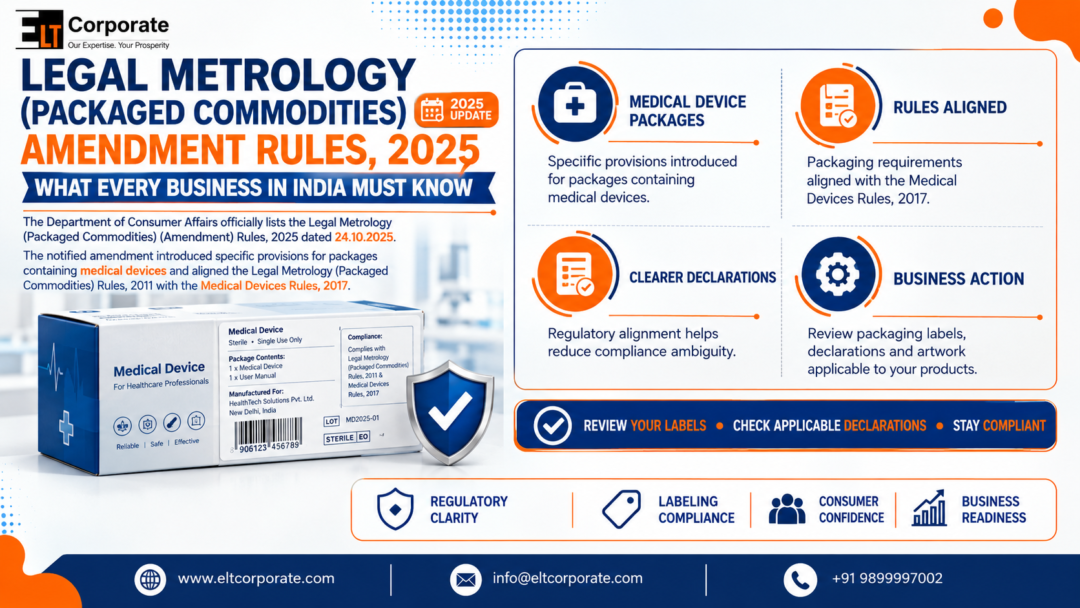
The legal Metrology (Packaged Commodities) Rules in 2011, which are the foundation of how packaged products are identified and sold in India, have been subject to two major changes in 2025. If your business manufactures or imports, packages, or sells packaged goods in India The changes directly impact the way that labels of your products need to be prepared as well as the declarations needed and which exemptions are still applicable to you.
This guide will go over the rules and those rules, Legal Metrology (Packaged Commodities) Amendment Rules, 2025, as well as the Second Amendment Rules, 2025. It explains exactly what has changed, who’s impacted, and the steps that businesses need to take to ensure they are legally in compliance.
A Quick Recap: What the LM (PC) Rules, 2011, Govern
Before you dive into the changes for 2025, it’s important to remember what the foundation framework covers. The Legal Metrology (Packaged Commodities) Rules (2011), which came into effect in 2011, require obligatory declarations to be made on all packaged commodities that are sold in India. These declarations must include the address and name of the manufacturer, net quantity, month and year of production, retail sales price (MRP), and the contact for consumer service. The rules also define the minimum width and height of the letters and numerals that are used to create declarations and outline exceptions (under Rule 26) and relaxations (under Rule 33) for certain categories of packaging.
Because these rules apply so broadly—from FMCG products to electronics to pharmaceuticals—even a small amendment can ripple across thousands of businesses. This is exactly what happened in the second quarter of 2025.
It’s important to remember that Legal Metrology (Packaged Commodities) Rules (2011) are not an indefinite document. Since their release in 2011, they have been updated regularly. The Department of Consumer Affairs has frequently updated certain provisions, including updating declaration requirements for sellers on e-commerce and adjusting exemption categories and defining enforcement procedures—as new models of business and product categories develop.
The 2025 amendments are noteworthy not for the fact that changes took place, but for the particular, specific nature of both amendments that resolve a real cross-regulatory dispute in the healthcare industry while the other closes an important but narrow exemption loophole. Businesses that have not reviewed their packaging compliance since an older notification—including many still referencing outdated 2023 or 2024 guidance—may be operating with labels that no longer reflect the current legal position.
Amendment One: The Medical Devices Carve-Out (October 2025)
On the 29th of October 2025, the Department of Consumer Affairs, under the Ministry of Consumer Affairs, Food and Public Distribution, issued that they would be implementing the Legal Metrology (Packaged Commodities) Amendment Rules, 2025. This change specifically focuses on the manner in which packages that contain medical devices should be labeled and aligns to the LM (PC) Rules, 2011, with the Medical Devices Rules, 2017.
What Exactly Changed
In the past, prior to this modification, medical device packaging had to meet at least the requirements of the Legal Metrology (Packaged Commodities) Rules as well as the Medical Devices Rules simultaneously, which resulted in overlapping, as well as sometimes incompatible, labeling obligations. The amendment of 2025 addresses this issue in three distinct ways:
- Standardization of font size and dimensions currently follows standards set by the Medical Devices Rules, 2017. For packages that contain medical devices, the width and height requirements for letters and numerals that are required in declarations conform to those of the Medical Devices Rules rather than the more general legal metrology formatting standards.
- The Rule 33 relaxations are not applicable to medical devices. Rule 33 under the LM (PC) Rules provides certain exemptions from declarations that apply to specific categories of packages. The change clarifies that the relaxations are only applicable to declarations made under the Legal Metrology Rules themselves—not to declarations covered in accordance with the Medical Devices Rules framework. In essence, medical device labels can no longer take advantage of relaxations intended for the general packaging of goods.
- Principal Display Panel (PDP) declarations no longer have to be made within terms of the Legal Metrology sense. Typically, the LM (PC) rules require specified declarations to be displayed on the Principal Display Panel of a package. In the case of medical equipment, this requirement has been eliminated; these declarations are now able to be made according to the Medical Devices Rules, 2017, that allow manufacturers to be more flexible in the design of packaging for devices while still adhering to the labeling requirements.
Why This Matters
Prior to this amendment, manufacturers of medical devices as well as importers had to keep in sync two different rulebooks using different formatting requirements—one specifically designed for general use while the other was specifically crafted for healthcare professionals. This led to a real confusion in compliance. What font size rule is applicable? Which panels must be adorned with the declaration? The new amendment clarifies that confusion in the Medical Devices Rules is controlled by the system to determine how labels for medical devices are created; however, the essence of what is required to be declared remains the same.
For companies, the practical conclusion is that if you are a manufacturer or importer of medical devices, Your packaging compliance plan should be based on those rules, the Medical Devices Rules, 2017, and CDSCO’s labelling requirements, not the standard legal metrology formatting rules that govern the majority of other products sold by consumers.
Amendment Two: The Pan Masala Exemption Change (December 2025)
A little over a month later, on December 2, 2025, the government announced the Legal Metrology (Packaged Commodities) Second Amendment Rules, 2025 as per Gazette Notification G.S.R. 881(E) and under the powers conferred through the clauses (j) (j) and (q) in Section 52(2) (q) and (j) of Section 52(2) of the Legal Metrology Act, 2009.
What This Amendment Does
This modification targets Rule 26(a) from the LM(PC) Rules, 2011—which allows certain categories of packaged goods from the specific declaration requirements. Rule 26 has previously provided relief to packages like those that weigh less than 10 grams or 10 ml of food items that are packed and directly by restaurants and hotels as well as certain drug products included in the Drug (Price Control) Order 2013.
This Second Amendment inserts a new clause to Rule 26(a), specifically stating that the exemption in this clause does not apply for pan masala. Practically speaking, it closes the loophole that allowed small pan masala packages to be exempt from some mandatory declarations required under the general exemption for small packages.
Effective Date and Transition Period
In contrast to other notifications that are effective immediately, this one has an integrated transition period—the amendment will take effect on February 1st, 2026. This gives manufacturers, packers, and distributors of pan masala the opportunity to modify their labeling, packaging, and inventory before enforcement starts.
Why This Matters
This is a specific, small, narrow amendment instead of broad reform, but it does reflect a broader trend in regulatory practice of examining tobacco-related products more thoroughly and even within a structure that is primarily focused on fair trade and protection of consumers. practices. Companies in the pan masala production and distribution chain should consider this as a strict time frame for compliance packaging that relied on the rule 26(a) exclusion for small packaging will need to be modified to incorporate mandatory declarations before the enforcement date of February 2026.
What This Means for Your Business: A Practical Breakdown
| If your company involves… | What do you need to look for? |
| Medical device manufacturer or importer | Make sure your labeling is in line with your labeling to the Medical Devices Rules, 2017, the size of the font, and PDP requirements. Confirm that you’re no longer dependent on Rule 33 relaxations. |
| Pan masala producer, either a packer or distributor | Labeling for small packages should be revised to include declarations that are mandatory prior to February 1st, 2026. |
| General FMCG, an electronics company, or a consumer goods firm. | There’s no significant change since the two amendments. However, be aware that the LM (PC) Rules are getting more frequent updates, and your particular product category might be the next to be affected. |
| A seller on e-commerce or any other of these | Check that your product listings online have the same enforceable declarations as the physical packaging because discrepancies between the listing and the label are becoming a major enforcement concern. |
A Broader Pattern: Why These Amendments Keep Happening
If you’ve been keeping track of developments in legal metrology over the last year, you’ll realize that the 2025 amendments aren’t just distinct events. They’re part of a larger development of the Department of Consumer Affairs fine-tuning the LM (PC) Rules, 2011, in response to industry-specific inconsistencies and enforcement issues. The medical devices amendment dealt with the issue of cross-regulatory conflicts. The pan masala change ended a loophole in exemptions. Both of them show that a regulator is constantly watching how products are labeled in the real world—not only what is stated on the paper.
For companies, this means that compliance with legal metrology requirements can no longer be considered an event that occurs only prior to the launch of a new product. Declarations, exemptions, and formats that were compliant in the past may not be in compliance in the present. Regularly reviewing compliance, at least each time a new notice is issued, is now a requirement instead of a security measure.
Compliance Checklist for 2025-2026
If your particular product will be directly impacted by the amendments This checklist is worth a look at:
- Find out the Rule 26 exemption, if you have one that your current packaging is based on, and verify that it’s not restricted or eliminated to fit your product’s class.
- Make sure you check your labeling against any sector-specific regulations (such as the Medical Devices Rules, 2017, as well as the Drug (Price Control) Order 2013,) which may have precedence over the general metrology format standards for legal purposes.
- Check the Principal Display Panel design to make sure it is in line with any current mandatory declaration requirements applicable to your product’s classification.
- Make a compliance review calendar, based on how often these regulations are updated A once-a-year (or even a semi-annual) audit of the label is advised for the majority of packaged-goods companies.
- Keep a record of your compliance reasoning, which includes the exemptions or specific rules for your sector you rely upon to respond quickly to questions at the time of an investigation.
Penalties for Non-Compliance
Infractions to the Legal Metrology (Packaged Products) Rules, 2011–including its modified provisions—can result in fines as per the Legal Metrology Act, 2009, and escalating penalties for repeated violations. In addition to monetary penalties and fines, packaging that is not compliant can result in seizures of stock or recalls of products, as well as disruptions in distribution agreements, especially for companies selling products by organized sales or online platforms, where compliance checks are now increasingly automated.
Frequently Asked Questions
Q1. Do manufacturers of medical devices have to adhere to legal metrology rules at all?
Yes, but the specific formatting and declaration-placement requirements for medical devices now follow the Medical Devices Rules, 2017, rather than the general Legal Metrology Packaged Commodities Rules. The requirement to declare the device isn’t gone, but the relevant standard has changed.
Q2. When will the exemption for pan masala actually become effective?
The Second Amendment Rules, 2025 will take effect on February 1st, 2026. It gives companies a time to make changes to their packaging before enforcement starts.
Q3. Does this impact the pan masala packaging in general or only the smaller ones?
The change specifically eliminates the rule 26(a) exemption, which previously allowed certain small containers (below the weight of 10 g or milliliters). Pan masala products that had previously relied on this exemption should now include the complete obligatory declarations, regardless of size.
Q4. How often are these LM(PC) rules being amended in the present?
Very often. 2025 was the only year that saw two major changes in medical device regulations in the month of October and the Pan Masala law in December, which reflects the continuous effort to fill in regulatory gaps and align specific regulations to the sector.
Q5. What should I do if I’m not certain if the product I’m using is affected?
Due to the narrowly focused nature of recent amendments, the best way to protect yourself is to perform an expert compliance audit of your packaging and declarations to the most current rules and regulations rather than simply assuming that your labels will be conforming.